

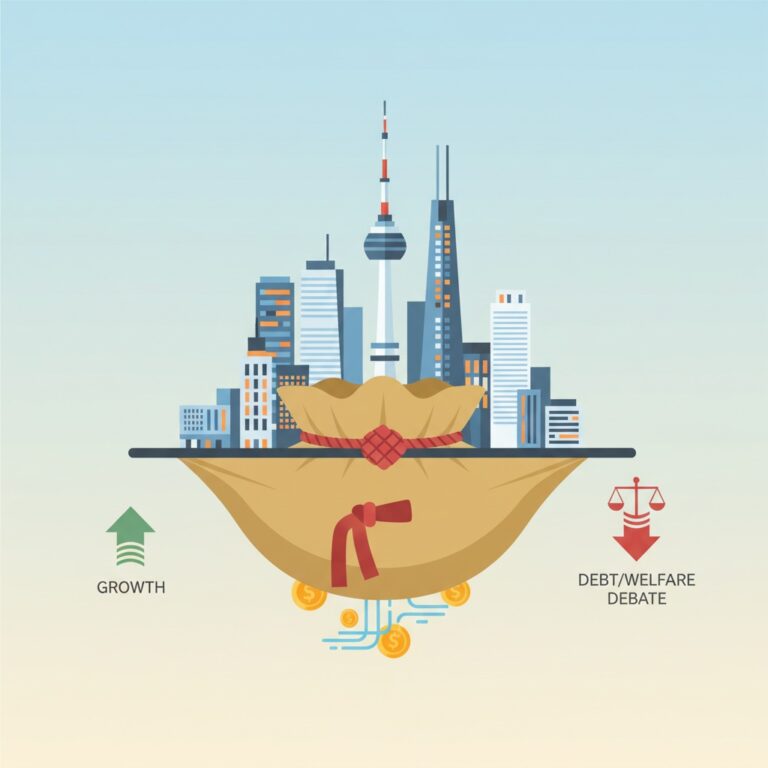
Beyond K-Pop: Master the Korean Economic Debate on Social Safety Nets!
Hello! This is [매일한글] (Maeil Hangeul), here to upgrade your Korean skills to the next level!
Today, we’re diving deep into a C1-level topic that will have you sounding like a native speaker discussing current events: the economic effects of social safety nets. This might sound complex, but it’s a conversation happening everywhere in Korea right now. Lately in Korea, with a rapidly aging population and ongoing discussions about economic inequality, the debate around welfare policies is hotter than ever. Mastering these terms will not only help you understand the news but also allow you to participate in more profound conversations. Let’s get started!
Core Expressions for the Economic Analyst
Here are four essential phrases you need to know to discuss social and economic policies in Korean.
1. 사회 안전망 (Sahoé Anjeonmang)
- Pronunciation [Sahoé anjeonmang]
- English Meaning: Social Safety Net
- Detailed Explanation: This is the foundational term for this topic. It refers to a collection of services and benefits provided by the state, such as unemployment benefits, public healthcare, and pensions, designed to protect citizens from economic shocks. It’s a compound noun made of 사회 (sahoé), meaning ‘society’, and 안전망 (anjeonmang), meaning ‘safety net’.
- 💡 Pronunciation Tip: The vowel ‘ㅚ’ (oe) in 사회 can be tricky. While its official sound is a diphthong similar to ‘we’ in ‘wet’, in modern Seoul Korean, it’s commonly pronounced simply as [ㅔ] (e). So, you’ll sound very natural pronouncing it as [사훼] (sahwe) or, more commonly, [사헤] (sahe).
2. 소득 재분배 (Sodeuk Jaebunbae)
- Pronunciation [Sodeuk jaebunbae]
- English Meaning: Income Redistribution
- Detailed Explanation: This is one of the primary goals of a social safety net. It refers to the mechanism of transferring income from wealthier to poorer individuals, typically through taxation and welfare benefits. 소득 (sodeuk) means ‘income’, and 재분배 (jaebunbae) means ‘redistribution’. This term is central to discussions about fairness and equality.
- 💡 Pronunciation Tip: Notice the word 재분배. The first syllable 재 (jae) uses the vowel ㅐ(ae), and the second syllable 분 (bun) is followed by 배 (bae), which uses the vowel ㅔ(e). For most modern speakers, ㅐ(ae) and ㅔ(e) are pronounced identically. Don’t stress about distinguishing them; focus on the context!
3. 근로 의욕 저하 (Geullo Uiyok Jeoha)
- Pronunciation [Geullo uiyok jeoha]
- English Meaning: A decline in the will to work / work ethic.
- Detailed Explanation: This is the most common counter-argument against expansive welfare policies. It expresses the concern that if benefits are too generous, people might lose their motivation—의욕 (uiyok)—to work—근로 (geullo)—leading to a 저하 (jeoha), or ‘decline/fall’. You will hear this phrase constantly in conservative arguments.
- 💡 Pronunciation Tip: The vowel ‘의’ (ui) in 의욕 is special. When it’s at the beginning of a word, it’s pronounced as a glide from ‘ㅡ’ (eu) to ‘ㅣ’ (i). However, when it’s the second syllable or later in a word (and not the possessive particle), it can also be pronounced as [ㅣ] (i). So, hearing [의욕] (uiyok) and [이욕] (iyok) are both correct and common.
4. 양극화 완화 (Yanggeukwa Wanhwa)
- Pronunciation [Yanggeukwa wanhwa]
- English Meaning: Alleviation of polarization.
- Detailed Explanation: This phrase describes a positive outcome of effective social policies. 양극화 (yanggeukwa) refers to the ‘polarization’ or widening gap, usually between the rich and the poor. 완화 (wanhwa) means ‘alleviation’ or ‘mitigation’. So, this term means ‘reducing the wealth gap’. It’s often presented as the primary justification for strengthening the social safety net.
- 💡 Pronunciation Tip: The syllable 화 (hwa) is a combination of the consonant ㅎ (h) and the diphthong ㅘ (wa). To make the ㅘ sound, start by forming your lips for ‘오’ (o) and then quickly open them to ‘아’ (a). It’s one fluid sound: [wa]. Practice with words like 사과 (sagwa – apple) and 왔어 (wasseo – came).
Example Dialogue: A Coffee Shop Debate
Let’s see how these phrases work in a real conversation between two friends, Minjun (A) and Sora (B).
A: 민준: 뉴스 봤어? 정부에서 기본소득(basic income) 도입을 다시 논의한대.
(Minjun: Did you see the news? They said the government is re-discussing the implementation of a basic income.)
B: 소라: 응, 봤어. 강력한 사회 안전망이 될 수 있다는 점에서 긍정적이라고 생각해.
(Sora: Yeah, I saw. I think it’s positive in the sense that it could become a strong social safety net.)
A: 민준: 맞아. 이상적인 소득 재분배 정책이 될 수도 있지. 하지만 재원 마련도 문제고, 일각에서는 근로 의욕 저하를 우려하잖아.
(Minjun: Right. It could also be an ideal income redistribution policy. But funding is an issue, and some people are concerned about a decline in the will to work.)
B: 소라: 타당한 지적이야. 그래도 심각한 양극화 완화를 위해서는 뭔가 새로운 시도가 필요하다고 봐. 균형을 잘 잡아야겠지.
(Sora: That’s a valid point. Still, I think a new approach is needed for the alleviation of polarization. We’ll have to find the right balance.)
Culture Tip & Trend Deep Dive: Korea’s Urgent Debate
This isn’t just an academic exercise in Korea; it’s one of the most urgent national conversations. Why?
- Demographic Crisis: Korea has one of the world’s lowest birth rates and a rapidly aging population. This puts immense pressure on the national pension and healthcare systems. The debate over how to build a sustainable 사회 안전망 for the elderly is a top political priority.
- Political Divide: These terms are keywords that define political ideologies. Generally, progressive parties (진보) champion policies for 소득 재분배 and 양극화 완화. In contrast, conservative parties (보수) often emphasize economic growth and raise concerns about 근로 의욕 저하 and fiscal health (재정 건전성). Understanding these phrases is key to understanding Korean political news.
- Real-Life Impact: From youth unemployment support to elderly care benefits, these policies directly affect the daily lives of Koreans. When you hear these terms, you’re tapping into the core anxieties and hopes of modern Korean society.
Let’s Practice!
Time to check your understanding. You’re ready for this!
- Fill in the Blank: A policy that aims to reduce the economic gap between the rich and the poor is focused on ______.
(부자와 가난한 사람 사이의 경제적 격차를 줄이려는 정책은 ______에 초점을 맞춘다.) -
Your Opinion: Using the phrase 사회 안전망, write one sentence in Korean expressing your opinion on its importance. (e.g., “A strong social safety net is essential for a stable society.” – 튼튼한 사회 안전망은 안정적인 사회를 위해 필수적이다.)
You did an amazing job today tackling such an advanced topic! Now you can confidently share your opinions on complex social issues in Korean.
Try leaving a comment below with your answer to the practice questions! We’d love to hear your thoughts
Frequently Asked Questions (FAQ)
Q: What does "[매일한글]" mean in Korean and how do you pronounce it?
A: In Korean, "[매일한글]" is pronounced [Maeil Hangeul] and means: , here to upgrade your Korean skills to the next level!
Q: What does "사회" mean in Korean and how do you pronounce it?
A: In Korean, "사회" is pronounced [sahoé] and means: , meaning 'society', and
Q: What does "안전망" mean in Korean and how do you pronounce it?
A: In Korean, "안전망" is pronounced [anjeonmang] and means: , meaning 'safety net'.
Q: What does "[사훼]" mean in Korean and how do you pronounce it?
A: In Korean, "[사훼]" is pronounced [sahwe] and means: or, more commonly,







