

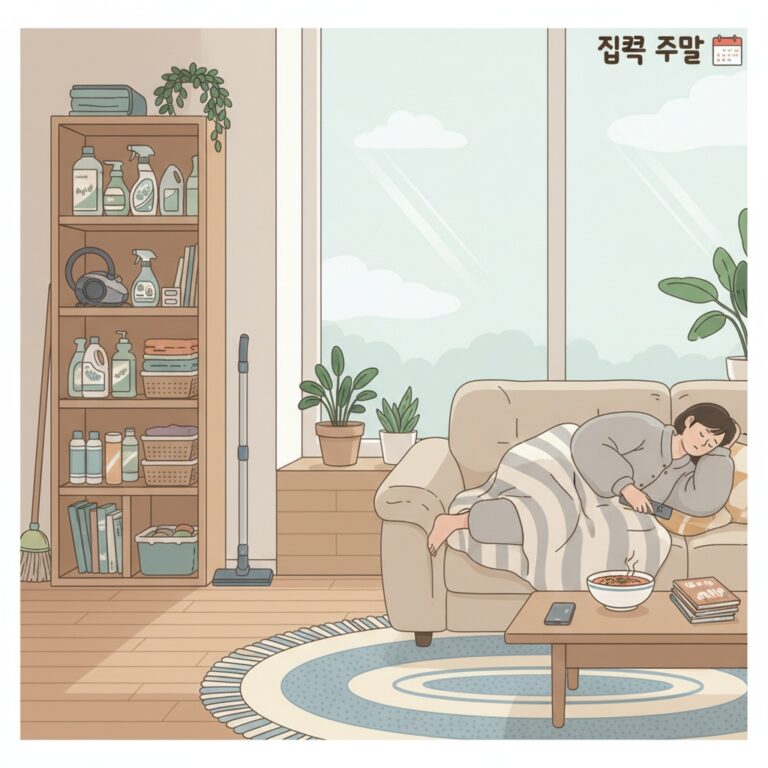
From ‘대청소’ to ‘뒹굴뒹굴’: Korean Phrases for Your Cozy Weekend!
Hello! It’s your favorite Korean teacher from [매일한글] (Maeil Hangeul), here to level up your Korean skills!
Do you ever just want to stay home all weekend, relax, and recharge? Well, you’re not alone! Lately in Korea, enjoying time at home, a lifestyle known as “집콕 (jipkok)”, has become a huge trend. People are sharing their cozy home life on social media, from major cleaning projects to just happily lazing around.
Today, we’ll learn some essential Korean phrases to talk about your perfect weekend at home. Let’s get started so you can talk about your “jipkok” life like a local!
Core Expressions for a Weekend at Home
Here are four key phrases that will make you sound like a native speaker when talking about your weekend.
1. 대청소하다 (Daecheongsohada)
- Pronunciation [Romanization]: Dae-cheong-so-ha-da
- English Meaning: To do a big clean-up / a deep clean.
- Detailed Explanation: This isn’t your average daily tidying up! ‘대 (大, dae)’ means “big,” and ‘청소 (cheongso)’ means “cleaning.” So, ‘대청소하다’ refers to a major, deep cleaning session you might do once a month or when the seasons change. It’s the perfect activity for a productive Saturday morning!
- 💡 Pronunciation Tip: The ‘ㅊ (ch)’ sound in ‘청소 (cheongso)’ is an aspirated consonant. This means you should release a strong puff of air when you say it, like the ‘ch’ in “chair.” Try holding your hand in front of your mouth. You should feel the air hit your palm when you say [cheongso] correctly!
2. 밀린 빨래를 하다 (Millin ppallaereul hada)
- Pronunciation [Romanization]: Mil-lin ppal-lae-reul ha-da
- English Meaning: To do the piled-up laundry.
- Detailed Explanation: We all know this feeling! ‘밀린 (millin)’ comes from the verb ‘밀리다 (millida)’, which means “to be pushed back” or “to be piled up.” ‘빨래 (ppallae)’ means laundry. So, this phrase perfectly describes tackling that mountain of laundry that has accumulated over the week.
- 💡 Pronunciation Tip: The ‘빨 (pp)’ sound is a tensed consonant. Unlike the English ‘p’, there’s no puff of air. To make this sound, tighten your lips as if you’re holding your breath for a split second, and then release the sound. It’s short, sharp, and strong. Practice saying [ppallae] without feeling any air on your hand.
3. 가구를 재배치하다 (Gagureul jaebaechi-hada)
- Pronunciation [Romanization]: Ga-gu-reul jae-bae-chi-ha-da
- English Meaning: To rearrange the furniture.
- Detailed Explanation: Feeling creative? This phrase is for you. ‘가구 (gagu)’ means “furniture,” and ‘재배치하다 (jaebaechi-hada)’ means “to rearrange.” The prefix ‘재 (jae)’ means “re-,” just like in English! This is a popular activity in the Korean “집꾸미기 (jipkkumigi – home decorating)” trend.
- 💡 Pronunciation Tip: In ‘재배치 (jaebaechi)’, the sound ‘ㅌ(t)’ in the final syllable block meets the vowel ‘ㅣ(i)’. When this happens, the ‘t’ sound changes to a ‘ㅊ(ch)’ sound. This is called palatalization. So, instead of pronouncing it as [jae-bae-ti], we naturally say [jae-bae-chi]. It makes the pronunciation much smoother!
4. 뒹굴뒹굴하다 (Dwinggul-dwinggul-hada)
- Pronunciation [Romanization]: Dwing-gul-dwing-gul-ha-da
- English Meaning: To laze around / to roll around idly.
- Detailed Explanation: This is my favorite weekend activity! ‘뒹굴뒹굴하다’ is a mimetic word (의태어) that paints a perfect picture of someone lazily rolling around in bed or on the sofa with no specific purpose. It has a very cute and casual nuance, perfect for describing a lazy Sunday afternoon.
- 💡 Pronunciation Tip: The vowel ‘ㅟ (wi)’ can be tricky. It sounds very similar to the English word “we.” Try to say
Frequently Asked Questions (FAQ)
Q: What does "[매일한글]" mean in Korean and how do you pronounce it?
A: In Korean, "[매일한글]" is pronounced [Maeil Hangeul] and means: , here to level up your Korean skills!







