

Hello! This is Maeil Hangeul, here to upgrade your Korean skills!
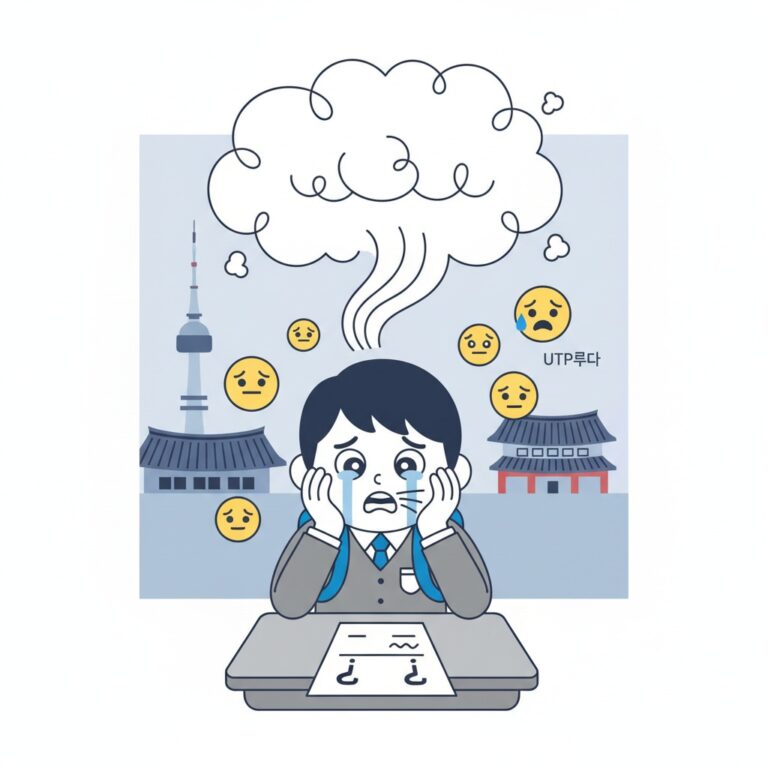
Feeling stressed? We all do! But what if you could face those stressful moments with a bit of humor, just like a local? Today, we’re going to learn some fantastic Korean phrases to help you laugh off the pressure. Lately in Korea, it’s a huge trend on social media to share “현타 (hyeonta)” moments—those times when reality hits you hard—and turn them into something funny and relatable. Let’s dive in and learn how you can add a humorous Korean twist to your tough days!
Core Expressions You Need to Know
Here are three key phrases to get you started.
1. 현타 온다 (Hyeonta onda)
- Pronunciation [Romanization]: Hyeonta onda
- English Meaning: Reality hits (hard). / I’m having a moment of harsh realization.
- Detailed Explanation: This is a very popular slang term, short for 현실 자각 타임 (hyeonsil jagak taim), which literally means “reality awareness time.” You use it when you suddenly realize the harsh, unglamorous truth of a situation. For example, after spending all your money on a K-pop concert, you check your bank account and… 현타 온다. It’s an informal phrase, perfect for friends!
-
💡 Pronunciation Tip: The ‘현 (hyeon)’ sound can be tricky. It’s not ‘hi-eon’. Think of it as one smooth syllable, like the ‘hyun’ in the name ‘Hyun Bin’. For ‘타 (ta)’, the ‘ㅌ(t)’ sound is aspirated, meaning you should feel a small puff of air when you say it, making it stronger than the ‘ㄷ(d)’ sound.
2. 웃프다 (Utpeuda)
- Pronunciation [Romanization]: Utpeuda
- English Meaning: It’s funny but sad. / Tragicomedy.
-
Detailed Explanation: This brilliant word is a combination of 웃기다 (utgida), meaning “to be funny,” and 슬프다 (seulpeuda), meaning “to be sad.” It perfectly describes a situation that is so absurdly unfortunate, you can’t help but laugh. Imagine tripping in public and dropping your ice cream. It’s sad for you, but the situation is also a little bit funny. That’s a classic ‘웃픈’ moment.
-
💡 Pronunciation Tip: Pay attention to the first syllable, ‘웃 (ut)’. Even though it’s written with a ‘ㅅ(s)’ at the end, when it’s followed by a consonant like ‘프(p)’, the ‘ㅅ’ sound changes to a ‘ㄷ(d)’ sound. So, you don’t pronounce it as ut-seu-peu-da, but rather as [ud-peu-da]. This is a very common rule in Korean for final consonants!
3. 아무 말 대잔치 (Amu mal daejanchi)
- Pronunciation [Romanization]: Amu mal daejanchi
- English Meaning: A big party of random words; talking nonsense.
-
Detailed Explanation: Let’s break it down: 아무 말 (amu mal) means “any words” or “random words,” and 대잔치 (daejanchi) means “a big feast” or “a grand party.” Together, it creates a hilarious image of words just being thrown around without any logic. You can use this when someone is rambling nervously, or when a group chat becomes chaotic with everyone talking at once.
-
💡 Pronunciation Tip: This phrase is straightforward! Just remember to pronounce each part clearly. The ‘치 (chi)’ in ‘잔치 (janchi)’ is an aspirated sound, similar to the ‘ch’ in “cheese.” Make it a sharp, clear sound.
Example Dialogue
Let’s see these phrases in a real conversation!
A: I stayed up all night studying for my Korean exam, but my mind went completely blank when I saw the questions. 아, 현타 온다…
(A, hyeonta onda…)
(Ah, reality is hitting me so hard…)
B: Oh no! That’s so 웃프다. So what did you write on the test?
(Oh no! That’s so utpeuda.)
(Oh no! That’s hilariously sad.)
A: I basically had an 아무 말 대잔치 on the paper. I just wrote down any Korean word I could remember.
(I basically had an amu mal daejanchi on the paper.)
(I basically just threw a party of random words on the paper.)
B: Haha, well, at least you wrote something! Let’s go get some tteokbokki to de-stress.
(Haha, well, at least you wrote something! Let’s go get some tteokbokki to de-stress.)
Culture Tip & Trend Deep Dive
- #현타 and #웃프다 on Instagram: These phrases aren’t just for speaking; they are major hashtags in Korea! People post pictures of their messy desks after a long project with #현타온다, or a funny but unfortunate text message screenshot with #웃프다. Using these hashtags will make you seem instantly in-the-know.
- Korean Variety Shows: You’ll hear ‘아무 말 대잔치’ all the time on popular Korean variety shows like Running Man or Knowing Bros. When a guest gets flustered by a surprise quiz and starts spouting nonsense, the hosts will yell, “It’s an 아무 말 대잔치!” It’s a key part of Korean TV humor.
- Sounding like a Native: When you say ‘현타 온다’, try saying it with a deep sigh for dramatic effect. It adds to the feeling of despair and makes it funnier!
Let’s Wrap It Up & Practice!
Great job today! You’ve learned three amazing phrases—현타 온다, 웃프다, and 아무 말 대잔치—to handle stress with a Korean sense of humor. Now you can understand those funny social media posts and even make your friends laugh during tough times.
Time for a quick quiz!
- You see your friend trying to assemble IKEA furniture with the instructions upside down. The situation is a little sad but also very funny. What would you say? “That’s so ______.”
- Try to make your own sentence! Think about a time when reality hit you hard. How would you describe it using 현타 온다?
Leave your answers and your own “웃픈” stories in the comments below! We’d love to hear them!
Frequently Asked Questions (FAQ)
Q: What does "현실 자각 타임" mean in Korean and how do you pronounce it?
A: In Korean, "현실 자각 타임" is pronounced [hyeonsil jagak taim] and means: , which literally means "reality awareness time." You use it when you suddenly realize the harsh, unglamorous truth of a situation. For example, after spending all your money on a K-pop concert, you check your bank account and...
Q: What does "웃기다" mean in Korean and how do you pronounce it?
A: In Korean, "웃기다" is pronounced [utgida] and means: , meaning "to be funny," and
Q: What does "슬프다" mean in Korean and how do you pronounce it?
A: In Korean, "슬프다" is pronounced [seulpeuda] and means: , meaning "to be sad." It perfectly describes a situation that is so absurdly unfortunate, you can't help but laugh. Imagine tripping in public and dropping your ice cream. It's sad for you, but the situation is also a little bit funny. That's a classic '웃픈' moment.
Q: What does "아무 말" mean in Korean and how do you pronounce it?
A: In Korean, "아무 말" is pronounced [amu mal] and means: means "any words" or "random words," and







