

Ticket Trouble in Seoul? Don’t Panic! Use These Korean Phrases
Hello! This is Maeil Hangeul, here to upgrade your Korean skills!
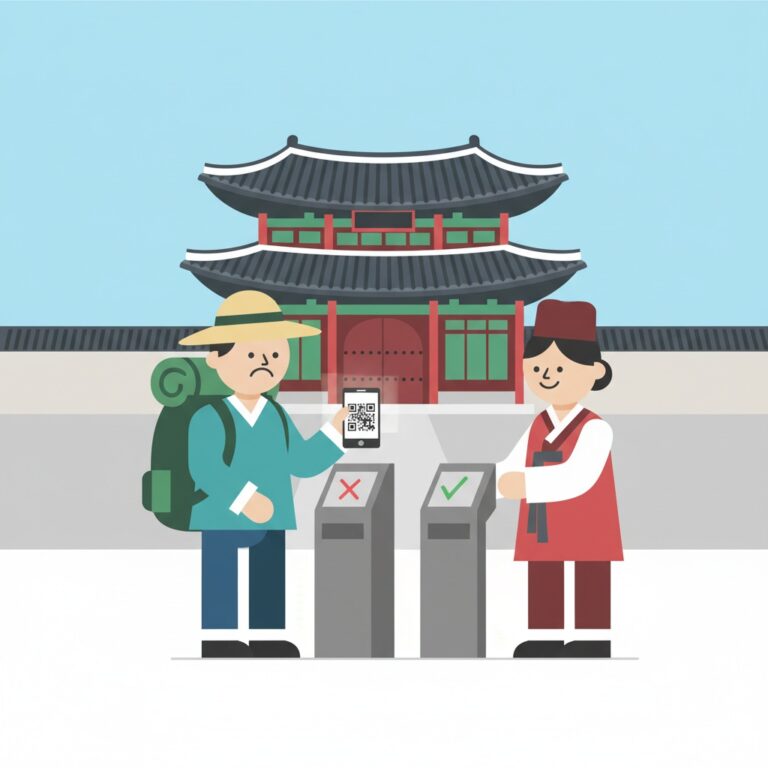
Imagine this: you’re standing in front of the magnificent Gyeongbokgung Palace in Seoul, ready for an amazing day. But when you try to scan your ticket, the machine beeps angrily. Panic! What do you do?
Don’t worry! Today, we’re going to learn some essential Korean phrases to handle exactly this kind of problem. Lately, with so many tourist spots in Korea switching to digital QR code tickets, knowing how to explain a problem politely is more useful than ever. Let’s learn how to solve ticket troubles like a pro!
Core Expressions for Ticket Troubles
Here are the key phrases that will turn a stressful situation into a smooth one.
1. 저기요 (Jeogiyo)
- Pronunciation [Romanization]: Jeogiyo
- English Meaning: Excuse me.
- Detailed Explanation: This is your magic word to politely get someone’s attention in Korea. It’s perfect for calling over staff at a ticket booth, a waiter in a restaurant, or anyone you need help from. It’s much more natural and polite than shouting “Hey!” or “Mister!”.
- 💡 Pronunciation Tip: The ‘어’ (eo) sound in ‘저’ (jeo) is similar to the ‘u’ in the English word “sun”. Try to keep your mouth relaxed when you say it. It’s a short, simple sound: Jeo-gi-yo.
2. 이거 안 돼요. (Igeo an dwaeyo.)
- Pronunciation [Romanization]: Igeo an dwaeyo.
- English Meaning: This doesn’t work.
- Detailed Explanation: A simple, powerful, and incredibly versatile phrase! ‘이거’ (igeo) means “this,” and ‘안 돼요’ (an dwaeyo) means “it doesn’t work” or “it’s not working.” You can point to your ticket, your credit card, or a machine and use this phrase. It clearly communicates the problem without you needing to know complex vocabulary.
- 💡 Pronunciation Tip: The ‘되’ (dwae) sound can be tricky. It’s a combination of ‘ㅗ’ (o) and ‘ㅐ’ (ae), pronounced quickly together like “dweh“. Practice saying it in one smooth motion: an-dwae-yo.
3. 입장권에 문제가 있는 것 같아요. (Ipjanggwone munjega inneun geot gatayo.)
- Pronunciation [Romanization]: Ipjanggwone munjega inneun geot gatayo.
- English Meaning: I think there’s a problem with my ticket.
- Detailed Explanation: This is a more detailed and polite way to explain the issue. Let’s break it down:
입장권(ipjanggwon): entrance ticket문제(munje): problem있는 것 같아요(inneun geot gatayo): It seems like there is… / I think there is…
This grammar pattern,~는 것 같아요(neun geot gatayo), is fantastic for softening your statement and sounding more humble and polite.
- 💡 Pronunciation Tip: Notice how ‘있는’ (itneun) is pronounced. The final consonant ‘ㅆ’ (ss) changes to a ‘ㄴ’ (n) sound before another ‘ㄴ’ (n). Then, the ‘ㄴ’ links to the next word ‘것’ (geot), making it sound like [인는 거 가타요, inneun geo gatayo]. This sound-linking rule, called liaison (연음), makes Korean flow smoothly.
4. 확인해 주시겠어요? (Hwaginae jusigesseoyo?)
- Pronunciation [Romanization]: Hwaginae jusigesseoyo?
- English Meaning: Could you please check it for me?
- Detailed Explanation: This is the perfect follow-up question. ‘확인하다’ (hwaginhada) means “to check,” and
~아/어 주시겠어요?(a/eo jusigesseoyo?) is a very polite way to request a favor. By using this phrase, you are respectfully asking the staff to help you find a solution. - 💡 Pronunciation Tip: The ‘ㅎ’ (h) in ‘확인해’ (hwaginhae) can sometimes become very soft or almost silent when spoken quickly, linking the vowels together. The pronunciation becomes [화기내 주시겠어요?, hwaginae jusigesseoyo?]. This makes your speech sound much more natural and less robotic.
Example Conversation
Let’s see these phrases in action! Here’s a short dialogue at the entrance to Lotte World Tower.
- A (Tourist): 저기요. 제 입장권이 안 돼요.
- (Jeogiyo. Je ipjanggwoni an dwaeyo.)
- Excuse me. My ticket isn’t working.
- B (Staff): 아, 그래요? 제가 한번 보겠습니다.
- (A, geuraeyo? Jega hanbeon bogetseumnida.)
- Oh, really? Let me take a look.
- A (Tourist): 여기요. 입장권에 문제가 있는 것 같아요. 확인해 주시겠어요?
- (Yeogiyo. Ipjanggwone munjega inneun geot gatayo. Hwaginae jusigesseoyo?)
- Here it is. I think there’s a problem with the ticket. Could you please check it for me?
- B (Staff): 네, 잠시만요… 아, 이 QR 코드는 내일 날짜로 예약되어 있네요.
- (Ne, jamsimanyo… A, i QR kodeuneun naeil naljjaro yeyakdoeeo inneyo.)
- Yes, one moment… Ah, this QR code is reserved for tomorrow’s date.
Culture Tip & Trend Deep Dive
Politeness is Key in the “Ppalli-Ppalli” Culture!
You may have heard of Korea’s “빨리빨리” (ppalli-ppalli), or “hurry, hurry,” culture. While efficiency is valued, politeness is even more important, especially when there’s a problem.
Using phrases like ~는 것 같아요 (I think…) and ~아/어 주시겠어요? (Could you please…?) is crucial. It shows that you aren’t blaming the staff member. Instead, you’re presenting a problem that you can solve together. This polite approach will almost always get you faster, friendlier help.
Today, many tourists use apps like Klook, Trazy, or Fever to buy tickets for attractions. Sometimes, there can be a booking error or a sync issue with the local system. In these cases, calmly getting the staff’s attention with “저기요” and politely asking “확인해 주시겠어요?” will solve the problem much more effectively than showing frustration. You’ll look like a seasoned traveler and a respectful Korean speaker!
Let’s Practice!
Ready to test your new skills?
- Fill in the Blank: You are trying to use a pre-paid transportation card, but it’s not working at the subway gate. You say to the station staff:
“저기요, ________ 안 돼요.” (Hint: What’s the simple word for “this”?) -
Make a Sentence: You bought a ticket online, but you think you received the wrong one. How would you politely ask the staff to check your ticket (
입장권) for you?
Great job today! With these phrases, you’re now fully prepared to handle any ticket troubles during your trip to Korea.
Try making your own sentence in the comments below using one of today’s expressions! We’d love to see it.







