

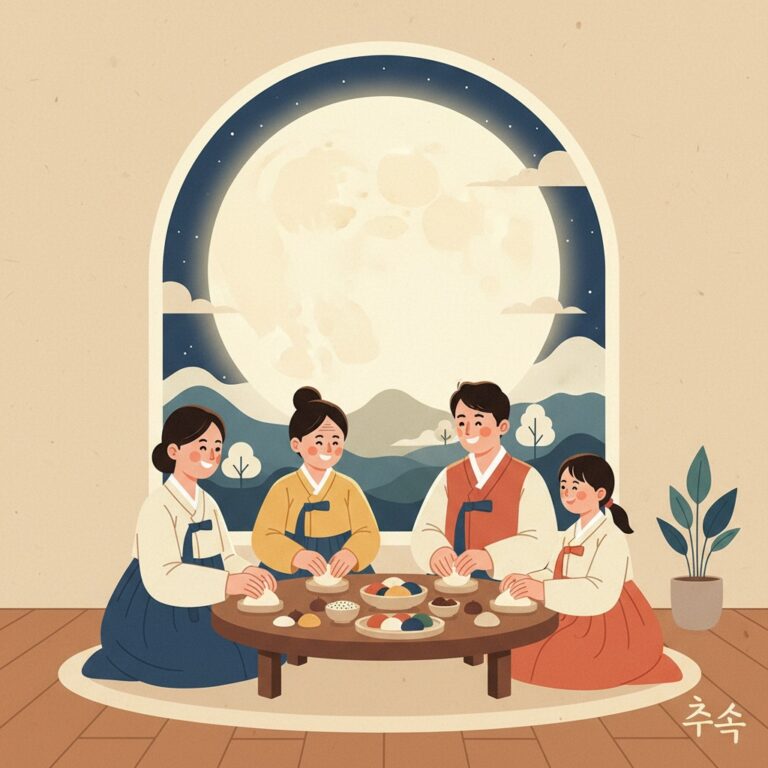
Your Chuseok Plan: Visiting Parents in Korean!
Hello! It’s [Maeil Hangeul] here to upgrade your Korean skills!
Have you ever wanted to talk about your future plans in Korean, especially for a special occasion? Today, we’re going to learn how to talk about one of the most important plans in Korean culture: visiting your parents’ house!
In Korea these days, everyone is getting excited and making plans for Chuseok (추석), the Korean Thanksgiving! It’s a huge holiday where millions of people travel back to their hometowns to be with family. This is the perfect time to learn the essential phrases you’ll hear everywhere during this season. Let’s get started!
Key Expressions You Need to Know
Here are three core expressions to talk about your plans to visit family.
1. 부모님 댁에 갈 거예요. (I’m going to my parents’ house.)
- Pronunciation [Romanization]: Bunonim daege gal geoyeyo.
- English Meaning: I’m going to go to my parents’ house.
- Detailed Explanation: This is the most common way to state your plan to visit your parents. It’s polite and natural. Let’s break it down:
부모님(bunonim): Parents댁(daek): This is the honorific (polite) word for ‘house’ (집, jip). You use댁when talking about the home of someone you respect, like your parents, your teacher, or your friend’s parents.에(e): ‘to’ (location particle)갈 거예요(gal geoyeyo): This is the future tense of the verb가다(gada, to go).-(으)ㄹ 거예요is a super useful grammar pattern to talk about your future plans or intentions.
- 💡 Pronunciation Tip:
The ending거예요(geoyeyo) is often pronounced more smoothly like [거에요] (geo-eyo) in casual conversation. The ‘y’ sound almost disappears, making it sound softer. Try saying “gal geo-eyo” to sound more like a native speaker!
2. 언제 갈 거예요? (When are you going to go?)
- Pronunciation [Romanization]: Eonje gal geoyeyo?
- English Meaning: When are you going to go?
-
Detailed Explanation: This is a simple and direct question to ask someone about their plans. You just add the question word
언제(eonje), meaning ‘when’, to the future tense phrase we just learned. You can use this to ask about any future plan!- Example: 언제 한국에 갈 거예요? (Eonje hanguge gal geoyeyo?) – When are you going to go to Korea?
- 💡 Pronunciation Tip:
The consonant ‘ㅈ’ (j) in언제[eonje] is a sound that sits between an English ‘j’ and ‘ch’. It’s not as strong as the ‘j’ in “jungle.” Make a soft, gentle ‘j’ sound.
3. 부모님 뵈러 가요. (I’m going to see my parents.)
- Pronunciation [Romanization]: Bunonim boereo gayo.
- English Meaning: I’m going (in order) to see my parents.
-
Detailed Explanation: This phrase explains the purpose of your visit.
뵈러 가요(boereo gayo) comes from the verb뵈다(boeda) + the grammar pattern-(으)러 가다(-eureo gada), which means “to go in order to do (verb).”뵈다is the honorific (polite) version of보다(boda, to see/meet). You use뵈다when you are seeing someone of a higher status, like your parents or a boss. Using this word shows great respect!
- 💡 Pronunciation Tip:
The Korean vowelㅓ(eo) in뵈러[boereo] can be tricky. It’s similar to the ‘o’ sound in the English word “song” or the ‘u’ in “uh-oh”. It’s an open sound made in the back of your throat. For뵈러, it sounds like “bweh-ruh,” where the ‘r’ is a light flap, similar to the ‘tt’ in the American pronunciation of “water.”
Example Dialogue
Let’s see how these phrases work in a real conversation between two friends, Mina and Chris.
A (Mina): 크리스 씨, 이번 추석에 뭐 할 거예요?
(Keuriseu ssi, ibeon chuseoge mwo hal geoyeyo?)
Chris, what are you doing for Chuseok this year?
B (Chris): 아, 저는 부모님 댁에 갈 거예요.
(A, jeoneun bunonim daege gal geoyeyo.)
Oh, I’m going to my parents’ house.
A (Mina): 정말요? 언제 갈 거예요?
(Jeongmallyo? Eonje gal geoyeyo?)
Really? When are you going to go?
B (Chris): 금요일에 출발해요. 가족들이랑 송편을 만들 거예요. 미나 씨는요?
(Geumyoire chulbalhaeyo. Gajokdeurirang songpyeoneul mandeul geoyeyo. Mina ssi-neunyo?)
I leave on Friday. I’m going to make songpyeon (rice cakes) with my family. What about you, Mina?
A (Mina): 저도 부모님 뵈러 가요. 같이 맛있는 거 많이 먹어야죠!
(Jeodo bunonim boereo gayo. Gachi masinneun geo mani meogeoyajyo!)
I’m also going to see my parents. We should eat lots of delicious food together!
Culture Deep Dive: The Great Chuseok Migration!
When you hear Koreans talking about visiting their parents’ house around September or October, they are likely talking about Chuseok! It’s one of Korea’s most important holidays, celebrating the autumn harvest.
- A Nationwide Journey: It’s often called the “great migration” because the highways become packed with cars as millions of people leave big cities like Seoul to go to their hometowns (
고향, gohyang). - Showing Respect: The phrases we learned today, especially the honorifics
댁(daek) and뵈다(boeda), are extra important during this time. Chuseok is all about family and showing respect to elders and ancestors. - Sound like a Pro: If your Korean friend says they’re going to their parents’ for Chuseok, you can impress them by saying, “부모님께 안부 전해주세요” (Bunonim-kke anbu jeonhaejuseyo), which means “Please say hello to your parents for me.” It’s a very warm and polite thing to say!
Let’s Practice!
You did an amazing job today! Let’s check what you’ve learned with a quick quiz.
1. Fill in the blank:
You want to tell your teacher that you are going to your friend’s house. Which word should you use?
* “선생님, 저는 친구 ______에 갈 거예요.” (Seonsaengnim, jeoneun chingu ______e gal geoyeyo.)
* A) 댁 (daek)
* B) 집 (jip)
(Answer: B) 집. A friend is not considered of higher status, so you use the standard word for house.)
2. Make a sentence:
How would you say, “I’m going to Korea to meet my friend”?
* Hint: Use the -(으)러 가다 grammar pattern.
(Answer: 친구를 만나러 한국에 가요. – Chingureul mannareo hanguge gayo.)
You’ve learned some incredibly useful and culturally important phrases today. Now you’re ready to talk about your own future plans!
What are your plans for this weekend? Try leaving a comment below using -(으)ㄹ 거예요! We’d love to read them
Frequently Asked Questions (FAQ)
Q: What does "[거에요]" mean in Korean and how do you pronounce it?
A: In Korean, "[거에요]" is pronounced [geo-eyo] and means: in casual conversation. The 'y' sound almost disappears, making it sound softer. Try saying "gal geo-eyo" to sound more like a native speaker!







