

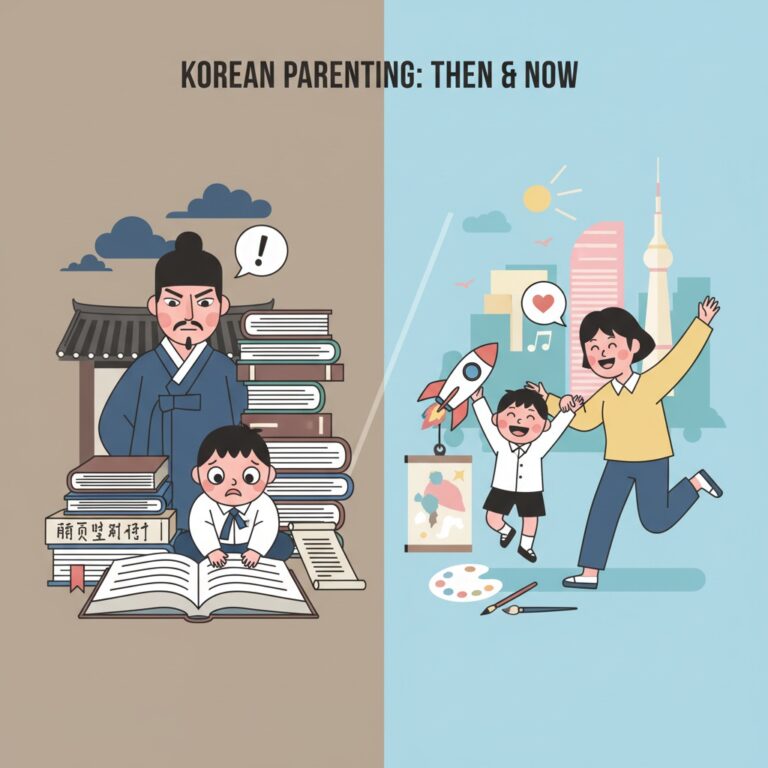
Korean Parenting Wars: Old School vs. New School!
Hello! Welcome back to [Maeil Hangeul], your go-to for leveling up your Korean!
Today, we’re diving into a fascinating and deeply relevant topic in modern Korean society: the clash and harmony between traditional and modern parenting. Ever wonder why education is such a hot topic in K-dramas or why parents seem so invested in their children’s success? You’re in the right place!
Lately in Korea, conversations around parenting are everywhere—from hit TV shows like “The Return of Superman” showcasing celebrity dads’ hands-on approaches, to dramas like “SKY Castle” or “The Good Bad Mother” exploring the intense pressures of academic achievement. This isn’t just TV drama; it’s a real-life reflection of a culture in transition. Today, we’ll learn the key phrases that will help you understand and discuss this cultural shift like a native.
Core Expressions You Need to Know
Here are some essential terms that capture the essence of Korean parenting debates.
1. 엄친아 (eomchina) / 엄친딸 (eomchinttal)
- Pronunciation [Romanization]: Eom-chin-a / Eom-chin-ttal
- English Meaning: “My mom’s friend’s son” / “My mom’s friend’s daughter”
- Detailed Explanation: This is a hugely important cultural keyword. It refers to a seemingly perfect, mythical child that your parents always compare you to. The “eomchina” gets top grades, is good at sports, plays a musical instrument, and is incredibly polite. The term embodies the immense social and academic pressure placed on children in a traditionally competitive, comparison-driven culture. While often used jokingly among friends now, it points to the stress that many Korean children experience.
- 💡 Pronunciation Tip: The key here is the tensed consonant in ‘딸’ (ttal). It’s not a soft ‘t’ or a breathy ‘t’. To make the ‘ㄸ’ [tt] sound, tense the back of your tongue and release the air with no puff, like the ‘t’ in the English word “stop”. It’s a short, sharp sound.
2. 기를 살리다 (gireul sallida)
- Pronunciation [Romanization]: Gi-reul sal-li-da
- English Meaning: To boost someone’s spirit/confidence; to encourage.
- Detailed Explanation: This phrase is central to the modern, more progressive style of parenting. ‘기’ (gi) refers to life force, energy, or spirit. So, ‘기를 살리다’ literally means “to make someone’s spirit live.” It’s the opposite of the more traditional, strict disciplinary approach, which was sometimes criticized as ‘기를 죽이다’ (gireul jugida)—”to kill someone’s spirit.” Today, many parents believe that encouraging their children and building their self-esteem is the best way to raise them.
- 💡 Pronunciation Tip: Notice how ‘살리다’ is pronounced [sallida]. In Korean, when a syllable ending in ‘ㄹ’ (l) is followed by a syllable beginning with ‘ㄹ’ (l), the sound is combined into a clear, prolonged [l] sound, not two separate ‘r’ sounds. Think of the ‘ll’ in the English word “million.”
3. 조기 교육 (jogi gyoyuk)
- Pronunciation [Romanization]: Jo-gi gyo-yuk
- English Meaning: Early education.
- Detailed Explanation: This refers to the practice of providing formal education to children at a very young age, often before they even start elementary school. This can include English, math, piano, or coding classes for preschoolers. ‘조기 교육’ is driven by the belief that an early start is crucial for long-term academic success in Korea’s hyper-competitive education system. It’s a modern manifestation of the traditional Confucian value placed on education.
- 💡 Pronunciation Tip: The pronunciation of ‘교육’ [gyoyuk] can be tricky. The ‘ㄱ’ (g) sound, when it meets a ‘y’ vowel like ‘ㅛ’ (yo), becomes slightly softer and palatalized. It sounds less like a hard ‘g’ and more like a ‘ky’ sound, as in [gyo]. It’s a subtle shift that makes your Korean sound much more natural.
4. ~는/은/ㄴ 셈이다 (~neun/eun/n semida)
- Pronunciation [Romanization]: ~neun/eun/n sem-i-da
- English Meaning: It’s as if…; It amounts to…; You could say that…
- Detailed Explanation: This is a fantastic C1-level grammar pattern for making a calculated judgment or summary. You use it when you’ve considered the facts of a situation and are drawing a logical conclusion. It’s more nuanced than simply saying “it is X.” For example, if a child has academies every day after school, you could say, “학교가 끝나도 끝난 게 아닌 셈이에요” (Hakgyoga kkeunnado kkeunnan ge anin semieyo) – “You could say that even when school is over, it’s not really over.”
- 💡 Pronunciation Tip: This pattern demonstrates a basic but crucial rule: 연음 (yeon-eum), or linking. In ‘셈이다’, the final consonant ‘ㅁ’ (m) from ‘셈’ doesn’t stay put. It “links” to the next syllable, which starts with a vowel, making the pronunciation smooth: [se-mi-da], not [sem-i-da].
Example Dialogue
Let’s see how these phrases work in a real conversation between two friends, Minjun and Sora.
A (Minjun): 요즘 ‘우리 아이 달라졌어요’ 리턴즈 봐? 어떤 아빠는 아이 기를 살려주려고 엄청 노력하더라.
(Y즘 ‘uri ai dallajyeosseoyo’ riteonjeu bwa? Eotteon appaneun ai gireul sallyeojuryeogo eomcheong noryeokadeora.)
Do you watch the new season of ‘My Kid has Changed’? One dad was trying so hard to boost his child’s confidence.
B (Sora): 아, 봤어. 우리 어릴 때랑은 완전 다르지. 그땐 옆집 엄친아랑 비교당하는 게 일상이었는데.
(A, bwasseo. Uri eoril ttaerang-eun wanjeon dareuji. Geuttaen yeopjip eomchina-rang bigyodanghaneun ge ilsangieonneunde.)
Ah, I saw it. It’s totally different from when we were kids. Back then, being compared to the neighborhood’s “perfect kid” was a daily routine.
A (Minjun): 맞아. 하긴, 요즘엔 조기 교육 경쟁이 너무 심해서 스트레스받는 건 똑같은 것 같아. 5살짜리가 코딩을 배운대.
(Maja. Hagin, yojeum-en jogi gyoyuk gyeongjaeng-i neomu simhaeseo seuteureseubanneun geon ttokgateun geot gata. Daseotsaljjariga koding-eul baeundae.)
True. Then again, the competition for early education is so intense these days, the stress seems to be the same. I heard a five-year-old is learning to code.
B (Sora): 정말? 그럼 유치원이 아니라 회사를 다니는 셈이네.
(Jeongmal? Geureom yuchiwon-i anira hoesareul danineun semine.)
Really? You could say that he’s going to a company, not a kindergarten.
Culture Tip & Trend Deep Dive
The shift from creating an ‘엄친아’ to ‘기를 살리다’ perfectly illustrates the evolution of Korean family values. The older generation, having lived through poverty and rapid industrialization, often prioritized tangible success (good university, stable job) above all else. This meant discipline, sacrifice, and fierce competition were seen as necessary virtues.
However, younger generations of parents (Millennials and Gen Z) are increasingly focusing on a child’s emotional well-being and individual happiness. They are more likely to value open communication and self-esteem.
But here’s the paradox: while the methods are changing, the desire for success remains. The obsession with ‘조기 교육’ shows that the competitive spirit is still very much alive. It has just morphed. Instead of simply pushing kids to study hard, modern parents become “managers” of their children’s lives, researching the best academies (학원, hagwon) and crafting the perfect educational roadmap from birth. This blend of new-age emotional support and old-school competitive drive is the fascinating reality of modern Korean parenting.
Let’s Practice!
Ready to test your knowledge?
- Fill in the blank: If a child is praised constantly by their parents to build their self-esteem, the parents are trying to __________.
(A) 조기 교육 (B) 기를 살리다 (C) 엄친아 -
Make a sentence: Think about your own learning journey. Using ~는 셈이다, how would you describe your current Korean level or study habits? (e.g., “I’ve been studying for 3 years, so you could say I’m no longer a beginner.” -> 3년 동안 공부했으니 이제 초급은 아닌 셈이에요.)
Leave your answers and your own sentences in the comments below! What are parenting and education like in your country? We’d love to hear your perspective
Frequently Asked Questions (FAQ)
Q: What does "'딸'" mean in Korean and how do you pronounce it?
A: In Korean, "'딸'" is pronounced [ttal] and means: . It's not a soft 't' or a breathy 't'. To make the 'ㄸ' [tt] sound, tense the back of your tongue and release the air with no puff, like the 't' in the English word "stop". It's a short, sharp sound.
Q: What does "'기'" mean in Korean and how do you pronounce it?
A: In Korean, "'기'" is pronounced [gi] and means: refers to life force, energy, or spirit. So,
Q: What does "'기를 죽이다'" mean in Korean and how do you pronounce it?
A: In Korean, "'기를 죽이다'" is pronounced [gireul jugida] and means: —"to kill someone's spirit." Today, many parents believe that encouraging their children and building their self-esteem is the best way to raise them.
Q: What does "'교육'" mean in Korean and how do you pronounce it?
A: In Korean, "'교육'" is pronounced [gyoyuk] and means: can be tricky. The 'ㄱ' (g) sound, when it meets a 'y' vowel like 'ㅛ' (yo), becomes slightly softer and palatalized. It sounds less like a hard 'g' and more like a 'ky' sound, as in [gyo]. It's a subtle shift that makes your Korean sound much more natural.






