

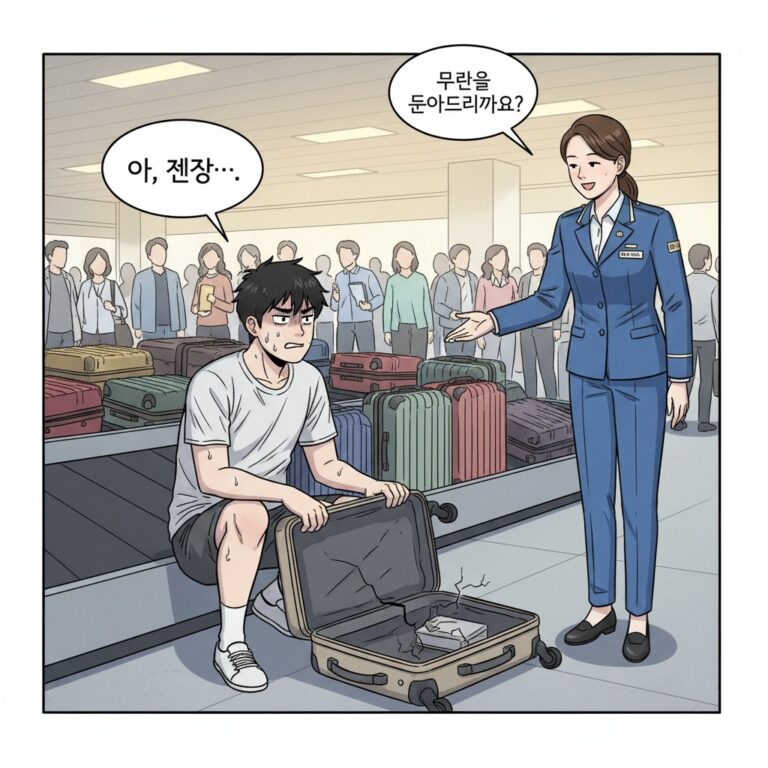
My Suitcase is Broken! Airport Korean Phrases You Need
Hello! This is Maeil Hangeul (매일한글), here to upgrade your Korean skills!
Have you ever arrived at your destination, excited to start your trip, only to find your luggage damaged at the baggage claim? It’s a frustrating situation! But don’t worry. Today, we’re going to learn some essential Korean phrases to handle this problem smoothly and confidently.
Lately in Korea, travel is booming! With so many people visiting to see their favorite K-pop idols or explore beautiful cafes, airports are busier than ever. Knowing how to explain your situation clearly can turn a travel nightmare into a minor inconvenience. Let’s get you prepared!
Core Expressions for Airport Troubles
Here are three key phrases to save the day when your luggage is damaged.
1. 제 가방이 부서졌어요. (My bag/suitcase is broken.)
- Pronunciation [Romanization]: Je gabang-i buseojyeosseoyo.
- English Meaning: My bag is broken.
- Detailed Explanation: This is the most direct and essential phrase to report the damage. ‘제’ (je) is the polite way to say ‘my’, ‘가방’ (gabang) means ‘bag’ or ‘suitcase’, and ‘부서졌어요’ (buseojyeosseoyo) is the past tense of ‘to be broken’. It’s a polite (
-아요/어요) form, perfect for speaking with airport staff. - 💡 Pronunciation Tip:
The trickiest part is 부서졌어요 (buseojyeosseoyo). Notice the double ‘ss’ in the romanization. In Korean, when the syllable ‘졌’ is followed by ‘어’, the sound often links and becomes tenser, sounding more like [부서저써요 (buseo-jeo-sseo-yo)]. Practice saying it smoothly!
2. 어떻게 해야 돼요? (What should I do?)
- Pronunciation [Romanization]: Eotteoke haeya dwaeyo?
- English Meaning: What should I do?
- Detailed Explanation: After explaining the problem, this is the perfect question to ask for guidance. ‘어떻게’ (eotteoke) means ‘how’, and ‘해야 돼요?’ (haeya dwaeyo?) is a common way to ask ‘what should I do?’ or ‘what do I have to do?’. It shows that you are seeking their help and instructions.
- 💡 Pronunciation Tip:
Be careful with ‘어떻게’ (eotteoke)! It’s not pronounced ‘eot-teot-ge’. The ‘ㅎ(h)’ sound at the end of ‘떻’ combines with the ‘ㄱ(g)’ sound at the beginning of ‘게’, creating an aspirated ‘ㅋ(k)’ sound. So, the natural pronunciation is [어떠케 (eotteoke)]. This is a very common pronunciation rule in Korean!
3. 보상받을 수 있을까요? (Can I get compensation?)
- Pronunciation [Romanization]: Bosangbadeul su isseulkkayo?
- English Meaning: Can I get compensation?
- Detailed Explanation: This phrase is for when you want to ask about the airline’s policy on damaged luggage. ‘보상’ (bosang) means ‘compensation’, and ‘-을 수 있을까요?’ (-eul su isseulkkayo?) is a polite way to ask ‘is it possible to…?’ or ‘can I…?’. It’s a slightly more advanced but incredibly useful phrase.
- 💡 Pronunciation Tip:
Let’s look at ‘받을 수’ (badeul su). The final consonant ‘ㄹ(l)’ from ‘받을’ links to the next syllable, so it sounds like [바들 수 (badeul su)]. Furthermore, the ‘ㅅ(s)’ in ‘수’ is often pronounced as a tense sound, like ‘ㅆ(ss)’, after a consonant. So, a very natural pronunciation would be [바들 쑤 (badeul ssu)].
Example Dialogue
Here’s how you can use these phrases in a real conversation at the airport.
- A (Traveler): 저기요, 죄송한데… 제 가방이 부서졌어요.
- (Jeogiyo, joesonghande… Je gabang-i buseojyeosseoyo.)
- Excuse me, I’m sorry but… my suitcase is broken.
- B (Airport Staff): 아, 그러세요? 가방 좀 보여주시겠어요? 상태를 확인해 보겠습니다.
- (A, geureoseyo? Gabang jom boyeojusigesseoyo? Sangtae-reul hwaginhae bogetseumnida.)
- Oh, is that so? Could you show me the bag? I will check its condition.
- A (Traveler): 네, 여기 바퀴가 깨졌어요. 어떻게 해야 돼요?
- (Ne, yeogi bakwi-ga kkaejyeosseoyo. Eotteoke haeya dwaeyo?)
- Yes, the wheel here is shattered. What should I do?
- B (Airport Staff): 먼저 이 서류를 작성해 주세요. 혹시 항공사로부터 보상을 원하시나요?
- (Meonjeo i seoryu-reul jakseonghae juseyo. Hoksi hanggongsa-robuteo bosang-eul wonhasinayo?)
- First, please fill out this form. Do you perhaps want compensation from the airline?
- A (Traveler): 네. 보상받을 수 있을까요?
- (Ne. Bosangbadeul su isseulkkayo?)
- Yes. Can I get compensation?
Culture Tip & Trend Deep Dive
Recently, a member of a famous K-pop group shared a vlog of their trip to Jeju Island, and they actually had their suitcase wheel break! They calmly went to the service desk and used phrases just like the ones we learned today. Their fans were so impressed with how they handled it, and it became a small trend to learn “airport problem phrases.”
This brings up a key aspect of Korean culture: while people value efficiency (빨리빨리 [ppalli-ppalli] culture), there is also a very strong emphasis on following proper procedures, especially in customer service. When you face a problem like a broken bag, don’t panic. If you calmly explain the situation using polite language (-아요/어요), the staff will almost always guide you through a very systematic and efficient process to resolve your issue. Taking a photo of the damage right away is a great tip anywhere, and in Korea, it will help make the documentation process even smoother!
Let’s Review & Practice!
Great job today! You’ve learned how to handle a common travel problem with confidence.
Quick Quiz:
Imagine you find your suitcase handle is broken. How would you fill in the blank to tell the staff?
- “저기요, 제 가방 손잡이가 ___________.” (Jeogiyo, je gabang sonjabi-ga ___________.)
- (Hint: Use the first expression we learned today!)
Leave your answer in the comments below using the phrases we learned! We’d love to see you try them out. Happy travels and happy learning
Frequently Asked Questions (FAQ)
Q: What does "'제'" mean in Korean and how do you pronounce it?
A: In Korean, "'제'" is pronounced [je] and means: is the polite way to say 'my',
Q: What does "'가방'" mean in Korean and how do you pronounce it?
A: In Korean, "'가방'" is pronounced [gabang] and means: means 'bag' or 'suitcase', and
Q: What does "'부서졌어요'" mean in Korean and how do you pronounce it?
A: In Korean, "'부서졌어요'" is pronounced [buseojyeosseoyo] and means: is the past tense of 'to be broken'. It's a polite (
Q: What does "부서졌어요" mean in Korean and how do you pronounce it?
A: In Korean, "부서졌어요" is pronounced [buseojyeosseoyo] and means: . Notice the double 'ss' in the romanization. In Korean, when the syllable '졌' is followed by '어', the sound often links and becomes tenser, sounding more like







