

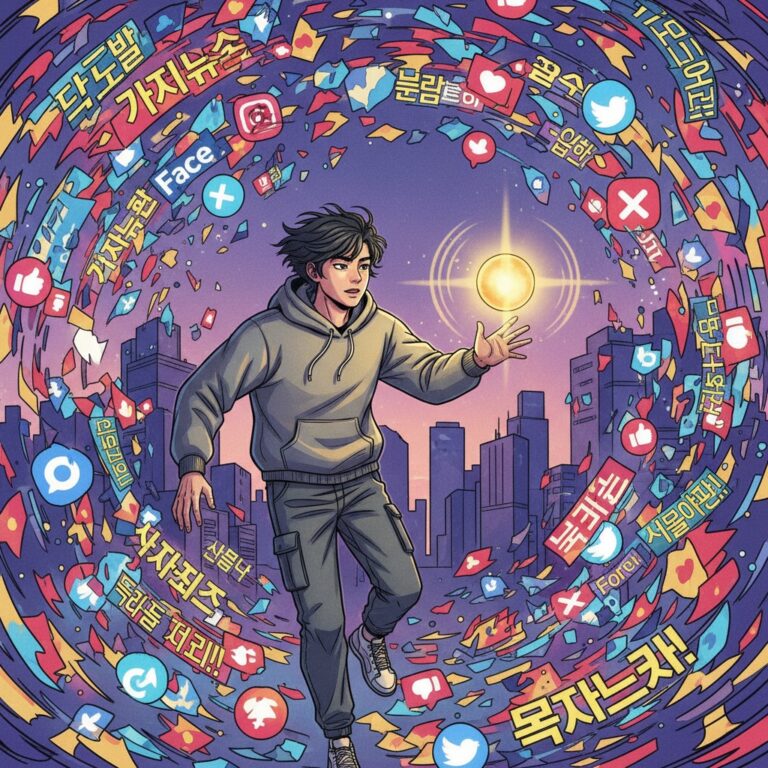
Hello! Welcome to [Maeil Hangul], your trusted partner in upgrading your Korean skills to the next level! Today, we’re tackling a challenging but incredibly relevant topic: how to talk about media, truth, and disinformation in Korean. In a world overflowing with information, being able to critically discuss what you read and see is a vital skill. Especially these days in Korea (요즘 한국에서는…), where public discourse is vibrant and fast-paced, online platforms can be a minefield of conflicting information. Understanding the vocabulary to navigate this “post-truth” (탈진실) era will not only make you a more informed consumer of Korean media but will also allow you to participate in deeper, more meaningful conversations. Let’s get started! — ### Core Expressions You Need to Know Here are five essential terms to arm yourself with for any discussion about modern media in Korea. #### 1. 가짜 뉴스 (Gajja Nyuseu) * Pronunciation [Romanization]: [Gajja nyuseu] * English Meaning: Fake News * Detailed Explanation: This is a direct and widely used term for “fake news” or disinformation. It refers to deliberately fabricated information disguised as genuine news to mislead the public, often for political or financial gain. It’s a straightforward term you’ll hear constantly in news reports, political debates, and everyday conversations about online content. * 💡 Pronunciation Tip: The key here is the ‘ㅉ’ (jj) sound in ‘가짜’. It’s a tense consonant. To make this sound, start by trying to say ‘ch’ but tighten your tongue against the roof of your mouth and push the air out forcefully without any puff of air. It should feel stronger and sharper than the regular ‘ㅈ’ (j). Think “pizza” but with a ‘j’ sound. #### 2. 팩트 체크 (Paekteu Chekeu) * Pronunciation [Romanization]: [Paekteu chekeu] * English Meaning: Fact Check * Detailed Explanation: A classic example of Konglish (Korean-style English), ‘팩트 체크’ is used exactly as it is in English. It can be a noun (“팩트 체크가 필요해요” – A fact check is needed) or part of a verb phrase, 팩트 체크하다 (to fact-check). In a media landscape where skepticism is high, calling for a ‘fact check’ is a common way to question a claim’s validity. * 💡 Pronunciation Tip: Notice the aspirated consonants ‘ㅍ’ (p) and ‘ㅋ’ (k). Unlike their English counterparts, these Korean sounds are produced with a strong puff of air. Hold a piece of paper in front of your mouth; when you say ‘팩트’ (paekteu) correctly, the paper should flutter significantly. #### 3. 분별력 (Bunbyeollyeok) * Pronunciation [Romanization]: [Bunbyeollyeok] * English Meaning: Discernment; Judgment; The ability to distinguish * Detailed Explanation: This is a sophisticated, C2-level word perfect for this topic. It’s composed of ‘분별’ (distinction) and ‘력’ (power/ability). It doesn’t just mean knowing something is true or false; it refers to the crucial cognitive ability to sift through information, identify biases, and make sound judgments. You would use this to talk about the skills a modern citizen needs, e.g., “가짜 뉴스가 많아서 분별력을 기르는 것이 중요해요.” (Because there’s so much fake news, cultivating discernment is important.) * 💡 Pronunciation Tip: This word has a fun assimilation rule! The Hangul is ‘분별력’, but the final ‘ㄴ’ (n) in ‘분’ and the initial ‘ㄹ’ (r/l) in ‘력’ don’t like to stay separate. The ‘ㄴ’ sound often changes to an ‘ㄹ’ sound to match the following consonant. Therefore, it’s pronounced [분별력/bunbyeol-lyeok], not [bunbyeol-ryeok]. This makes the pronunciation smoother and more natural. #### 4. 흑백 논리 (Heukbaek Nolli) * Pronunciation [Romanization]: [Heukbaek nolli] * English Meaning: Black-and-white logic; Dichotomous thinking * Detailed Explanation: Literally “black-white logic,” this four-character phrase (사자성어) is used to criticize overly simplistic, polarized arguments that ignore nuance. It describes the tendency to see everything in absolute terms—good or evil, right or wrong, our side or their side—which is a hallmark of the post-truth era’s divisive rhetoric. You’ll often hear this in political analysis or critiques of online comment sections. * 💡 Pronunciation Tip: The final consonants in ‘흑’ (heuk) and ‘백’ (baek) are unreleased stops. This means you form the ‘k’ sound with your tongue at the back of your mouth, but you don’t release the puff of air that you would if the ‘k’ were at the beginning of a syllable. The sound is cut off abruptly. It’s a subtle but key feature of natural Korean pronunciation. #### 5. 기레기 (Giregi) * Pronunciation [Romanization]: [Giregi] * English Meaning: (Derogatory) Trashy reporter; hack journalist * Detailed Explanation: This is a powerful and very common piece of modern slang. It’s a portmanteau of 기자 (gija – reporter) and 쓰레기 (sseuregi – trash). It’s a derogatory term for journalists who are perceived as unethical, writing sensationalist clickbait, or spreading misinformation. Using this word shows a deep understanding of the current public cynicism towards media in Korea. Be careful, as it’s a strong and offensive term! * 💡 Pronunciation Tip: The pronunciation is straightforward. Focus on the initial ‘ㄱ’ (g). In the middle of a word, as in ‘쓰레기’, it’s often voiced, sounding closer to an English ‘g’. However, at the beginning of a word like ‘기자’, it’s voiceless, sitting somewhere between an English ‘g’ and ‘k’. — ### Example Dialogue Let’s see how these words play out in a real conversation between two friends discussing an online article. A: 와, 이 기사 봤어? 정부가 다음 달부터 모든 커피숍에서 일회용 컵 사용을 전면 금지한대! (Wow, did you see this article? It says the government is completely banning disposable cups at all coffee shops starting next month!) B: 진짜? 그거 완전 가짜 뉴스 같은데. 출처가 어디야? 일단 팩트 체크부터 해봐야 할 것 같아. (Really? That sounds like total fake news. What’s the source? I think we need to fact-check it first.) A: 음… 그냥 페이스북에서 본 건데. 하긴, 요즘엔 하도 자극적인 정보가 많아서 분별력을 갖기가 쉽지 않아. (Hmm… I just saw it on Facebook. You’re right, there’s so much provocative information these days it’s hard to have discernment.) B: 맞아. 댓글 창은 벌써 난리 났겠지. 찬성 아니면 반대, 완전 흑백 논리로 싸우고 있을걸. 클릭 수만 노리는 기레기가 쓴 글일 수도 있고. (Exactly. The comment section is probably already a warzone. People will be fighting with total black-and-white logic, either for or against. It could have been written by some trashy reporter just chasing clicks.) — ### Culture Tip & Trend Analysis The term 기레기 (Giregi) isn’t just a random insult; it reflects a significant cultural trend in Korea: a deep and growing distrust of mainstream media. While Korea has many respected journalists, the rise of online portals like Naver and Daum, where headlines are often optimized for clicks rather than accuracy, has fueled public cynicism. Furthermore, disinformation (가짜 뉴스) spreads with incredible speed through platforms like YouTube and the ubiquitous messaging app KakaoTalk, particularly within closed groups of older generations. This has deepened political and social divides, making concepts like 흑백 논리 (black-and-white logic) and the need for personal 분별력 (discernment) central themes in public conversation. Understanding these terms is understanding the anxieties and challenges of modern Korean society. — ### Let’s Practice! Time to check your understanding. 1. Fill in the blank: If you read a news report that seems intentionally misleading and poorly researched, you might describe the author as a _______. 2. Make a sentence: Using the term 팩트 체크하다, write a short sentence explaining what you should do before sharing a shocking piece of news with your friends. You’ve learned some incredibly useful and advanced vocabulary today! Now you’re ready to engage with Korean news and social media on a much deeper level. Challenge yourself! Try using one of today’s expressions in a sentence and post it in the comments below!
Frequently Asked Questions (FAQ)
Q: What does "기레기" mean in Korean and how do you pronounce it?
A: In Korean, "기레기" is pronounced [Giregi] and means: isn't just a random insult; it reflects a significant cultural trend in Korea: a deep and growing distrust of mainstream media. While Korea has many respected journalists, the rise of online portals like Naver and Daum, where headlines are often optimized for clicks rather than accuracy, has fueled public cynicism. Furthermore, disinformation (
Q: What does "흑백 논리" mean in Korean and how do you pronounce it?
A: In Korean, "흑백 논리" is pronounced [black-and-white logic] and means: and the need for personal
Q: What does "분별력" mean in Korean and how do you pronounce it?
A: In Korean, "분별력" is pronounced [discernment] and means: central themes in public conversation. Understanding these terms is understanding the anxieties and challenges of modern Korean society. --- ### Let's Practice! Time to check your understanding. 1.







