

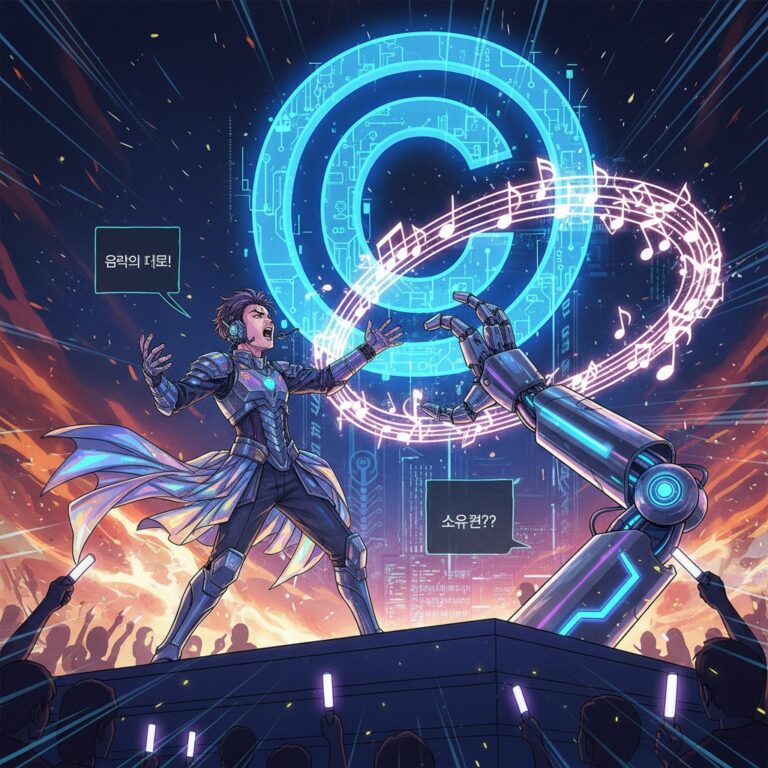
AI K-Pop Covers? Let’s Talk Copyright in Korean!
Hello! Welcome to Maeil Hangeul (매일한글), your daily stop for upgrading your Korean skills!
Have you ever scrolled through YouTube or TikTok and seen an AI-generated cover of your favorite K-Pop song, sung in the voice of another artist? It’s a huge trend right now! These covers are fascinating, but they also bring up some interesting questions. What about the original artist? Is it okay to use their music like that?
These days in Korea, the conversation around AI music and copyright is a hot topic online. Today, we’ll learn some key Korean expressions so you can understand and even join in on these conversations. Let’s get started!
Core Expressions You Need to Know
Here are three essential phrases to discuss music and ownership like a pro.
1. 저작권 (jeojakgwon)
- Pronunciation [Romanization]: jeo-jak-gwon
- English Meaning: Copyright
- Detailed Explanation: This is the most important word for our topic! It’s a formal noun made of ‘저작’ (jeojak), meaning “creation” or “work,” and ‘권’ (gwon), meaning “right” or “authority.” You’ll see this word everywhere, from music albums to books and software. It refers to the legal right of the owner of an intellectual property.
-
💡 Pronunciation Tip:
When the syllable ‘작’ (jak) is followed by ‘권’ (gwon), the ‘ㄱ’ (g/k) sound in ‘권’ becomes a strong, tense sound, almost like ‘kkwon’. This is a common sound change rule in Korean called 경음화 (gyeongeumhwa), or “tensing.” So, instead of a soft “jak-gwon,” you should pronounce it with more force: [jeojakkkwon].
2. 원곡 (wongok)
- Pronunciation [Romanization]: won-gok
- English Meaning: The original song
-
Detailed Explanation: This word is a combination of ‘원’ (won), from Chinese characters meaning “original” or “first,” and ‘곡’ (gok), meaning “song” or “melody.” When you’re talking about a cover, a remix, or a sample, you use ‘원곡’ to refer to the source material. For example, “I like this cover, but the 원곡 is still the best.”
-
💡 Pronunciation Tip:
This one is pronounced pretty much as it’s written! Just make sure to pronounce both syllables clearly: [won-gok]. The ‘o’ sound is similar to the ‘o’ in “go.”
3. 허락 없이 (heorak eopsi)
- Pronunciation [Romanization]: heo-rak eop-si
- English Meaning: Without permission
-
Detailed Explanation: This is a super useful phrase! ‘허락’ (heorak) means “permission” or “consent,” and ‘없이’ (eopsi) is a particle that means “without.” You can use this phrase in many situations, not just for music. For example, “You can’t enter without permission” (허락 없이 들어가면 안 돼요).
-
💡 Pronunciation Tip:
This phrase has a cool pronunciation rule called 연음 (yeoneum), or “liaison.” The final consonant of a syllable, in this case, the ‘ㄱ’ (k) in ‘락’ (rak), moves over to the beginning of the next syllable if that syllable starts with a vowel. So, ‘허락 없이’ is not pronounced “heorak / eopsi.” Instead, it flows together smoothly as [허라겁씨 (heo-ra-geop-ssi)]. Notice the ‘없이’ also becomes a tense ‘ssi’ sound after the consonant. This will make you sound much more natural!
Example Dialogue
Let’s see how these expressions work in a real conversation. Two friends, A and B, are talking about a new AI cover they found online.
A: 이 AI 커버 들어봤어? 뉴진스 ‘Hype Boy’를 아이유 목소리로 부른 거!
i AI keobeo deureobwasseo? Nyujinseu ‘Hype Boy’reul Aiyu moksoriro bureun geo!
(Have you heard this AI cover? It’s NewJeans’ ‘Hype Boy’ sung in IU’s voice!)
B: 응, 들어봤어. 진짜 신기하더라. 근데 이거 저작권 문제없는 걸까?
Eung, deureobwasseo. Jinjja singihadeora. Geunde igeo jeojakgwon munje-eomneun geolkka?
(Yeah, I have. It’s really fascinating. But I wonder if there’s no copyright issue with this?)
A: 맞아. 원곡 가수한테 허락 없이 만든 거면 문제가 될 수도 있겠다.
Maja. Wongok gasuhante heorak eopsi mandeun geomyeon munjega doel sudo itgetda.
(Right. If they made it without permission from the original song‘s artist, it could become a problem.)
B: 그래도 기술은 정말 대단한 것 같아.
Geuraedo gisureun jeongmal daedanhan geot gata.
(Still, the technology is pretty amazing.)
Culture Tip & Trend Analysis
In Korea, discussions about AI and intellectual property are very active, especially among the Z-generation. On platforms like YouTube and the Korean forum theqoo, you’ll find long threads debating the ethics of AI covers.
While some see it as a new form of creative expression, many K-Pop fans are concerned about protecting the artist’s voice and identity. The phrases we learned today—저작권 (copyright), 원곡 (original song), and 허락 없이 (without permission)—are the exact keywords you’ll see in these online discussions.
If you want to sound even more like a native speaker when talking about a controversial topic, you can use the trendy slang phrase “이거 완전 논란 각인데 (Igeo wanjeon nonlan gaginde).” It roughly translates to “This is totally going to be controversial” or “I see a controversy brewing.” Using this will definitely impress your Korean friends!
Let’s Practice!
Ready to test your knowledge? Try these simple exercises.
- Fill in the blank:
You shouldn’t use someone else’s photo on your blog ______.
(다른 사람의 사진을 블로그에 ______ 쓰면 안 돼요.) -
Make a short sentence:
Think of your favorite K-Pop cover song. Try to make a sentence using the word 원곡 (original song) to compare it to the cover. (e.g., “The cover is good, but I like the original song more.”)
Great job today! You’ve learned some very relevant and useful Korean expressions.
Now, it’s your turn! What do you think about AI music covers? Leave a comment below in Korean using the phrases you learned today!
Frequently Asked Questions (FAQ)
Q: What does "경음화" mean in Korean and how do you pronounce it?
A: In Korean, "경음화" is pronounced [gyeongeumhwa] and means: , or "tensing." So, instead of a soft "jak-gwon," you should pronounce it with more force:
Q: What does "연음" mean in Korean and how do you pronounce it?
A: In Korean, "연음" is pronounced [yeoneum] and means: , or "liaison." The final consonant of a syllable, in this case, the 'ㄱ' (k) in '락' (rak), moves over to the beginning of the next syllable if that syllable starts with a vowel. So, '허락 없이' is not pronounced "heorak / eopsi." Instead, it flows together smoothly as
Q: What does "원곡" mean in Korean and how do you pronounce it?
A: In Korean, "원곡" is pronounced [original song] and means: , and
Q: What does "허락 없이" mean in Korean and how do you pronounce it?
A: In Korean, "허락 없이" is pronounced [without permission] and means: —are the exact keywords you'll see in these online discussions.







