

Hello! This is [Daily Hangeul], here to upgrade your Korean skills to the next level!
Today, we are diving into a sophisticated and philosophical topic: Aesthetics and the nature of beauty. specifically focusing on Minimalism.
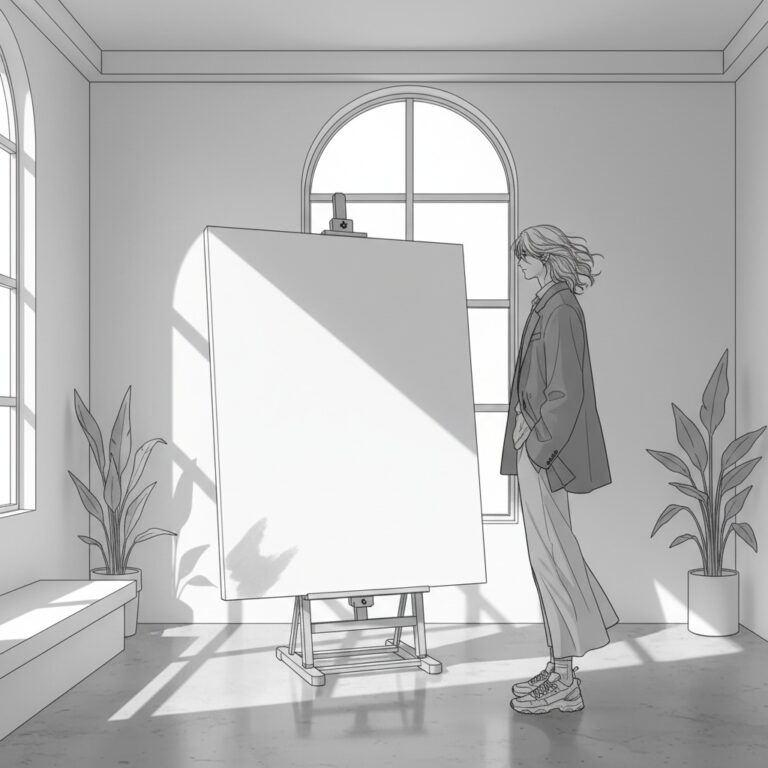
Have you noticed the recent trend in Seoul’s hottest cafes and galleries? Nowadays in Korea, the “maximalist” trend of flashy interiors is fading. Instead, spaces that emphasize “Yeobaek” (empty space) and “Dansaekhwa” (Korean monochrome painting) are taking over Instagram feeds. This reflects a desire to clear the mind and focus on what truly matters.
If you want to discuss art, design, or even lifestyle philosophies like a true Korean intellectual, these C1-level expressions are essential!
🎨 Key Expressions for Discussing Aesthetics
Here are 4 high-level expressions to help you discuss the philosophy of “Less is More.”
1. 여백의 미 (The beauty of empty space)
- Pronunciation: [Yeobaek-ui mi] -> [여배게 미 (Yeobae-ge mi)]
- English Meaning: The beauty of empty space / The aesthetics of emptiness
- Detail: This is the most crucial concept in Korean traditional art and modern minimalism. It refers to the beauty found not in what is painted, but in the unpainted space left behind. It suggests that emptiness allows room for imagination and resonance.
- 💡 Pronunciation Tip:
- When the particle ‘의 (ui)’ indicates possession, it is often pronounced as [에 (e)] in spoken Korean for ease.
- Also, the final consonant ‘ㄱ’ in ‘백’ moves over to the next vowel sound. So, it sounds like [Yeobae-ge mi].
2. 군더더기 없다 (To be free of superfluity)
- Pronunciation: [Gundeodeogi eopda] -> [군더더기 업따 (Gundeodeogi eop-tta)]
- English Meaning: To be flawless; to be clean and simple without anything unnecessary.
- Detail: ‘군더더기’ means unnecessary additions or superfluities. This phrase is perfect for praising a minimalist design, a concise speech, or a neat writing style. It implies perfection through subtraction.
- 💡 Pronunciation Tip:
- The final consonant ‘ㅂ’ in ‘없’ makes the following ‘다’ sound harder. This is called Tensification.
- So, ‘다’ becomes a strong [따 (tta)] sound.
3. 본질에 집중하다 (To focus on the essence)
- Pronunciation: [Bonjil-e jipjunghada] -> [본지레 집쭝하다 (Bonji-re jip-jjung-hada)]
- English Meaning: To focus on the essence/core nature.
- Detail: In minimalist philosophy, stripping away the decoration allows you to see the “essence.” This is a great phrase to use in business meetings or serious discussions when you want to get to the heart of the matter.
- 💡 Pronunciation Tip:
- Liaison: The ‘ㄹ’ in ‘질’ flows into ‘에’, becoming [re].
- Tensification: The ‘ㅂ’ in ‘집’ meets ‘중’, turning the ‘ㅈ’ into a strong [ㅉ (jj)] sound -> [Jip-jjung].
4. 함축적이다 (To be implicative/connotative)
- Pronunciation: [Hamchukjeok-ida] -> [함축쩌기다 (Hamchuk-jjeo-gi-da)]
- English Meaning: To be implicative; suggestive; containing deep meaning in a simple form.
- Detail: Minimalist art doesn’t explain everything; it hints at it. You use this word when something simple (like a poem or a single line on a canvas) holds a vast, hidden meaning.
- 💡 Pronunciation Tip:
- The ‘ㄱ’ in ‘축’ meets ‘적’, causing Tensification again. ‘적’ becomes [쩍 (jjeok)].
- Then, the final ‘ㄱ’ in ‘적’ flows into ‘이’, sounding like [gi].
🗣️ Real-Life Conversation: At a Gallery
Let’s see how these words are used in a conversation about a trendy art exhibition.
Situation: A and B are looking at a famous “Dansaekhwa” (Monochrome painting) piece.
A: 이 그림 좀 봐. 그냥 점 하나만 찍혀 있는데, 묘하게 끌리네.
(Look at this painting. It’s just a single dot, but it’s strangely attractive.)B: 맞아. 화려한 색채는 없지만, 오히려 여백의 미가 느껴져서 좋아.
(Right. It lacks colorful hues, but I actually like it because I can feel the beauty of empty space.)A: 요즘은 이렇게 복잡한 장식을 다 덜어내고 본질에 집중한 작품이 인기래.
(I heard that artworks that remove complex decorations and focus on the essence are popular these days.)B: 디자인도 마찬가지야. 군더더기 없는 스타일이 제일 세련돼 보이잖아. 정말 함축적인 매력이 있어.
(It’s the same with design. Styles that are free of superfluity look the most sophisticated. It really has an implicative charm.)
🇰🇷 Culture Tip & Trend Deep Dive
“Why is the ‘Void’ so trendy in Korea right now?”
Recently, the concept of “Mung-beat” (Mung-ttaerigi / Spacing out) has become a cultural phenomenon in Korea. From “Fire Mung” (staring at a fire) to “View Mung” (staring at a view), people are looking for a break from their busy, competitive lives.
This connects directly to today’s theme, Minimalism. The popularity of Dansaekhwa (Korean Monochrome Painting)—artists like Lee Ufan or Park Seo-bo—is soaring not just because of the art, but because the “Yeobaek” (empty space) in their work gives the viewer a place to rest their mind.
When you use the expression “여백의 미” (Beauty of empty space), you aren’t just talking about art; you are showing that you understand the modern Korean desire for mental peace and simplicity!
📝 Wrap-up & Practice
Today, we explored the philosophy of “Less is More” through Korean expressions. Remember, sometimes using fewer, more precise words makes your Korean sound much more advanced!
Let’s practice! Fill in the blank:
“This report is too long. Please remove the unnecessary parts and make it ___________.”
(이 보고서는 너무 길어요. 불필요한 부분은 빼고 ___________ 만들어 주세요.)
Hint: Think of the expression that means “free of superfluity” or “flawless”!
Answer: 군더더기 없이 (Gundeodeogi eopsi)
Did you enjoy today’s lesson? Leave a comment below using one of the expressions you learned today! See you next time! 👋
Frequently Asked Questions (FAQ)
Q: What does ""여백의 미"" mean in Korean and how do you pronounce it?
A: In Korean, ""여백의 미"" is pronounced [Beauty of empty space] and means: , you aren't just talking about art; you are showing that you understand the modern Korean desire for mental peace and simplicity!






