

What Are You Doing Now? Master Korea’s “-고 있어” Tense!
Hello! This is [Daily Hangul], here to upgrade your Korean skills! 🎉
Have you ever been texting a friend and wanted to ask, “What are you doing?” or tell them what you’re up to right now? Today, we’re going to learn the super useful Korean grammar pattern that lets you do just that!
You’ll be able to describe any action as it’s happening. This is especially fun because if you watch K-pop idols on their live streams, you’ll see thousands of comments asking, “지금 뭐 하고 있어요?” (What are you doing now?). After today’s lesson, you’ll be able to understand and even ask that question yourself!
Let’s dive into the world of the present continuous tense: -고 있어 (-go isseo).
Core Expressions You Need to Know
The magic formula is simple: Verb Stem + -고 있어 (-go isseo). This is the informal way to speak to friends. For a more polite version, you can use -고 있어요 (-go isseoyo).
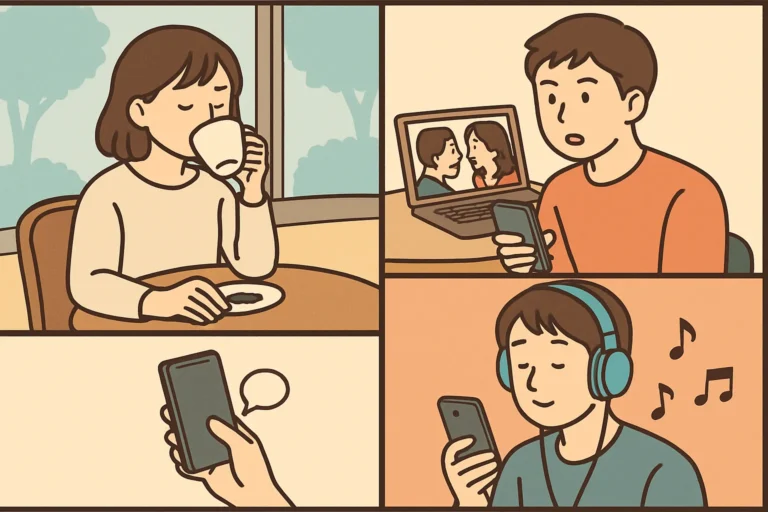
1. 커피 마시고 있어 (I’m drinking coffee.)
- Pronunciation [Romanized]: Keopi masigo isseo.
- English Meaning: I’m drinking coffee.
- Detailed Explanation: This is a classic! It’s formed by taking the verb “to drink,” 마시다 (masida), removing the -다 (-da) to get the stem 마시 (masi), and adding -고 있어 (-go isseo). It’s the perfect phrase to use when you’re chilling at a café.
- 💡 Pronunciation Tip:
The syllable 시 (si) is pronounced with a soft ‘s’ sound, similar to the “she” in “sheep.” Make sure not to pronounce it like a hard “see.” So, it’s ma-shi-go, not “ma-see-go.”
2. 드라마 보고 있어 (I’m watching a drama.)
- Pronunciation [Romanized]: Deurama bogo isseo.
- English Meaning: I’m watching a K-drama.
- Detailed Explanation: Binge-watching the latest hit show? This is your phrase! It comes from the verb “to see” or “to watch,” 보다 (boda). The stem is 보 (bo), so you just attach -고 있어 (-go isseo).
- 💡 Pronunciation Tip:
Notice the consonant ‘ㅂ’ (b) in 보고 (bogo). When ‘ㅂ’ is in the middle of a word, it has a softer ‘b’ sound, like in “boy.” However, if it were at the beginning of a word, it would sound closer to a ‘p.’ This subtle difference will make you sound much more natural!
3. 음악 듣고 있어 (I’m listening to music.)
- Pronunciation [Romanized]: Eumak deutgo isseo.
- English Meaning: I’m listening to music.
- Detailed Explanation: This one uses the verb “to listen,” 듣다 (deutda). The stem is 듣 (deut). This verb is special (it’s an irregular verb!), but luckily, when you add -고 있어 (-go isseo), it stays regular! You just attach it directly to the stem.
- 💡 Pronunciation Tip:
The final consonant in 듣 (deut) is a ‘ㄷ’ (d), but it sounds like an unreleased ‘t’ at the end of a syllable. This means you put your tongue in the ‘t’ position but don’t release the puff of air. It’s a “stopped” sound. So, it’s [deut-go], not “deu-deu-go.”
Example Dialogue in Action
Let’s see how these phrases work in a real conversation between two friends, Subin and Minjun.
Subin: 민준아, 지금 뭐 해?
(Minjun, jigeum mwo hae?)
Minjun, what are you doing now?
Minjun: 나? 지금 카페에서 커피 마시고 있어. 너는?
(Na? Jigeum kape-eseo keopi masigo isseo. Neoneun?)
Me? I’m drinking coffee at a café right now. And you?
Subin: 나는 집에서 새로 나온 아이돌 노래 듣고 있어. 완전 좋아!
(Naneun jibeseo saero naon aidol norae deutgo isseo. Wanjeon joa!)
I’m at home listening to the new idol song. It’s so good!
Minjun: 아, 진짜? 나도 이따가 들어봐야겠다!
(A, jinjja? Nado ittaga deureobwayagetda!)
Oh, really? I should listen to it later!
Culture Tip: The “What Are You Doing?” Culture
In Korea, asking “지금 뭐 해?” (Jigeum mwo hae? – What are you doing now?) is a very common and friendly way to start a conversation with friends via text. It’s like saying, “Hey, what’s up?”
You’ll see this everywhere on social media. People love sharing their current activities on Instagram Stories with a short caption like “친구랑 저녁 먹고 있어요” (I’m having dinner with a friend).
Pro-Tip: If you want to impress your Korean friends, you can even use the trendy slang abbreviation “지뭐해?” (jimwohae?). It’s a quicker, cuter way of asking the same question. Now you’re in on the secret!
Let’s Review and Practice!
Great job today! You’ve learned how to talk about what’s happening right now using the -고 있어 grammar. It’s all about adding it to a verb stem.
Now, let’s test your knowledge!
- Fill in the blank: How would you say “I’m studying”? The verb for “to study” is 공부하다 (gongbuhada).
- 저는 지금 한국어를 ______ ______.
- Your Turn! What are YOU doing right now? Try to write a short sentence in Korean using a verb you know.
- Example Verbs: 자다 (jada – to sleep), 일하다 (ilhada – to work), 운동하다 (undonghada – to exercise).
Leave your answers in the comments below! We’d love to see you use your new skills. Keep up the amazing work
Frequently Asked Questions (FAQ)
Q: What does "Verb Stem + -고 있어" mean in Korean and how do you pronounce it?
A: In Korean, "Verb Stem + -고 있어" is pronounced [-go isseo] and means: . This is the informal way to speak to friends. For a more polite version, you can use
Q: What does "마시다" mean in Korean and how do you pronounce it?
A: In Korean, "마시다" is pronounced [masida] and means: , removing the
Q: What does "-다" mean in Korean and how do you pronounce it?
A: In Korean, "-다" is pronounced [-da] and means: to get the stem
Q: What does "마시" mean in Korean and how do you pronounce it?
A: In Korean, "마시" is pronounced [masi] and means: , and adding







