

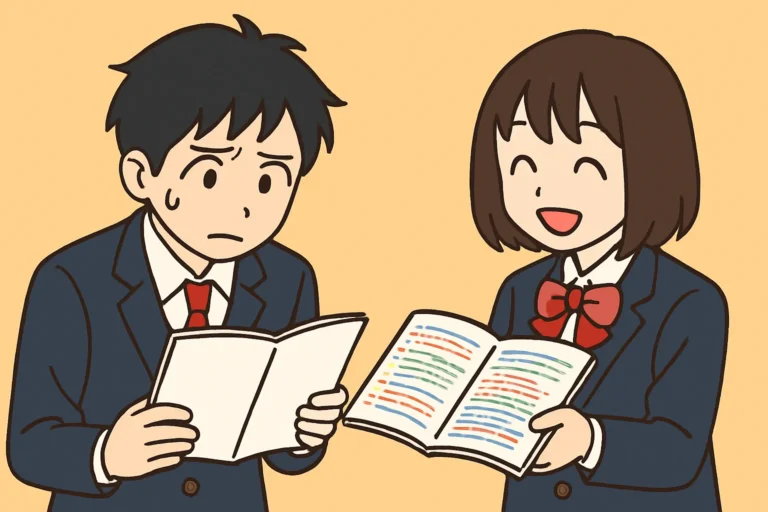
Missed Class? Your Korean Guide to Catching Up!
Hello! It’s your friendly guide, [Everyday Hangul], here to upgrade your Korean skills!
Have you ever been sick and had to miss a day of school? The worst part is trying to figure out what you missed! Today, we’re going to learn some essential Korean phrases to ask a friend for class notes and homework. You know those scenes in K-dramas where the main character misses a crucial class and has to catch up? Recently in Korea, webtoons and dramas about high school life are super popular, and you’ll see these situations all the time! With these phrases, you’ll be able to handle it just like a K-drama pro.
Let’s get started!
Core Expressions You Need to Know
Here are three key phrases to help you get back on track after a day off.
1. What did we learn in class yesterday?
- Korean: 어제 수업 뭐 배웠어?
- Pronunciation [Romanization]: Eoje sueop mwo baewosseo?
- English Meaning: What did we learn in class yesterday?
- Detailed Explanation: This is the most direct and casual way to ask a close friend what happened in class. Let’s break it down:
어제(eoje) = yesterday수업(sueop) = class뭐(mwo) = what배웠어?(baewosseo?) = did (we) learn?
This is banmal (반말), or informal language, so make sure you only use it with close friends!
- 💡 Pronunciation Tip:
The double ‘ss’ in 배웠어 (baewosseo) is a tense consonant sound. It’s not like the ‘s’ in “see.” To make this sound, press the tip of your tongue against the back of your teeth and force the air out, creating a stronger, tighter ‘ss’ sound. It should sound sharp, not soft!
2. By any chance, can you show me your notes?
- Korean: 혹시 필기 좀 보여줄 수 있어?
- Pronunciation [Romanization]: Hoksi pilgi jom boyeojul su isseo?
- English Meaning: By any chance, can you show me your notes?
- Detailed Explanation: This is a very polite and considerate way to ask for a favor.
혹시(hoksi) means “by any chance” or “maybe.” Adding it makes your request sound much softer and less demanding.필기(pilgi) means “(handwritten) notes.”좀(jom) is a softener, similar to adding “a little” or “please.”보여줄 수 있어?(boyeojul su isseo?) means “can you show me?”
- 💡 Pronunciation Tip:
For 혹시 (hoksi), the pronunciation is closer to [hokssi]. When the final consonant ‘ㄱ’ (k) is followed by ‘ㅅ’ (s), the ‘ㅅ’ becomes a tense ‘ㅆ’ (ss) sound. So, instead of a soft ‘hok-si’, you say a stronger ‘hok-ssi’. It’s a small change that makes you sound much more natural.
3. Was there any homework?
- Korean: 숙제 있었어?
- Pronunciation [Romanization]: Sukje isseosseo?
- English Meaning: Was there any homework?
- Detailed Explanation: A simple and absolutely essential question for any student!
숙제(sukje) = homework있었어?(isseosseo?) = was there? / did we have?
- 💡 Pronunciation Tip:
Listen carefully to 있었어 (isseosseo). The sound flows together. The final consonant ‘ㅆ’ (ss) from the second syllable links to the vowel ‘어’ (eo) in the last syllable. So, you don’t pronounce it as ‘iss-eoss-eo’. Instead, it flows smoothly as [i-sseo-sseo]. Practice saying it quickly!
Example Dialogue
Let’s see how these phrases work in a real conversation between two friends, Sujin and Minjun.
A (Sujin): 민준아, 나 어제 아파서 학교 못 왔어.
(Minjun-a, na eoje apaseo hakgyo mot wasseo.)
(Minjun, I was sick yesterday so I couldn’t come to school.)
B (Minjun): 아, 괜찮아? 어제 수학 시간에 새로운 거 배웠어.
(A, gwaenchana? Eoje suhak sigane saeroun geo baewosseo.)
(Oh, are you okay? We learned something new in math class yesterday.)
A (Sujin): 정말? 어제 수업 뭐 배웠어? 혹시 필기 좀 보여줄 수 있어?
(Jeongmal? Eoje sueop mwo baewosseo? Hoksi pilgi jom boyeojul su isseo?)
(Really? What did we learn in class yesterday? By any chance, can you show me your notes?)
B (Minjun): 응, 당연하지. 여기 봐. 아, 그리고 숙제 있었어. 이 문제 풀어야 돼.
(Eung, dangyeonhaji. Yeogi bwa. A, geurigo sukje isseosseo. I munje pureoya dwae.)
(Yeah, of course. Look here. Oh, and there was homework. We have to solve this problem.)
A (Sujin): 고마워! 너 최고야!
(Gomawo! Neo choegoya!)
(Thanks! You’re the best!)
Culture Tip & Trend Deep Dive
In Korea, sharing notes, or ‘필기 공유’ (pilgi gong-yu), is a huge part of student friendship culture. Helping a friend who was absent is considered very normal and kind. You’ll see this all the time in popular school-themed webtoons like True Beauty or dramas like Extraordinary You. The top student’s perfectly organized notes are often treated like a hidden treasure!
Here’s a pro-tip to sound even more like a native: Notice how Minjun’s first reaction was to ask, “괜찮아?” (Are you okay?). In Korea, showing concern for your friend’s well-being before jumping into business is very important. So, if your friend comes back to school after being sick, always start by asking if they’re feeling better. It shows you care!
Let’s Review & Practice!
Great job today! You’ve learned how to ask what you missed in class, request notes politely, and check for homework. You’re all set for your Korean school life adventure!
Now, let’s test your knowledge.
- Fill in the blank: You want to ask your friend if there was any homework yesterday. You would say:
“어제 _______ 있었어?” -
Sentence Building: Using the words below, how would you politely ask a friend to show you their Korean language (
국어) notes?
(국어 / 보여줄 수 있어? / 혹시 / 필기 / 좀)
Leave your answers in the comments below! We’d love to see you try using these expressions. Until next time, happy studying
Frequently Asked Questions (FAQ)
Q: What does "배웠어" mean in Korean and how do you pronounce it?
A: In Korean, "배웠어" is pronounced [baewosseo] and means: is a tense consonant sound. It's not like the 's' in "see." To make this sound, press the tip of your tongue against the back of your teeth and force the air out, creating a stronger, tighter 'ss' sound. It should sound sharp, not soft!
Q: What does "혹시" mean in Korean and how do you pronounce it?
A: In Korean, "혹시" is pronounced [hoksi] and means: , the pronunciation is closer to
Q: What does "있었어" mean in Korean and how do you pronounce it?
A: In Korean, "있었어" is pronounced [isseosseo] and means: . The sound flows together. The final consonant 'ㅆ' (ss) from the second syllable links to the vowel '어' (eo) in the last syllable. So, you don't pronounce it as 'iss-eoss-eo'. Instead, it flows smoothly as
Q: What does "'필기 공유'" mean in Korean and how do you pronounce it?
A: In Korean, "'필기 공유'" is pronounced [pilgi gong-yu] and means: , is a huge part of student friendship culture. Helping a friend who was absent is considered very normal and kind. You'll see this all the time in popular school-themed webtoons like







