

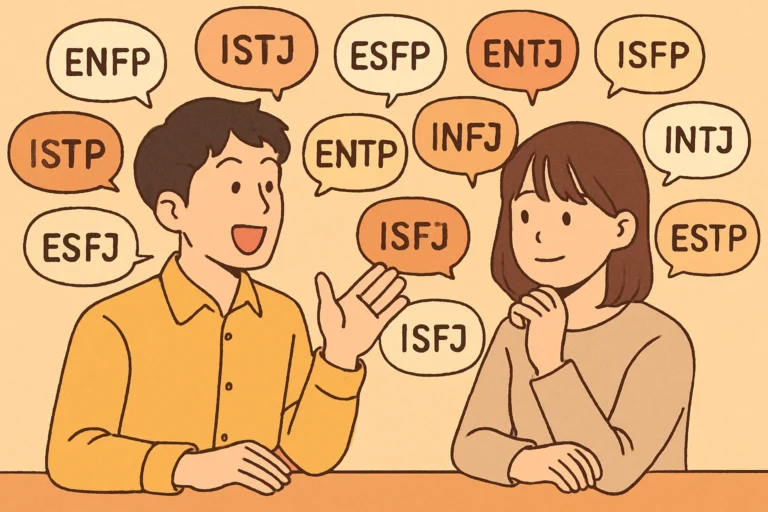
What’s Your MBTI? Korean Phrases for Making Friends!
Hello! This is Maeil Hangeul, here to upgrade your Korean skills!
Have you ever met someone new and wanted to quickly find some common ground? Today, we’re going to learn how to introduce yourself and describe your personality in Korean. This is super useful when you’re making new friends, going on a blind date, or joining a new club.
Especially these days in Korea, one topic is on everyone’s lips: MBTI! From K-pop idols to characters in K-dramas, everyone is talking about their personality type. Asking “What’s your MBTI?” has become the ultimate icebreaker for the younger generation. So, let’s learn how to talk about our personalities like a true local!
Core Expressions You Need to Know
Here are some essential phrases to help you describe who you are.
1. MBTI가 뭐예요?
- Pronunciation [Romanized]: MBTI-ga mwo-ye-yo?
- English Meaning: What’s your MBTI?
- Detailed Explanation: This is the go-to question to start a conversation about personality in Korea right now. It’s a casual and friendly question, perfect for people your age or younger. ‘뭐예요?’ (mwo-ye-yo?) is the standard, polite way to ask “What is it?”.
- 💡 Pronunciation Tip:
The ‘예(ye)’ in ‘뭐예요?’ is pronounced softly. Instead of a hard “yeh-yo,” think of it as a smooth glide: [mwo-ye-yo]. Practice saying it quickly and naturally.
2. 저는 활발한 편이에요.
- Pronunciation [Romanized]: Jeo-neun hwal-bal-han pyeo-ni-e-yo.
- English Meaning: I’m the outgoing/active type.
- Detailed Explanation: ‘활발하다’ (hwalbalhada) means to be active, lively, or outgoing. The grammar point ‘-(으)ㄴ/는 편이다’ is a fantastic way to soften your description. Instead of saying “I AM outgoing,” it means “I tend to be outgoing” or “I’m on the outgoing side.” It sounds more humble and natural in Korean.
- 💡 Pronunciation Tip:
The letter ‘ㅎ’ (h) in ‘활발한’ has a slight puff of air. The real magic is in ‘편이에요’ which is pronounced as [pyeo-ni-e-yo]. The final consonant ‘ㄴ’ (n) from ‘편’ links to the next syllable ‘이에요’, making the sound flow smoothly.
3. 저는 좀 내성적이에요.
- Pronunciation [Romanized]: Jeo-neun jom nae-seong-jeo-gi-e-yo.
- English Meaning: I’m a bit introverted.
- Detailed Explanation: ‘내성적이다’ (naeseongjeogida) means to be introverted. Adding the word ‘좀’ (jom), which means “a little” or “a bit,” makes the sentence sound softer and more conversational. It’s a very common way Koreans describe themselves.
- 💡 Pronunciation Tip:
The word ‘적이에요’ is pronounced [jeo-gi-e-yo]. The final consonant ‘ㄱ’ (g/k) from ‘적’ links to ‘이에요’ to create a smooth, connected sound. Don’t pause between the words!
4. 저랑 비슷하네요!
- Pronunciation [Romanized]: Jeo-rang bi-sut-ha-ne-yo!
- English Meaning: You’re similar to me! / We’re alike!
- Detailed Explanation: This is a wonderful reaction phrase to show connection. ‘저랑’ (jeorang) means “with me,” and ‘비슷하다’ (bisuthada) means “to be similar.” The ending ‘-네요’ (-neyo) is used to express mild surprise or realization. You use it when you’ve just learned something new and are reacting to it.
- 💡 Pronunciation Tip:
This is a great example of a common Korean pronunciation rule! The word ‘비슷하네요’ is not pronounced ‘bi-sut-ha-ne-yo’. The ‘ㅎ’ (h) sound becomes silent when it’s between two voiced sounds. So, it is pronounced as [비스타네요 / bi-seu-ta-ne-yo]. It sounds much more natural this way!
Example Conversation
Let’s see how these expressions work in a real conversation between two people, Subin and Mark, who just met at a Korean language club.
A (Subin): 마크 씨, 안녕하세요! 만나서 반가워요.
(Mark, hello! Nice to meet you.)
B (Mark): 수빈 씨, 안녕하세요. 저도 반가워요! 우리 친해져요!
(Subin, hello. Nice to meet you, too! Let’s get close!)
A (Subin): 좋아요! 혹시… MBTI가 뭐예요? 저는 ENFP예요.
(Sounds good! By any chance… What’s your MBTI? I’m an ENFP.)
B (Mark): 와! 저는 ISTJ예요. 저는 좀 내성적이에요. 수빈 씨는 정말 활발한 편이네요!
(Wow! I’m an ISTJ. I’m a bit introverted. You seem like a really outgoing type!)
A (Subin): 네, 맞아요. 그래도 저도 집에서 책 읽는 거 좋아해요.
(Yes, that’s right. But I also like reading books at home.)
B (Mark): 정말요? 저도요! 저랑 비슷하네요!
(Really? Me too! You’re similar to me!)
Culture Tip & Trend Deep Dive
In Korea, MBTI isn’t just a personality test; it’s a cultural phenomenon. Why is it so popular? Many people feel it’s a fun and easy way to understand themselves and others without having to ask a lot of personal questions.
- On Dating Apps: You’ll often see people list their MBTI type right in their profile! It’s a quick filter to see if you might get along with someone.
- K-Pop Idols: Idols frequently share their MBTI types with fans, and fans love to analyze how their personalities match their roles in the group. For example, many members of BTS have shared their MBTI results, leading to fun discussions among ARMYs.
- A Conversation Starter, Not a Rule: While it’s a great icebreaker, remember that Koreans don’t believe it defines a person completely. It’s a fun tool for conversation, not a strict scientific rule. So feel free to use it to start a chat, but don’t be afraid to show other sides of your personality too!
Let’s Practice!
Great job today! You’ve learned some key phrases for introducing your personality and making friends in Korean, all while learning about a huge cultural trend.
Now it’s your turn to practice!
- Fill in the blank:
저는 사람들과 어울리는 것을 좋아해요. 저는 _______________ .
(I like hanging out with people. I’m the outgoing type.)
Hint: Use the ‘-(으)ㄴ/는 편이다’ grammar! -
Your Turn!
What’s your MBTI, and what’s one word you would use to describe your personality in Korean? (e.g., 활발하다, 내성적이다, 조용하다 – quiet, 재미있다 – fun/funny)
Leave a comment below with your answers! We can’t wait to learn more about you. See you next time







