

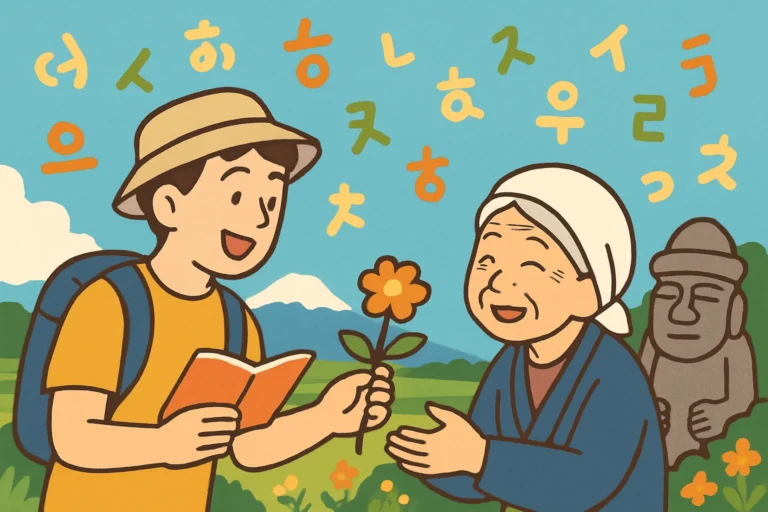
Revitalizing Voices: Discussing Language Preservation in Korean Tourism
Hello! Welcome back to [Maeil Hangeul], your go-to blog for upgrading your Korean proficiency!
Today, we’re diving into a topic that’s both intellectually stimulating and incredibly important: sustainable tourism and its role in preserving cultural heritage. Specifically, we’ll learn how to discuss the preservation of indigenous or local languages in Korean. This is perfect for when you want to engage in deeper conversations about culture, society, and policy.
Lately in Korea, there’s a growing movement towards “공정 관광” (fair tourism) and protecting unique local cultures. This goes beyond just visiting historical sites; it’s about safeguarding living, breathing heritage. A prime example is the effort to protect the beautiful Jeju dialect (제주어). So, let’s learn the advanced vocabulary you’ll need to join this meaningful conversation!
Core Expressions for In-Depth Discussion
Here are some sophisticated expressions that will allow you to articulate your thoughts on this topic like a native speaker.
1. -는 데에 기여하다 (to contribute to…)
- Korean Expression: 관광 산업이 토착 언어 보존에 기여할 수 있습니다.
- Pronunciation [Romanization]: Gwangwang saneobi tochak eoneo bojone giyeohal su itseumnida.
- English Meaning: The tourism industry can contribute to the preservation of indigenous languages.
- Detailed Explanation: This is a formal and impactful way to say “to contribute to.” The verb 기여하다 (giyeohada) carries a strong, positive nuance of making a meaningful and valuable contribution to a significant cause. It’s a staple in academic papers, news reports, and formal presentations. While you could use the simpler verb 돕다 (dopda, to help), using 기여하다 elevates your language and shows a deeper understanding of the subject’s importance.
- 💡 Pronunciation Tip:
In 보존에 [bojone], notice the smooth connection. The final consonant ‘ㄴ’ (n) of ‘보존’ links directly to the vowel ‘에’ (e) in a process called 연음 (yeon-eum) or liaison. Instead of a pause (bojon-e), it flows naturally as [bo-jo-ne]. This is fundamental to sounding fluent in Korean.
2. 상생 (相生) (Symbiosis / Mutually Beneficial Relationship)
- Korean Expression: 문화 관광과 언어 보존은 상생 관계를 구축해야 합니다.
- Pronunciation [Romanization]: Munhwa gwangwanggwa eoneo bojoneun sangsaeng gwangyereul guchukaeya hamnida.
- English Meaning: Cultural tourism and language preservation must build a symbiotic relationship.
- Detailed Explanation: 상생 (sangsaeng) is a profound concept derived from Hanja (Chinese characters): 相 (sang – mutual) and 生 (saeng – life). It goes beyond a simple “win-win” situation. It implies a deep, sustainable, and mutually beneficial coexistence where two or more entities thrive together over the long term. It’s a key term in Korean discourse on the economy, society, and the environment.
- 💡 Pronunciation Tip:
When pronouncing Hanja-based words like 상생 [sangsaeng], clarity is key. Ensure you pronounce both syllables with equal weight. There’s no complex rule here, but listening to and mimicking the crisp pronunciation of news anchors can help you master the formal tone associated with such words.
3. 인식 제고 (Raising Awareness)
- Korean Expression: 토착 언어의 가치에 대한 사회적 인식 제고가 시급합니다.
- Pronunciation [Romanization]: Tochak eoneoui gachie daehan sahoejeok insik jegoga sigeupamnida.
- English Meaning: Raising social awareness about the value of indigenous languages is urgent.
- Detailed Explanation: This is a set phrase you’ll frequently encounter in formal contexts. 인식 (insik) means “awareness” or “perception,” and 제고 (jego) means “to raise” or “to enhance.” Together, 인식 제고 is the go-to professional term for “awareness campaign” or “consciousness-raising.” Using this phrase instead of a simpler alternative like ‘사람들에게 알리는 것’ (letting people know) demonstrates a high level of linguistic sophistication.
- 💡 Pronunciation Tip:
In 시급합니다 [sigeupamnida], the final consonant ‘ㅂ’ (p) in ‘시급’ comes before the consonant ‘ㄴ’ (n) in ‘합니다’. Due to 비음화 (bi-eumhwa) or nasalization, the ‘ㅂ’ sound changes to an ‘ㅁ’ (m) sound for easier pronunciation. So, instead of trying to say sigeup-hamnida, your mouth will naturally produce the smoother [si-geu-pam-ni-da].
4. 지속가능성을 담보하다 (To Secure/Guarantee Sustainability)
- Korean Expression: 경제적 이익뿐만 아니라 문화적 지속가능성을 담보하는 정책이 필요합니다.
- Pronunciation [Romanization]: Gyeongjejeok iikppunman anira munhwajeok jisokganeungseongeul dambohaneun jeongchaegi piryohamnida.
- English Meaning: We need policies that secure not only economic benefits but also cultural sustainability.
- Detailed Explanation: 지속가능성 (jisokganeungseong) is the direct Korean equivalent of “sustainability.” The verb 담보하다 (dambohada) originally means “to use as collateral,” but in this context, it takes on the powerful meaning of “to guarantee” or “to secure.” Pairing it with ‘지속가능성’ creates a very strong and persuasive statement, emphasizing a commitment to ensuring a positive future outcome.
- 💡 Pronunciation Tip:
In 정책이 [jeongchaegi], we see another example of liaison (연음). The final consonant ‘ㄱ’ (k) from ‘정책’ moves over to the next syllable, which starts with the vowel ‘ㅣ’ (i). This makes the pronunciation flow smoothly as [jeong-chae-gi] rather than a choppy [jeong-chaek / i].
Example Dialogue
Let’s see how these expressions work in a conversation between a policy advisor (A) and a cultural heritage expert (B).
A: 저희는 제주도의 고유한 문화를 중심으로 새로운 관광 사업을 기획하고 있습니다.
(We are planning a new tourism project centered on Jeju Island’s unique culture.)
B: 좋은 시도입니다. 그 사업이 진정으로 지역 유산 보존에 기여하려면, 제주어 활용 방안이 반드시 포함되어야 합니다.
(That’s a great initiative. For the project to truly contribute to preserving local heritage, it must include ways to utilize the Jeju dialect.)
A: 물론입니다. 저희는 관광의 성공이 언어 교육 지원으로 이어지는 상생 모델을 구상하고 있습니다.
(Of course. We are envisioning a symbiotic model where the success of tourism leads to support for language education.)
B: 그러기 위해서는 관광객과 지역 주민 모두에게 제주어의 가치에 대한 인식 제고가 선행되어야 합니다.
(To do that, raising awareness about the value of the Jeju dialect among both tourists and locals must come first.)
A: 동의합니다. 단기적 수익이 아닌, 문화적 지속가능성을 담보하는 선례를 만드는 것이 저희의 목표입니다.
(I agree. Our goal is to set a precedent that secures cultural sustainability, not just short-term profit.)
Culture Tip & Trend Deep Dive
The conversation about language preservation isn’t just academic; it’s happening right now in Korea!
The Jeju dialect (제주어), for example, is listed by UNESCO as a “critically endangered” language. In response, there has been a fantastic local movement. Many trendy cafes, independent shops, and local brands on Jeju Island actively use the dialect in their names, products, and marketing. Phrases like “혼저옵서예” (Honjeo-opseoye – Welcome) have become iconic. This is a perfect example of tourism creating a commercial and cultural incentive to keep a language alive.
Furthermore, popular media plays a huge role. The hit K-drama “Our Blues” (우리들의 블루스), set and filmed on Jeju Island, featured the dialect heavily. This brought the language’s unique beauty to a massive national and international audience, sparking curiosity and significantly contributing to 인식 제고 (raising awareness). When you use these expressions, you’re tapping into a very current and relevant cultural conversation in Korea!
Wrap-up & Practice
Today, we learned four powerful expressions to discuss cultural preservation and tourism:
* -는 데에 기여하다 (to contribute to)
* 상생 (symbiosis)
* 인식 제고 (raising awareness)
* 지속가능성을 담보하다 (to secure sustainability)
Now, it’s your turn to practice!
Practice Challenge: Imagine you are writing a proposal for a sustainable tourism project. Complete the following sentence using at least two of the expressions we learned today.
이 프로젝트는 지역 사회와 관광객의 ( ) 관계를 통해, 사라져가는 문화의 ( )을/를 목표로 합니다.
(This project aims to [goal] a vanishing culture through a [type of relationship] between the local community and tourists.)
Share your completed sentence or your own thoughts on this topic in the comments below. We’d love to see you put your advanced Korean skills to use
Frequently Asked Questions (FAQ)
Q: What does "기여하다" mean in Korean and how do you pronounce it?
A: In Korean, "기여하다" is pronounced [giyeohada] and means: carries a strong, positive nuance of making a meaningful and valuable contribution to a significant cause. It's a staple in academic papers, news reports, and formal presentations. While you could use the simpler verb 돕다 (dopda, to help), using 기여하다 elevates your language and shows a deeper understanding of the subject's importance.
Q: What does "보존에" mean in Korean and how do you pronounce it?
A: In Korean, "보존에" is pronounced [bojone] and means: , notice the smooth connection. The final consonant 'ㄴ' (n) of '보존' links directly to the vowel '에' (e) in a process called
Q: What does "상생" mean in Korean and how do you pronounce it?
A: In Korean, "상생" is pronounced [sangsaeng] and means: is a profound concept derived from Hanja (Chinese characters): 相 (sang - mutual) and 生 (saeng - life). It goes beyond a simple "win-win" situation. It implies a deep, sustainable, and mutually beneficial coexistence where two or more entities thrive together over the long term. It's a key term in Korean discourse on the economy, society, and the environment.
Q: What does "상생" mean in Korean and how do you pronounce it?
A: In Korean, "상생" is pronounced [sangsaeng] and means: , clarity is key. Ensure you pronounce both syllables with equal weight. There's no complex rule here, but listening to and mimicking the crisp pronunciation of news anchors can help you master the formal tone associated with such words.







