

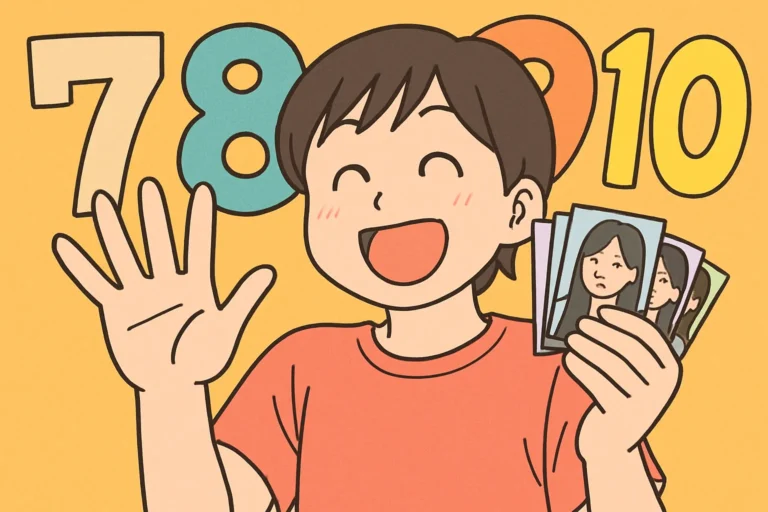
Count Like a K-Pop Idol: Master Korean Numbers 7-10!
Hello! Welcome to [Maeil Hangeul], here to upgrade your Korean skills!
Have you ever wanted to buy your favorite K-pop group’s albums or order just the right amount of delicious Korean fried chicken? To do that, you need to know how to count! Today, we’re going to master the native Korean numbers from seven to ten.
You might be wondering, “Why these numbers?” Well, 요즘 한국에서는 (yojeum hangugeseoneun – nowadays in Korea), numbers are everywhere, especially in K-pop! For instance, the global superstars BTS have seven members. By the end of this post, you’ll be able to count them like a true fan!
Let’s get started!
Core Expressions: Numbers 7-10
Here are the essential numbers for counting items, people, and more.
1. Seven: 일곱
- Pronunciation [Romanization]: ilgop
- English Meaning: Seven
- Detailed Explanation: This is the native Korean word for the number seven. You use it when counting physical objects. For example, “seven apples” is 사과 일곱 개 (sagwa ilgop gae).
- 💡 Pronunciation Tip:
The pronunciation is quite straightforward. The first syllable is ‘il’ (like the English word ‘ill’) and the second is ‘gop’ (like ‘go’ with a ‘p’ at the end). Just say them together: [ilgop].
2. Eight: 여덟
- Pronunciation [Romanization]: yeodeol
- English Meaning: Eight
- Detailed Explanation: This is how you say “eight” when counting. Be careful, its spelling can be tricky!
- 💡 Pronunciation Tip:
Look closely at the spelling: 여덟. It has two consonants, ‘ㄹ(l)’ and ‘ㅂ(b)’, at the end. This is called a ‘final consonant cluster’. When you say this word by itself, the second consonant ‘ㅂ(b)’ becomes silent! So, you don’t pronounce it as ‘yeodeolb’. Instead, you say [yeodeol]. It’s a rule called 자음군 단순화 (jaeumgun dansunhwa), or consonant cluster simplification. It makes pronunciation smoother!
3. Nine: 아홉
- Pronunciation [Romanization]: ahop
- English Meaning: Nine
- Detailed Explanation: The native Korean number for nine. You’re almost at ten! For example, “nine friends” is 친구 아홉 명 (chingu ahop myeong).
- 💡 Pronunciation Tip:
This one is also easy to pronounce as it’s written. The first syllable ‘아(a)’ is like the ‘a’ in “father.” The second syllable ‘홉(hop)’ sounds like the English word “hop.” Put them together: [ahop].
4. Ten: 열
- Pronunciation [Romanization]: yeol
- English Meaning: Ten
- Detailed Explanation: You made it to ten! This is a very common and useful number. “Ten fingers” is 손가락 열 개 (songarak yeol gae).
- 💡 Pronunciation Tip:
The pronunciation is simple: [yeol]. The ‘yeo’ sound is similar to the ‘yo’ in “yonder,” and you finish with a clear ‘l’ sound at the end.
Example Dialogue
Let’s see how these numbers are used in a real conversation at a K-pop store in Seoul!
- A: 와, 이 방탄소년단 포토카드 좀 봐! 너무 멋있다!
- (Wa, i Bangtansonyeondan potokadeu jom bwa! Neomu meositda!)
- Wow, look at these BTS photo cards! They’re so cool!
- B: 진짜네! 여기 정국 포토카드는 일곱 장 있고, 스티커는 열 장 들어있어.
- (Jinjjane! Yeogi Jungkook potokadeuneun ilgop jang itgo, seutikeoneun yeol jang deureoisseo.)
- For real! There are seven Jungkook photo cards here, and it comes with ten stickers.
- A: 그럼 저기 있는 앨범은 몇 개 남았어?
- (Geureom jeogi inneun aelbeomeun myeot gae namasseo?)
- Then how many of that album over there are left?
- B: 음… 여덟 개 남았네. 빨리 사자!
- (Eum… yeodeol gae namanne. Ppalli saja!)
- Umm… There are eight left. Let’s buy one quickly!
Culture Tip & Trend Deep Dive
In Korea, numbers are more than just for counting—they’re a huge part of fan culture!
- The Power of Seven (일곱): As we mentioned, BTS has 일곱 (ilgop) members. For their fans, ARMY, this number is incredibly special and symbolizes the complete group. When you see the number 7, you’ll often see fans associating it with BTS!
- The Silent ‘B’ in Eight (여덟): Knowing the silent ‘b’ pronunciation in 여덟 [yeodeol] is a small detail that will make you sound much more like a native speaker. It shows you understand the nuances of Korean pronunciation.
- Ten (열) means Passion!: The word 열 (yeol) not only means “ten” but is also the root for words like 열정 (yeoljeong), which means “passion,” and 열기 (yeolgi), which means “heat” or “excitement.” This perfectly describes the passionate energy of K-pop concerts and fans!
Wrap-up & Practice Time!
Great job! Today you learned how to count from 7 to 10 in Korean (일곱, 여덟, 아홉, 열) and discovered their connection to modern Korean culture. Now you’re ready to count your favorite idol’s photo cards or order food with confidence!
Let’s check what you’ve learned.
Practice Quiz:
1. Fill in the blank: I have nine cats. -> 저는 고양이가 ________ 마리 있어요.
2. How would you pronounce 여덟?
a) yeodeolb
b) yeodeol
Now it’s your turn! Try counting something around you right now. How many books are on your desk? How many pens do you have?
Leave a comment below using the Korean numbers we learned today! We’d love to see you practice.
Frequently Asked Questions (FAQ)
Q: What does "자음군 단순화" mean in Korean and how do you pronounce it?
A: In Korean, "자음군 단순화" is pronounced [jaeumgun dansunhwa] and means: , or consonant cluster simplification. It makes pronunciation smoother!
Q: What does "일곱" mean in Korean and how do you pronounce it?
A: In Korean, "일곱" is pronounced [ilgop] and means: members. For their fans, ARMY, this number is incredibly special and symbolizes the complete group. When you see the number 7, you'll often see fans associating it with BTS!
Q: What does "여덟" mean in Korean and how do you pronounce it?
A: In Korean, "여덟" is pronounced [yeodeol] and means: is a small detail that will make you sound much more like a native speaker. It shows you understand the nuances of Korean pronunciation.
Q: What does "열" mean in Korean and how do you pronounce it?
A: In Korean, "열" is pronounced [yeol] and means: not only means "ten" but is also the root for words like







