

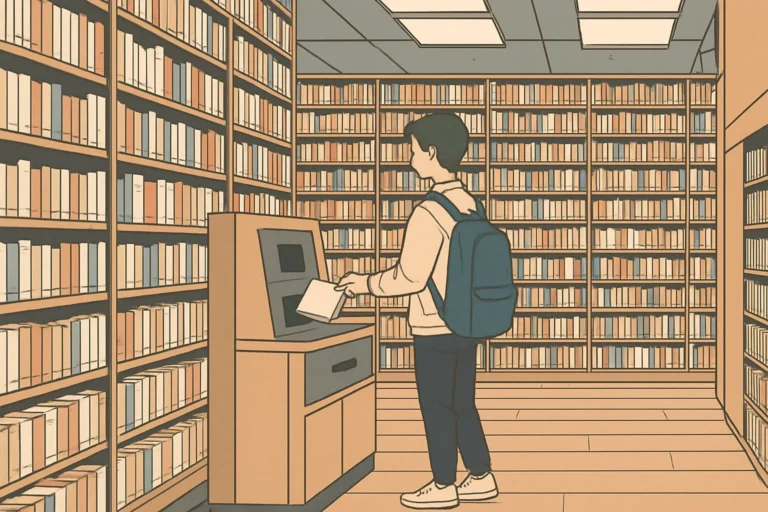
Late Fees? No Way! How to Return Books in Korea Like a Pro
Hello! It’s [Maeil Hangeul], here to upgrade your Korean skills!
Have you ever borrowed a book from a library in Korea? It’s a fantastic way to practice your reading! But what happens when it’s time to give it back? Don’t worry, today we’re going to learn all the essential phrases you need to return a book smoothly.
Lately in Korea, visiting beautiful, aesthetic libraries for a “book-cance” (북캉스 – a mix of “book” and the French word “vacance” for vacation) has become a huge trend on social media. So, after you’ve enjoyed your trendy reading time, let’s make sure you can return your books like a local!
Core Expressions You Need to Know
Here are three key phrases that will make your library trip a breeze.
1. 책을 반납하러 왔어요. (Chaegeul bannapareo wasseoyo.)
- English Meaning: I came to return a book.
- Detailed Explanation: This is the most direct and polite way to tell the librarian why you’re there. ‘책(chaek)’ means book, ‘반납하다(bannapada)’ means to return, and the grammar pattern ‘-(으)러 오다’ means “to come in order to do (something).” You can use this pattern for many situations, like “밥 먹으러 왔어요” (I came to eat).
- 💡 Pronunciation Tip:
Listen closely to the pronunciation of ‘반납하러’. It’s not [bannap-hareo], but [bannapareo]. Why? When a final consonant like ‘ㅂ(b)’ is followed by ‘ㅎ(h)’, they often merge into an aspirated (breathy) sound. So, ㅂ + ㅎ = ㅍ(p). It’s a cool shortcut that makes you sound much more natural!
2. 연체됐어요. (Yeonche-dwaesseoyo.)
- English Meaning: It’s overdue.
- Detailed Explanation: Oops! We all forget sometimes. ‘연체(yeonche)’ means overdue or late, and ‘됐어요(dwaesseoyo)’ is the past tense of ‘되다(doeda)’, meaning ‘to become’. You use this phrase to admit that your book is late. Don’t be scared to use it; the librarian will help you!
- 💡 Pronunciation Tip:
The syllable ‘됐’ can be tricky. It’s a contraction of ‘되었’. When you pronounce it, the final ‘ㅆ(ss)’ sound is a tense consonant. This means you should make the ‘s’ sound stronger and shorter than in English, with more tension in your tongue. Practice saying it with a little burst of air: [dwaess-eoyo].
3. 무인 반납기 (Mu-in bannapgi)
- English Meaning: Automated return machine
- Detailed Explanation: This is a lifesaver when the library is closed or you’re in a hurry! It’s a compound word: ‘무인(mu-in)’ means unmanned, ‘반납(bannap)’ means return, and ‘기(gi)’ means machine. You can ask, “무인 반납기 어디에 있어요?” (Where is the automated return machine?).
- 💡 Pronunciation Tip:
In ‘반납기’ [bannapgi], the last letter of ‘반납’ is ‘ㅂ(b)’. When a ‘ㅂ’ is at the end of a syllable (a ‘받침’), it’s pronounced like a soft, unreleased ‘p’ sound. You close your lips to make the sound, but you don’t release a puff of air like you would for the English letter ‘p’. This makes the transition to the next sound, ‘기(gi)’, much smoother.
Example Dialogue
Let’s see how these expressions work in a real conversation!
- A: 소희 씨, 어디 가요? (Sohui, where are you going?)
- B: 도서관에 가요. 책을 반납하러 왔어요. (I’m going to the library. I came to return a book.)
- A: 아, 그 책 다 읽었어요? 마감일 안 지났어요? (Oh, did you finish that book? Is it past the due date?)
- B: 네, 다행히 아직 괜찮아요. 어제까지였으면 연체됐어요. (Yeah, thankfully it’s still okay. If the due date was yesterday, it would have been overdue.)
- A: 다행이다! 사람이 많으면 저기 무인 반납기 이용하세요. 더 빨라요. (That’s a relief! If there’s a long line, use the automated return machine over there. It’s faster.)
- B: 좋은 생각이에요. 고마워요! (Great idea. Thanks!)
Culture Tip: The “Book-cance” (북캉스) Trend
As we mentioned, libraries in Korea are evolving. They aren’t just quiet places to study anymore. Famous libraries like the Starfield Library (별마당 도서관) at COEX Mall in Seoul are major tourist attractions and popular Instagram spots because of their stunning, floor-to-ceiling bookshelves.
Young Koreans enjoy going to these beautiful libraries or trendy book cafés for a “북캉스 (Book-cance)”. It’s a way to relax, read, take cool photos, and escape the summer heat or daily stress. So, when you’re using your new Korean phrases at a library, take a moment to look around. You might be standing in one of Korea’s hottest cultural spots! Knowing this trend will make your library visit even more special.
Let’s Review and Practice!
Great job today! We learned how to say you’re returning a book (책을 반납하러 왔어요), what to say if it’s late (연체됐어요), and the magic word for the automated machine (무인 반납기).
Now, it’s your turn to practice!
Quiz: Fill in the blank. You are in a hurry at the library and want to use the automated machine. You ask a staff member:
“저기요, ___________ 어디에 있어요?” (Excuse me, where is the ___________?)
What word goes in the blank?
Leave your answer and try making your own sentence with today’s expressions in the comments below. We’d love to see them! Happy learning
Frequently Asked Questions (FAQ)
Q: What does "'반납기'" mean in Korean and how do you pronounce it?
A: In Korean, "'반납기'" is pronounced [bannapgi] and means: , the last letter of '반납' is 'ㅂ(b)'. When a 'ㅂ' is at the end of a syllable (a '받침'), it's pronounced like a soft, unreleased 'p' sound. You close your lips to make the sound, but you don't release a puff of air like you would for the English letter 'p'. This makes the transition to the next sound, '기(gi)', much smoother.







