

Unlock Korean Pharma-Speak: Ace Your DSMB Meeting!
Hello! Welcome to Daily Korean, the place to upgrade your Korean skills to the next level!
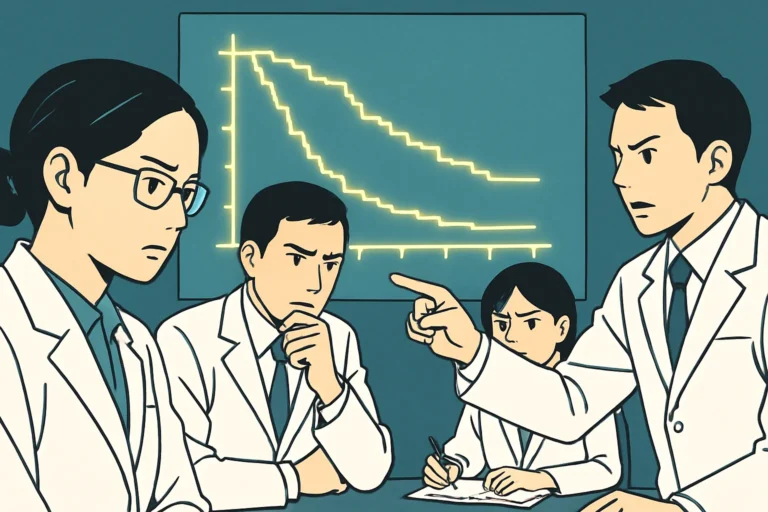
Are you working in the pharmaceutical, biotech, or clinical research industry? Ever imagined yourself participating in a high-stakes meeting where crucial decisions about a new drug are made? Today, we’re diving into a very specific but incredibly valuable scenario: a Data Safety Monitoring Board (DSMB) meeting.
These days, the Korean bio-pharma industry (often called ‘K-바이오’) is a global powerhouse. As Korean companies expand their reach, understanding the professional language of clinical trials is more important than ever. This post will equip you with the essential terminology to confidently navigate a DSMB meeting and sound like a seasoned professional. Let’s get started!
Core Expressions for Your DSMB Toolkit
Here are four key phrases you absolutely need to know.
1. 중간 분석 (Junggan bunseok)
- Pronunciation [Romanization]: [Jung-gan bun-seok]
- English Meaning: Interim Analysis
- Detailed Explanation: This isn’t just a ‘middle check-in’.
중간 분석is a formal, pre-planned analysis of data conducted before a clinical trial has been completed. The DSMB reviews this analysis to determine if the trial should continue as planned, be modified, or stopped early due to safety concerns or overwhelming efficacy. This term is standard in all official reports and discussions. - 💡 Pronunciation Tip: In the word
중간[jung-gan], the first syllable ends with the ‘ㅇ’ [ng] sound, which is made at the back of your throat. For분석[bun-seok], make sure the ‘ㅅ’ [s] sound is clean and not too airy. It’s a crisp sound, like the ‘s’ in “see.”
2. 유효성 및 안전성 (Yuhyoseong mit anjeonseong)
- Pronunciation [Romanization]: [Yu-hyo-seong mit an-jeon-seong]
- English Meaning: Efficacy and safety
- Detailed Explanation: These are the two pillars of any clinical trial.
유효성refers to the drug’s effectiveness—does it work?안전성refers to its safety profile—what are the side effects and risks? The connector및[mit] is the formal equivalent of ‘and’ (그리고), used primarily in written documents and formal presentations. Using및instantly makes your language sound more professional and academic. - 💡 Pronunciation Tip: The final consonant in
및is ‘ㅌ’ (t), but when it’s at the end of a word or syllable, it’s an “unreleased” stop. This means you place your tongue in the ‘t’ position but don’t release the puff of air. It sounds like a sudden stop, not the ‘t’ in the English word “mitt.” This is called 음절의 끝소리 규칙 (the rule of syllable-final consonants).
3. 임상 지속을 권고하다 (Imsang jisogeul gwongohada)
- Pronunciation [Romanization]: [Im-sang ji-so-geul gwon-go-ha-da]
- English Meaning: To recommend the continuation of the trial
- Detailed Explanation: This is the phrase for a positive outcome from a DSMB review. Let’s break it down:
임상(clinical trial) +지속(continuation) +을(object particle) +권고하다(to recommend).권고하다is a formal verb that carries the weight of an official recommendation from an authoritative body like a committee. It’s much stronger and more appropriate in this context than a simple verb like추천하다(to recommend, more for general things like restaurants or books). - 💡 Pronunciation Tip: Notice how
지속을is pronounced [ji-so-geul]? The final consonant ‘ㄱ’ [g] from지속“links” to the empty vowel ‘ㅇ’ of the next syllable을. This sound-linking rule, called 연음 (liaison), is essential for making your Korean flow naturally. Instead of a choppy “ji-sok / eul,” it becomes a smooth “ji-so-geul.”
4. 중대한 이상반응 (Jungdaehan isangbaneung)
- Pronunciation [Romanization]: [Jung-dae-han i-sang-ba-neung]
- English Meaning: Serious Adverse Event (SAE)
- Detailed Explanation: This is a critical piece of regulatory terminology. An
이상반응is an “adverse event” or “adverse reaction.” The adjective중대한elevates it to “serious,” which has a specific definition in clinical trials (e.g., results in death, is life-threatening, requires hospitalization). Reporting and evaluating SAEs is a primary function of the DSMB. - 💡 Pronunciation Tip: In fast, natural speech, you might hear
이상반응pronounced closer to [isang-maneung]. This is due to a phenomenon called 비음화 (nasalization), where the ‘ㅂ’ [b] sound is influenced by the preceding nasal ‘ㅇ’ [ng] sound and changes to a ‘ㅁ’ [m] sound. While the standard pronunciation is [isang-baneung], recognizing this change will greatly improve your listening comprehension.
Example Dialogue: Inside the DSMB Meeting
Let’s see how these expressions come to life in a mock meeting.
- A (Chairperson): 이번 중간 분석 결과를 바탕으로 위원회의 검토 의견을 말씀해 주십시오.
- (Based on the results of this interim analysis, please provide the committee’s review opinion.)
- B (Committee Member): 데이터를 면밀히 검토한 결과, 시험약의 유효성 및 안전성 프로파일이 매우 양호한 것으로 판단됩니다. 현재까지 보고된 중대한 이상반응은 없었습니다.
- (After a thorough review of the data, we’ve concluded that the investigational drug’s efficacy and safety profile is very favorable. There have been no Serious Adverse Events reported to date.)
- A (Chairperson): 알겠습니다. 그렇다면 위원회의 공식적인 결정은 무엇입니까?
- (Understood. Then, what is the committee’s official decision?)
- B (Committee Member): 저희는 만장일치로 본 임상 시험의 지속을 권고합니다.
- (We unanimously recommend the continuation of this clinical trial.)
Culture Tip & K-Bio Trend Deep Dive
The Korean pharmaceutical industry is not just growing; it’s a leader in biosimilars and cell and gene therapies. Companies like Samsung Biologics and Celltrion are major global players. This means that these professional Korean terms are no longer confined to Korea—they are part of international business and research collaborations.
When you participate in these professional settings, remember that precision is key. Using the correct, formal terminology like 중대한 이상반응 instead of a simpler description shows your expertise and respect for the field. Furthermore, Korean corporate and academic culture values formality. Always use appropriate honorifics (-시-) and formal sentence endings (-ㅂ니다/-습니다) when addressing the committee or senior members. Mastering this professional language will not only demonstrate your Korean skills but also your cultural competence.
Let’s Review and Practice!
Great job today! We’ve covered some highly specialized but crucial vocabulary for anyone in the life sciences field. We learned about:
* 중간 분석 (interim analysis)
* 유효성 및 안전성 (efficacy and safety)
* 임상 지속을 권고하다 (to recommend the continuation of the trial)
* 중대한 이상반응 (Serious Adverse Event)
Now, it’s your turn to practice!
- Fill in the blank: The committee reviewed the data and made an official recommendation.
위원회는 데이터를 검토한 후, ___________ . (They recommend the continuation of the clinical trial.) -
Scenario: Your colleague asks you to summarize the two most important factors the DSMB looks at. How would you answer formally in one phrase?
Leave your answers in the comments below using the expressions we learned today! We can’t wait to see you put your new pharma-speak to use.
Frequently Asked Questions (FAQ)
Q: What does "연음" mean in Korean and how do you pronounce it?
A: In Korean, "연음" is pronounced [liaison] and means: , is essential for making your Korean flow naturally. Instead of a choppy "ji-sok / eul," it becomes a smooth "ji-so-geul."
Q: What does "비음화" mean in Korean and how do you pronounce it?
A: In Korean, "비음화" is pronounced [nasalization] and means: , where the 'ㅂ' [b] sound is influenced by the preceding nasal 'ㅇ' [ng] sound and changes to a 'ㅁ' [m] sound. While the standard pronunciation is [isang-baneung], recognizing this change will greatly improve your listening comprehension.







