

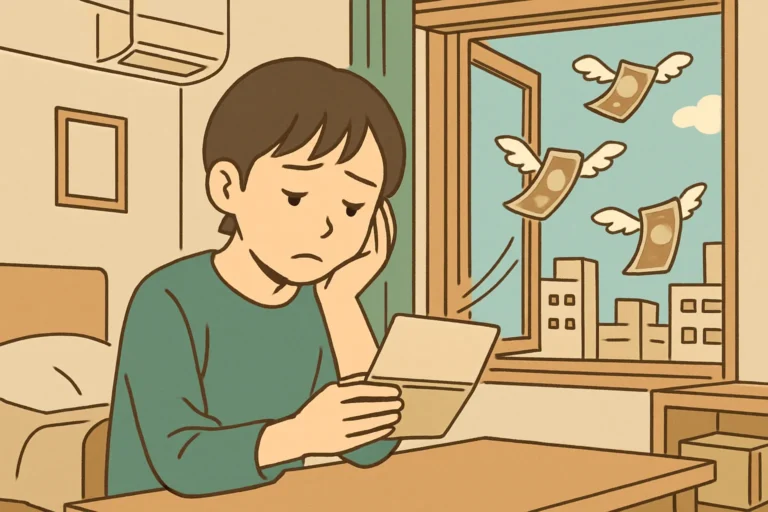
Seoul Prices Stressing You Out? Vent in Perfect Korean!
Hello! This is Maeil Hangeul (매일한글), here to upgrade your Korean skills!
Have you ever looked at your bank account after paying rent in a big city and let out a big sigh? You’re not alone! Today, we’re going to learn how to express the stress and frustration of the high cost of living, a topic that’s very real for many people.
These days in Korea, especially in Seoul, young people often talk about the challenge of rising prices. Learning these expressions will not only make your Korean sound more natural but also help you connect with the real-life conversations happening all around you. Let’s dive in!
Core Expressions You Need to Know
Here are three key phrases to complain about money like a native speaker!
1. 숨만 쉬어도 돈이 나가다 (summan swieodo doni nagada)
- Pronunciation [Romanization]: sum-man swi-eo-do don-i na-ga-da
- English Meaning: “Money goes out just by breathing.”
- Detailed Explanation: This is a fantastic idiomatic expression that perfectly captures the feeling that basic existence is expensive. You use it when you feel like you’re spending money constantly, even when you’re not buying anything special. It’s a very common and relatable complaint among friends.
-
💡 Pronunciation Tip:
The word 쉬어도 (swieodo) can be tricky. It’s a combination of 쉬다 (swida – to rest/breathe) and the grammar particle -어도 (eodo – even if). The ‘eo’ sound (어) is like the ‘o’ in “song” but with unrounded lips. Practice making that sound to sound more natural!
2. 월급이 통장을 스쳐 지나간다 (wolgeubi tongjangeul seuchyeo jinaganda)
- Pronunciation [Romanization]: wol-geu-bi tong-jang-eul seu-chyeo ji-na-gan-da
- English Meaning: “My salary just passes (brushes) by my bank account.”
-
Detailed Explanation: This vivid phrase paints a picture of your hard-earned salary arriving in your bank account (통장) only to disappear immediately to pay for bills, rent, and credit card debt. It’s a slightly dramatic and funny way to say your paycheck doesn’t last long. The verb 스치다 (seuchida) means “to graze” or “to brush past,” emphasizing how briefly the money stays.
-
💡 Pronunciation Tip:
In 월급이 (wolgeubi), the final consonant ‘ㅂ’ (b) from 월급 moves over to the next syllable, which starts with the vowel ‘ㅣ’ (i). This is a liaison rule called 연음 (yeoneum). So, instead of “wol-geup-i,” it’s pronounced smoothly as [wolgeubi]. It makes your speech flow much better!
3. 물가가 장난 아니다 (mulgaga jangnan anida)
- Pronunciation [Romanization]: mul-ga-ga jang-nan a-ni-da
- English Meaning: “The prices are no joke.” / “The cost of living is insane.”
-
Detailed Explanation: 물가 (mulga) means “prices” or “cost of living,” and 장난 아니다 (jangnan anida) literally means “is not a joke.” You can use this phrase to react to almost any high price – a cup of coffee, a movie ticket, or groceries. It’s a versatile and common expression of shock or complaint.
-
💡 Pronunciation Tip:
The word 장난 (jangnan) has two ‘n’ sounds. Make sure to pronounce them both distinctly. In the second part, 아니다 (anida), the consonant ‘ㄷ’ (d) is between two vowels. In this position, it sounds much softer, almost like the ‘d’ in the English word “water.” It’s not a hard “t” sound.
Example Dialogue
Let’s see how these expressions work in a real conversation between two friends, Mina and Jinwoo, living in Seoul.
A (Mina): 와, 이 동네 카페는 아메리카노 한 잔에 6,000원이네… 물가가 장난 아니야.
Wa, i dongne kapeneun amerikano han jane yuk-cheon-won-ine… mulgaga jangnan aniya.
(Wow, a cup of americano at this neighborhood cafe is 6,000 won… The prices are no joke.)
B (Jinwoo): 맞아. 곧 월세 낼 날인데 벌써 걱정돼. 내 월급은 맨날 통장을 스쳐 지나가는 것 같아.
Maja. got wolsae nael narinde beolsseo geokjeongdwae. nae wolgeubeun maennal tongjangeul seuchyeo jinaganeun geot gata.
(I know. Rent is due soon and I’m already worried. It feels like my salary just passes through my bank account every month.)
A (Mina): 정말. 서울에서는 진짜 숨만 쉬어도 돈이 나가는 기분이야.
Jeongmal. Seoureseoneun jinjja summan swieodo doni naganeun gibuniya.
(Seriously. In Seoul, it really feels like money goes out just by breathing.)
Culture Tip & Trend Deep Dive
In Korea, conversations about the high cost of living are a huge part of daily life, especially for the Z-generation. You’ll see these expressions constantly in webtoons, on social media as memes, or in K-dramas depicting the struggles of young professionals.
For example, the phrase “월급이 통장을 스쳐 지나간다” is often accompanied by a funny image of a salary “ghost” flying through a bankbook. It’s a humorous way to cope with financial stress.
This trend is also fueling a renewed interest in life outside the big city. The dream of 귀촌 (gwichon), or returning to the countryside for a slower, more affordable life, is a hot topic among those tired of the urban rat race. So, if you use these expressions with your Korean friends, you’re not just speaking the language—you’re tapping into a major cultural conversation!
Let’s Practice!
Ready to test your knowledge?
- Your friend just told you that their monthly rent is over 1 million won. What would be a natural reaction?
- A) 정말 싸네요! (That’s really cheap!)
- B) 와, 물가가 장난 아니네요! (Wow, the cost of living is no joke!)
- Fill in the blank:
Payday was yesterday, but after paying all my bills, my wallet is already empty. It feels like ____________________.
(Hint: “money goes out just by breathing”)
Great job today! You’ve learned some incredibly useful and natural-sounding Korean expressions.
Try making your own sentence in the comments using one of today’s phrases! We’d love to see them. See you next time at Maeil Hangeul
Frequently Asked Questions (FAQ)
Q: What does "쉬어도" mean in Korean and how do you pronounce it?
A: In Korean, "쉬어도" is pronounced [swieodo] and means: can be tricky. It's a combination of
Q: What does "쉬다" mean in Korean and how do you pronounce it?
A: In Korean, "쉬다" is pronounced [swida - to rest/breathe] and means: and the grammar particle
Q: What does "-어도" mean in Korean and how do you pronounce it?
A: In Korean, "-어도" is pronounced [eodo - even if] and means: . The 'eo' sound (어) is like the 'o' in "song" but with unrounded lips. Practice making that sound to sound more natural!
Q: What does "스치다" mean in Korean and how do you pronounce it?
A: In Korean, "스치다" is pronounced [seuchida] and means: means "to graze" or "to brush past," emphasizing how briefly the money stays.







