

Korea’s ‘Wise Quarantine Life’: How to Plan a Safe Hangout
Hello! Welcome to [Maeil Hangeul], your go-to blog for upgrading your Korean skills!
Are you eager to meet up with friends in Korea but also want to be safe and considerate? Planning social events during a time of public health concern requires a new set of vocabulary and etiquette. Today, we’re going to learn how to do just that! Lately in Korea, while things are more open, the concept of ‘슬기로운 방역 생활’ (Wise Quarantine Life) is still very important. People are finding creative and safe ways to connect. Let’s learn the essential Korean expressions you need to plan a safe and fun gathering like a local!
Core Expressions for Safe Socializing
Here are three key expressions that will help you navigate social planning with care and confidence.
1. 방역 수칙을 준수하다 (Bangyeok suchigeul junsuhada)
- English Meaning: To comply with quarantine/disease control regulations.
- Detailed Explanation: This is a somewhat formal but crucial phrase you’ll hear in public announcements and news reports. Using it in conversation shows a high level of awareness and social responsibility.
방역 수칙(bangyeok suchik) means “quarantine rules,” and준수하다(junsuhada) is a verb meaning “to comply with” or “to observe.” When you suggest a plan and add, “우리 방역 수칙은 꼭 준수하자,” it means, “Let’s make sure we follow the safety rules.” It shows you’re a considerate person (배려심이 깊은 사람). - 💡 Pronunciation Tip:
The pronunciation of수칙을is a great example of liaison (연음 법칙). The final consonant of a syllable, in this case,ㄱ(k) in칙(chik), moves over to the empty vowel spot of the next syllable,을(eul). So, instead of pronouncing it assuchik-eulwith a pause, it flows together smoothly as [수치글, suchigeul]. This makes your Korean sound much more natural and fluid!
2. 오붓하게 (Obutage)
- English Meaning: Cozily; privately; intimately (among a small group).
- Detailed Explanation: This adverb beautifully captures the feeling of a small, private, and cozy gathering. It’s the perfect word for planning a get-together that avoids large crowds. You wouldn’t use
오붓하게for a big party, but it’s ideal for a quiet dinner at home with a few close friends, a chat at a secluded café, or a private movie night. It implies warmth, closeness, and privacy. For example: “이번 주말에는 밖에서 보지 말고 우리 집에서 오붓하게 보자.” (This weekend, instead of going out, let’s meet cozily at my place.) - 💡 Pronunciation Tip:
This word showcases aspiration (거센소리되기). When the final consonantㅅ(which is pronounced asㄷ[t] in the final position, so오붓->[오붇]) is followed byㅎ(h), they merge to create an aspirated sound. Here,ㄷ(d/t) +ㅎ(h) =ㅌ(t). Therefore,오붓하게is not pronouncedobut-hagebut rather [오부타게, obutage]. It’s a stronger, puff-of-air sound!
3. -(으)ㄹ까 봐 걱정이다 (-(eu)lkka bwa geokjeongida)
- English Meaning: I’m worried that… / I’m concerned that… might happen.
- Detailed Explanation: This is an essential grammar pattern for expressing concern or anxiety about a potential negative situation. It’s incredibly useful when planning events amidst uncertainty. You attach it to a verb stem to show what you’re worried about. It’s more nuanced than simply saying “I’m worried” because it specifies the potential event causing the worry.
- Verb stem ending in a vowel or
ㄹ: +-ㄹ까 봐 걱정이다(e.g.,사람이 많을까 봐 걱정이다– I’m worried there will be too many people.) - Verb stem ending in a consonant: +
-을까 봐 걱정이다(e.g.,음식이 부족할까 봐 걱정이다– I’m worried there won’t be enough food.)
- Verb stem ending in a vowel or
- 💡 Pronunciation Tip:
Notice the tensification (경음화) in-ㄹ까 봐. When the grammar pattern-ㄹ까is used, theㄱsound that followsㄹbecomes the tense soundㄲ(kk). So,갈까 봐(galkka bwa) is pronounced [갈까 봐, galkka bwa], not[gal-ga bwa]. This is a very common rule in Korean that makes your speech sound more authentic.
Example Dialogue
Let’s see how these expressions work in a real conversation between two friends, Ji-hoon and Chloe, planning to watch the finale of a hit K-drama, “왕국의 눈물 (Tears of the Kingdom).”
A: 지훈 (Ji-hoon): 클로이, 이번 주에 ‘왕국의 눈물’ 마지막 회인데 같이 볼까?
Chloe, the finale of ‘Tears of the Kingdom’ is this week. Shall we watch it together?
B: 클로이 (Chloe): 좋아! 그런데 요즘 다시 확진자가 늘어서 시내에 나가기는 좀… 사람이 너무 많을까 봐 걱정이야.
Sounds great! But the number of cases is rising again, so I’m a bit… I’m worried there might be too many people downtown.
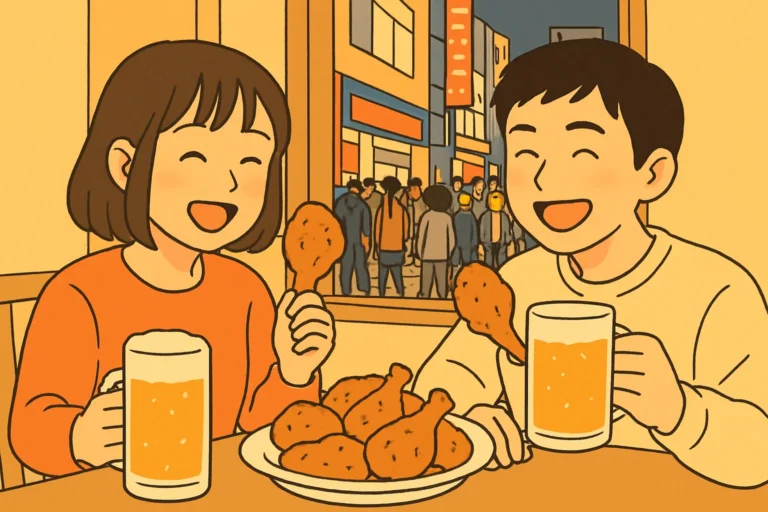
A: 지훈 (Ji-hoon): 맞아. 그럼 우리 집에서 오붓하게 치맥 하면서 보는 건 어때? 다른 사람 없이 우리끼리만.
You’re right. Then how about we watch it cozily at my place with some chicken and beer? Just the two of us, no one else.
B: 클로이 (Chloe): 그거 좋은 생각이다! 대신 손 소독 잘하고, 환기도 자주 시키고, 우리 방역 수칙을 잘 준수하자.
That’s a fantastic idea! But let’s make sure to sanitize our hands, ventilate the room often, and properly comply with the public health rules.
A: 지훈 (Ji-hoon): 물론이지! 그럼 토요일 저녁에 우리 집에서 보자!
Of course! See you at my place on Saturday evening then!
Culture Tip & Trend Deep Dive
In Korea, the principle of 배려 (baeryeo) – consideration for others – is a cornerstone of social etiquette. During the pandemic, this was deeply reflected in public behavior. Following 방역 수칙 wasn’t just seen as a legal requirement, but as a social duty to protect the community, especially the vulnerable.
This has shifted social trends. While large gatherings (회식) are returning, many people, especially the younger generation, have grown to prefer the 오붓한 gatherings mentioned above. The forced period of 집콕 (jipkok – staying cooped up at home) made people rediscover the joy of small, intimate get-togethers. So, when you suggest a safe, private meeting, you’re not just being cautious—you’re also aligning with a modern Korean social trend that values quality time over large, impersonal events. Using these phrases shows you’re not only fluent in Korean but also culturally aware.
Let’s Practice!
Time to check your understanding!
- Fill in the Blank: You want to go to a concert, but you’re worried it might be cancelled. How would you say, “I’m worried the concert might be cancelled”?
- 콘서트가 ______ __ ______.
- Sentence Building: Imagine you are texting a friend to plan a birthday celebration. Write one or two sentences suggesting a small, cozy party at a quiet restaurant, emphasizing that you should follow safety rules. Try to use
오붓하게and방역 수칙을 준수하다.
Great job today! You’ve learned some incredibly relevant and useful expressions for navigating social life in Korea. Now you can plan gatherings with both confidence and consideration.
Try using one of today’s expressions in the comments below!
Frequently Asked Questions (FAQ)
Q: What does "'슬기로운 방역 생활'" mean in Korean and how do you pronounce it?
A: In Korean, "'슬기로운 방역 생활'" is pronounced [Wise Quarantine Life] and means: is still very important. People are finding creative and safe ways to connect. Let's learn the essential Korean expressions you need to plan a safe and fun gathering like a local!
Q: What does "A: 지훈" mean in Korean and how do you pronounce it?
A: In Korean, "A: 지훈" is pronounced [Ji-hoon] and means: 클로이, 이번 주에 '왕국의 눈물' 마지막 회인데 같이 볼까?
Q: What does "B: 클로이" mean in Korean and how do you pronounce it?
A: In Korean, "B: 클로이" is pronounced [Chloe] and means: 좋아! 그런데 요즘 다시 확진자가 늘어서 시내에 나가기는 좀... 사람이 너무
Q: What does "A: 지훈" mean in Korean and how do you pronounce it?
A: In Korean, "A: 지훈" is pronounced [Ji-hoon] and means: 맞아. 그럼 우리 집에서







