

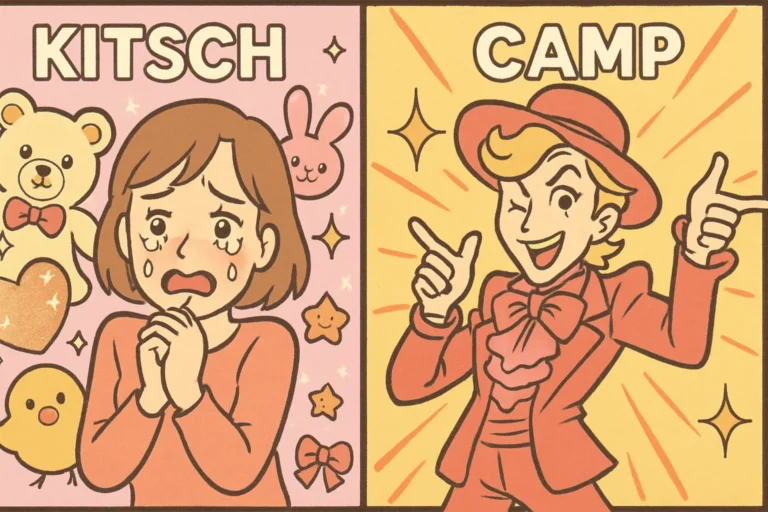
Kitsch vs. Camp: Your Guide to Korea’s “So Bad It’s Good” Aesthetic
Hello! Welcome to Maeil Hangeul, the place to upgrade your Korean skills and cultural fluency!
Ever looked at a K-pop music video, a trendy café, or a fashion item and thought, “That’s so over-the-top… but I love it”? You might be looking at something Kitsch (키치) or Camp (캠프). But what’s the difference? Lately in Korea, with the rise of “Newtro” (뉴트로) and Y2K fashion, these aesthetic concepts are everywhere. Understanding them will not only boost your Korean vocabulary but also give you a much deeper appreciation for the art and trends shaping modern Korea. Let’s dive in!
Core Expressions You Need to Know
Here are the key terms to help you navigate the world of Korean aesthetics like a pro.
1. 키치하다 (Kichi-hada)
- Pronunciation [Romanization]: Kichi-hada
- English Meaning: To be kitsch / kitschy.
- Detailed Explanation: This term describes art, objects, or styles that are considered to be in poor taste because they are overly sentimental, garish, or commercially mass-produced. Think of cute, glittery souvenirs or overly emotional drama scenes. While often viewed negatively, Kitsch can sometimes be appreciated ironically. It’s an adjective formed by adding -하다 to the noun 키치.
- 💡 Pronunciation Tip: The first character ‘키’ is an aspirated ‘k’ sound. Imagine a strong puff of air coming out as you say it, more like the ‘k’ in “key” than the ‘c’ in “scan.”
2. 캠프하다 (Kaempeu-hada)
- Pronunciation [Romanization]: Kaempeu-hada
- English Meaning: To be camp / campy.
- Detailed Explanation: Camp is the intentional love of the exaggerated, the unnatural, and the theatrical. It’s a self-aware aesthetic that says, “This is artificial and over-the-top, and that’s what makes it brilliant.” While Kitsch is often sincere in its sentimentality, Camp is ironic and performative. It’s “so bad, it’s good” on purpose.
- 💡 Pronunciation Tip: The vowel ㅐ (ae) sounds like the ‘a’ in “apple” or “cat.” It’s a bright, open sound.
3. 촌스럽다 (Chonsseureopda)
- Pronunciation [Romanization]: Chonsseureopda
- English Meaning: To be unfashionable, tacky, countrified.
- Detailed Explanation: Literally meaning “village-like” (촌 means village), this is a crucial word for discussing both Kitsch and Camp. It can be used negatively to call something outdated or unsophisticated. However, in the context of Newtro or Camp aesthetics, being 촌스럽다 can be a deliberate and cool style choice.
- 💡 Pronunciation Tip: The consonant cluster ‘ㅂㅅ’ in 스럽다 can be tricky. Here, the ‘ㅅ’ becomes a tensed sound, similar to ‘ㅆ’ (ss). So, instead of “seureop-da,” the pronunciation is closer to [촌쓰럽따 (chonsseureoptta)]. This consonant tensing (된소리되기) is very common in Korean and makes your speech sound much more natural.
4. 과장되다 (Gwajangdoeda)
- Pronunciation [Romanization]: Gwajangdoeda
- English Meaning: To be exaggerated, overblown.
- Detailed Explanation: This is the heart of the Camp aesthetic. It describes something that goes beyond normal limits in a dramatic way. When you say a concept is 과장되다, you’re pointing out its theatrical and larger-than-life quality, which is a hallmark of Camp.
- 💡 Pronunciation Tip: The syllable ‘과’ (gwa) is a combination of ‘ㄱ’ (g) and the vowel ‘ㅘ’ (wa). Practice making a “w” sound immediately after the “g.”
Example Dialogue
Let’s see how these words are used in a real conversation. Two friends, A and B, are discussing a new café in Seoul’s trendy Euljiro district.
A: 이 카페 인테리어 봤어? 80년대 다방 느낌인데, 색깔이 정말 화려하다.
(I kapae interieo bwasseo? Palsimnyeondae dabang neukkiminde, saekkari jeongmal hwaryeohada.)
(Have you seen this café’s interior? It has an 80s coffee house vibe, but the colors are so flashy.)
B: 응, 어떤 사람들은 너무 촌스럽다고 할 수도 있겠어. 근데 난 이게 의도된 캠프 컨셉이라서 좋아.
(Eung, eotteon saramdeureun neomu chonsseureopdago hal sudo itgesseo. Geunde nan ige uido-doen kaempeu keonsebiraseo joa.)
(Yeah, some people might say it’s too tacky. But I like it because it’s an intentional Camp concept.)
A: 맞아. 그냥 감상에 젖은 키치한 복고풍이랑은 달라. 모든 소품이 일부러 과장된 느낌이잖아.
(Maja. Geunyang gamsang-e jeojeun kichihan bokgopung-irang-eun dalla. Modeun sopumi ilbureo gwajangdoen neukkimijana.)
(Exactly. It’s different from just a sentimental, kitschy retro style. You can tell every prop is intentionally exaggerated.)
B: 그래서 더 재밌는 것 같아. 사진 찍기에도 좋고!
(Geuraeseo deo jaeminneun geot gata. Sajin jjiggiedo joko!)
(That’s what makes it more fun. And it’s great for taking pictures!)
Culture Tip & Trend Deep Dive
So, how can you spot the difference in the wild?
- Kitsch in Korea: Think of the cute, mass-produced character phone grips sold in Myeongdong, or the overly dramatic slow-motion rain scene in an old K-drama. The intention is sincere (to be cute, to be romantic), but the result can feel a bit cheesy or cliché.
- Camp in Korea: Look no further than K-pop! Groups like SHINee in their “Married to the Music” video or Orange Caramel‘s entire discography are perfect examples of Camp. The concepts are highly theatrical, the fashion is fabulously 과장되다, and there’s a playful, self-aware irony to it all. The current “Newtro” trend, which reinterprets old, sometimes 촌스럽다 styles in a modern way, often leans heavily into a Camp aesthetic. The key is the winking self-awareness.
Understanding this difference allows you to move beyond simply saying “I like it” or “it’s weird.” You can now analyze the artistic intention behind it. Is this K-pop concept sincerely trying to be cool, or is it playfully performing a “tacky” version of cool? The answer separates the Kitsch from the Camp.
Let’s Review & Practice!
To sum up: Kitsch is often unintentionally tacky and sentimental, while Camp is intentionally theatrical and exaggerated.
Now, it’s your turn to test your knowledge!
- Fill-in-the-blank:
You see an old-fashioned floral-print sofa that is so out of style it’s actually fashionable again in a retro café. You might say:
“이 소파는 좀 ________ 보이지만, 그래서 오히려 매력 있어.”
(This sofa looks a bit __________, but that’s what makes it charming.) -
Your Turn!
Think of a K-pop group, a drama, or a fashion trend that you think is either 키치하다 or 캠프하다. Describe it in a short Korean sentence!
Leave your answers and your own examples in the comments below! We can’t wait to see what you come up with.
Frequently Asked Questions (FAQ)
Q: What does "'과'" mean in Korean and how do you pronounce it?
A: In Korean, "'과'" is pronounced [gwa] and means: is a combination of 'ㄱ' (g) and the vowel 'ㅘ' (wa). Practice making a "w" sound immediately after the "g."






