

Unlock Superhost Status: Korean Secrets for a Killer Airbnb Profile! 🏡✨
Hello! This is Daily Hangul (매일한글), here to upgrade your Korean skills!
Are you thinking about hosting on Airbnb in Korea, or do you just want to sound more persuasive and professional in your writing? Today, we’re diving into the language of the sharing economy, a massive trend in Korea. We’ll learn how to write a captivating Airbnb profile that will make guests want to book immediately.
Lately in Korea, the concept of “한 달 살기” (living for a month) in a new city has become incredibly popular, especially among the younger generation. This means the competition among hosts on platforms like Airbnb is fierce! A well-written profile isn’t just a description; it’s a marketing tool. Let’s learn the key phrases to make your listing stand out!
Core Expressions for Your Profile ✍️
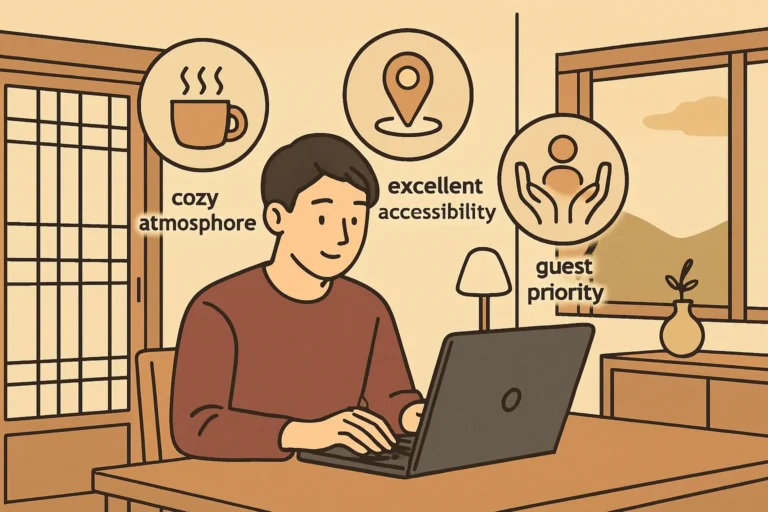
Here are three essential phrases that blend professionalism with warm hospitality, perfect for attracting guests.
1. 아늑하고 편안한 분위기를 자랑합니다 (Aneuk-hago pyeonan-han bunwigi-reul jarang-hamnida)
- Pronunciation [Romanization]: Aneuk-hago pyeon-an-han bun-wi-gi-reul jarang-ham-ni-da
- English Meaning: It boasts a cozy and comfortable atmosphere.
- Detailed Explanation: This is a much more sophisticated way of saying “the atmosphere is good” (분위기가 좋아요). The word 아늑하다 means cozy or snug, perfect for describing a welcoming space. 자랑하다 literally means “to boast” or “to be proud of.” In a profile, it’s a confident and appealing way to highlight your property’s best features without sounding arrogant. It implies that this cozy atmosphere is a key selling point you’re proud to offer.
- 💡 Pronunciation Tip:
In 편안한 (pyeonan-han), the ‘ㅎ’ (h) sound at the beginning of 한 is very weak and often disappears when it follows a consonant like ‘ㄴ’ (n). So, instead of a distinct “pyeon-an-han,” it sounds more like a smooth [pyeonanan]. This linking of sounds is very common and will make you sound much more natural.
2. 뛰어난 접근성을 갖추고 있습니다 (Ttwieonan jeopgeunseong-eul gatchugo itseumnida)
- Pronunciation [Romanization]: Ttwi-eo-nan jeop-geun-seong-eul gat-chu-go it-seum-ni-da
- English Meaning: It is equipped with excellent accessibility.
- Detailed Explanation: This is a C1-level upgrade from “the location is good” (위치가 좋아요) or “transportation is convenient” (교통이 편리해요). 접근성 (jeopgeunseong) means “accessibility,” a key term in real estate and business. 뛰어나다 means “to be outstanding” or “excellent.” 갖추고 있습니다 means “is equipped with,” giving a formal and well-prepared impression. Using this phrase shows you understand what travelers value and can communicate it professionally.
- 💡 Pronunciation Tip:
The word 접근성 is a great example of consonant assimilation. It’s written as ‘jeop-geun-seong’, but the pronunciation is [접끈썽 / jeopkkeunsseong]. The ‘ㄱ’ (g) in ‘근’ becomes a tense ‘ㄲ’ (kk) sound due to the preceding ‘ㅂ’ (p) sound, and the ‘ㅅ’ (s) in ‘성’ becomes a tense ‘ㅆ’ (ss) sound after ‘ㄴ’ (n). Mastering these tension rules is a hallmark of an advanced speaker!
3. 게스트의 편의를 최우선으로 생각합니다 (Geseuteu-ui pyeonui-reul choeuseon-euro saenggak-hamnida)
- Pronunciation [Romanization]: Geseuteu-ui pyeon-ui-reul choe-u-seon-eu-ro saeng-gak-ham-ni-da
- English Meaning: We consider our guests’ convenience our top priority.
- Detailed Explanation: This single sentence powerfully conveys your commitment as a host. 편의 (pyeonui) means “convenience,” and 최우선 (choeuseon) means “top priority.” This phrase is common in Korean service industries and immediately builds trust. It tells potential guests that you are a thoughtful and dedicated host who will take good care of them. It’s the perfect way to show your hospitality ethos.
- 💡 Pronunciation Tip:
The possessive particle 의 (ui) has a few different pronunciations depending on its position. Here, in 게스트의 (geseuteu-ui), it’s pronounced as [에/e] in everyday speech, making it sound like [게스트에 / geseuteu-e]. While [ui] is technically correct, using [e] will make you sound more like a native speaker in conversation.
Example Dialogue: Booking a Place 💬
Let’s see how these phrases look from a guest’s perspective.
A: I’m looking for a place to stay in Hongdae for a month. This one looks good.
(홍대에서 한 달 살기 할 숙소 찾고 있는데, 여기 괜찮아 보인다.)
B: Oh, what does the host’s description say?
(오, 호스트 소개에 뭐라고 쓰여있어?)
A: It says, “아늑하고 편안한 분위기를 자랑합니다.” The pictures look really cozy, too. And for the location, it says, “지하철역과 가까워 뛰어난 접근성을 갖추고 있습니다.”
( “아늑하고 편안한 분위기를 자랑합니다“라고 쓰여있어. 사진도 정말 포근해 보여. 그리고 위치는 “지하철역과 가까워 뛰어난 접근성을 갖추고 있습니다“래.)
B: Wow, sounds perfect. A host who uses that kind of language must be professional.
(와, 완벽한데? 저런 표현을 쓰는 걸 보니 호스트가 전문적인 것 같아.)
A: I agree! And listen to this last part: “게스트의 편의를 최우선으로 생각합니다.” I feel taken care of already. Let’s book it!
(맞아! 그리고 마지막에 “게스트의 편의를 최우선으로 생각합니다“라고 쓰여있어. 벌써부터 케어받는 느낌이야. 여기로 예약하자!)
Culture Tip & Trend Deep Dive 🇰🇷
In Korea, especially when marketing to the MZ Generation (Millennials + Gen Z), it’s all about “감성” (gamseong). This word means “sensibility” or “aesthetic,” but it’s more about the overall vibe and feeling a place or product gives you.
Your Airbnb profile isn’t just a list of amenities; it’s a story that sells a “감성.” Using phrases like 아늑하고 편안한 분위기 helps build this story. You’re not just offering a bed; you’re offering a cozy, aesthetically pleasing experience. This is why many popular Korean listings on platforms like Airbnb or the interior design app “오늘의 집” (Today’s House) use beautiful, almost poetic language alongside high-quality photos. They are selling a lifestyle, not just a space. By using the advanced and caring language we learned today, you show that you understand this cultural nuance and can provide that special “감성” experience.
Wrap-up & Practice!
Today, we learned how to elevate a simple room description into a professional and enticing Airbnb profile. By moving beyond basic adjectives and using sophisticated terms like 자랑하다, 접근성, and 최우선, you can build trust and attract more guests.
Now, it’s your turn to practice!
- Fill in the Blank: My place is located right downtown, with cafes, restaurants, and shops all nearby. It has _______. (Hint: A word meaning “excellent accessibility”)
- Make a Sentence: Imagine you are a host. Using “~을/를 최우선으로 생각합니다,” write a sentence declaring what your top priority is for your guests (e.g., cleanliness, safety, communication).
I’d love to see your answers! Leave a comment below with your practice sentences. Good luck, and happy hosting
Frequently Asked Questions (FAQ)
Q: What does "편안한" mean in Korean and how do you pronounce it?
A: In Korean, "편안한" is pronounced [pyeonan-han] and means: , the 'ㅎ' (h) sound at the beginning of 한 is very weak and often disappears when it follows a consonant like 'ㄴ' (n). So, instead of a distinct "pyeon-an-han," it sounds more like a smooth
Q: What does "편의" mean in Korean and how do you pronounce it?
A: In Korean, "편의" is pronounced [pyeonui] and means: means "convenience," and
Q: What does "최우선" mean in Korean and how do you pronounce it?
A: In Korean, "최우선" is pronounced [choeuseon] and means: means "top priority." This phrase is common in Korean service industries and immediately builds trust. It tells potential guests that you are a thoughtful and dedicated host who will take good care of them. It's the perfect way to show your hospitality ethos.
Q: What does "의" mean in Korean and how do you pronounce it?
A: In Korean, "의" is pronounced [ui] and means: has a few different pronunciations depending on its position. Here, in







