

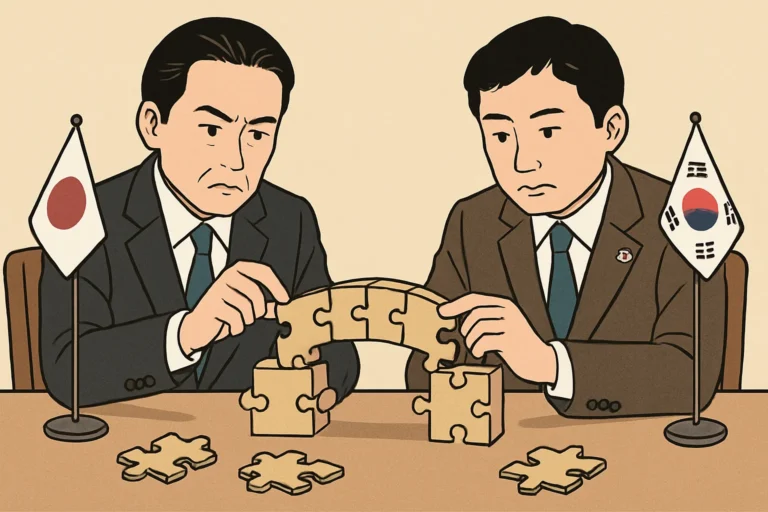
Mastering Diplomatic Korean: Sealing the Deal
Hello! Welcome back to [Maeil Hangeul], your go-to source for upgrading your Korean skills!
Today, we’re stepping into the high-stakes world of international relations. Have you ever wondered how diplomats and officials communicate when hammering out a treaty? We’re going to learn the precise, formal language used to initiate a bilateral treaty negotiation. This is C1-level Korean that will make you sound incredibly polished and professional.
In today’s interconnected world, where Korea is a key player in global trade and politics, understanding this vocabulary is essential for anyone interested in international affairs, business, or law. Let’s learn how to open the door to dialogue like a seasoned diplomat!
Core Diplomatic Expressions
Here are some essential phrases you absolutely need to know when kicking off formal negotiations.
1. 상호 관심사 (sangho gwansimsa)
- Pronunciation [Romanization]: Sangho gwansimsa
- English Meaning: Matters of mutual interest / Mutual concerns
- Detailed Explanation: This is a cornerstone phrase in diplomacy. It’s a formal, Hanja-based term (相互 關心事) used to establish a cooperative and positive tone from the very beginning. By framing the discussion around “mutual interests,” you signal that the negotiation is not a zero-sum game but a collaborative effort for shared benefit. It’s the perfect way to set the stage for a productive dialogue.
- 💡 Pronunciation Tip:
The pronunciation here is quite straightforward, which is common for many formal Hanja words. However, pay attention to the syllable breaks: [상-호 관-심-사, sang-ho gwan-sim-sa]. Unlike some words where sounds blend together, in formal speech, enunciating each syllable clearly adds to the gravity and clarity of your statement.
2. 협상의제를 조율하다 (hyeopsang uijereul joyulhada)
- Pronunciation [Romanization]: Hyeopsang uijereul joyulhada
- English Meaning: To coordinate/fine-tune the negotiation agenda
- Detailed Explanation: Let’s break this down: 협상 (hyeopsang) means ‘negotiation,’ 의제 (uije) means ‘agenda,’ and 조율하다 (joyulhada) means ‘to tune’ or ‘coordinate.’ The verb ‘조율하다’ is very nuanced. It’s the same word used for tuning a musical instrument, so it implies a careful, detailed process of adjustment to create harmony and agreement between both parties. It’s much more sophisticated than simply ‘정하다’ (to decide).
- 💡 Pronunciation Tip:
The vowel ‘의’ in 의제 [uije] can be tricky. Its standard pronunciation is a diphthong [ɰi]. However, when it comes after a consonant, it’s often pronounced simply as [i]. So, in natural, fluid speech, you’ll hear [협쌍 이제를 조율하다, hyeopssang ijereul joyulhada]. This is an example of consonant assimilation (ㅅ -> ㅆ) and vowel simplification, making your speech sound more native.
3. 양자 간 현안 (yangja gan hyeon-an)
- Pronunciation [Romanization]: Yangja gan hyeon-an
- English Meaning: Pending bilateral issues / Bilateral pending issues
- Detailed Explanation: This is another key term derived from Hanja (兩者 間 懸案). 양자 (yangja) means ‘both parties,’ 간 (gan) means ‘between,’ and 현안 (hyeon-an) refers to a ‘pending issue’ or a problem that needs to be solved. This phrase is used to formally address the specific, often challenging, topics that are on the table for discussion.
- 💡 Pronunciation Tip:
This phrase is a great example of nasalization. When you say 현안 (hyeon-an) followed by a word starting with a vowel, like the object marker 을 (eul), the final ‘ㄴ’ sound carries over. For example, 현안을 논의하다 (hyeonaneul nonuihada) is pronounced [혀나늘 노늬하다, hyeonaneul nonuihada]. The ‘ㅇ’ in ‘의’ becomes silent after a consonant, and the ‘ㄴ’ sound from the preceding syllable links to it, a process called 연음 (yeon-eum) or liaison.
4. 실무급 회담을 개최하다 (silmugeup hoedameul gaechoehada)
- Pronunciation [Romanization]: Silmugeup hoedameul gaechoehada
- English Meaning: To hold a working-level meeting/talks
- Detailed Explanation: This phrase describes the practical first step in many negotiations. 실무 (silmu) means ‘practical affairs’ or ‘working-level,’ -급 (geup) means ‘level/class,’ 회담 (hoedam) means ‘talks,’ and 개최하다 (gaechoehada) means ‘to hold or host’ an event. These are the meetings where experts and officials hash out the details before the leaders (at a 정상회담, jeongsang hoedam, or summit) meet.
- 💡 Pronunciation Tip:
Pay close attention to the aspirated sounds in 개최하다 [gae-choe-ha-da]. The ‘ㅊ (ch)’ and ‘ㅎ (h)’ sounds require a distinct puff of air. If you pronounce them softly like ‘ㅈ (j)’ or ‘ㅇ’ (silent ‘h’), the meaning can be lost. Practice saying “CHOE” and “HA” with force to master the correct aspiration.
Example Dialogue
Let’s see how these expressions work in a conversation between Diplomat A (Korea) and Diplomat B (Partner Country).
A: 양국 간의 상호 관심사를 바탕으로 새로운 자유무역협정(FTA) 체결을 논의할 시점이라고 생각합니다.
(A: I believe it is time to discuss signing a new Free Trade Agreement (FTA) based on the matters of mutual interest between our two countries.)
B: 전적으로 동의합니다. 우선, 구체적인 협상의제를 조율하기 위해 실무급 회담을 개최하는 것이 어떻겠습니까?
(B: I completely agree. First, how about we hold a working-level meeting to coordinate the specific negotiation agenda?)
A: 좋은 생각입니다. 해결해야 할 양자 간 현안들이 있으니, 실무선에서부터 차근차근 풀어가는 것이 효율적이겠군요.
(A: That’s an excellent idea. As there are several pending bilateral issues to resolve, it would be efficient to address them step-by-step, starting from the working level.)
B: 그럼 다음 주 중으로 저희 측 실무진 명단을 공식 서한으로 전달해 드리겠습니다.
(B: In that case, we will deliver the list of our working-level staff via an official letter sometime next week.)
Culture Tip & Trend Analysis
In Korean diplomatic and business culture, the concept of 명분 (myeongbun)—a just cause or legitimate reason—is incredibly important. Using phrases like “상호 관심사 (matters of mutual interest)” is not just polite; it’s a strategic move to build myeongbun. It frames the negotiation as a logical, mutually beneficial endeavor, making it easier for both sides to agree and justify the outcome to their respective governments and public.
If you watch the 9 o’clock news on KBS or read articles on Naver about Korea’s diplomatic activities, you will see these exact phrases used constantly. For instance, when reporting on negotiations over supply chains or security alliances, journalists will report that “양측은 실무급 회담을 열어 양자 간 현안을 조율했다” (The two sides opened working-level talks and coordinated on pending bilateral issues). Mastering this vocabulary is your key to understanding Korean media at a professional level.
Wrap-up & Practice
Fantastic work today! You’ve just learned four key expressions that are essential for high-level diplomatic and professional communication in Korean.
Now, let’s test your knowledge!
- Fill in the blank:
To prepare for the presidential summit, the two countries decided to first ___________ to discuss the details.
(정상회담을 준비하기 위해, 양국은 세부 사항을 논의하고자 우선 ___________기로 결정했다.) -
Sentence Building:
Using the words “양자 간 현안” and “논의하다” (to discuss), write a formal sentence proposing a discussion on pending issues.
You’ve taken a huge step in mastering sophisticated Korean. Now, try to impress us! Leave a comment below describing a recent international event using one of the phrases you learned today!
Frequently Asked Questions (FAQ)
Q: What does "협상" mean in Korean and how do you pronounce it?
A: In Korean, "협상" is pronounced [hyeopsang] and means: means 'negotiation,'
Q: What does "의제" mean in Korean and how do you pronounce it?
A: In Korean, "의제" is pronounced [uije] and means: means 'agenda,' and
Q: What does "조율하다" mean in Korean and how do you pronounce it?
A: In Korean, "조율하다" is pronounced [joyulhada] and means: means 'to tune' or 'coordinate.' The verb '조율하다' is very nuanced. It's the same word used for tuning a musical instrument, so it implies a careful, detailed process of adjustment to create harmony and agreement between both parties. It's much more sophisticated than simply '정하다' (to decide).
Q: What does "의제" mean in Korean and how do you pronounce it?
A: In Korean, "의제" is pronounced [uije] and means: can be tricky. Its standard pronunciation is a diphthong







