

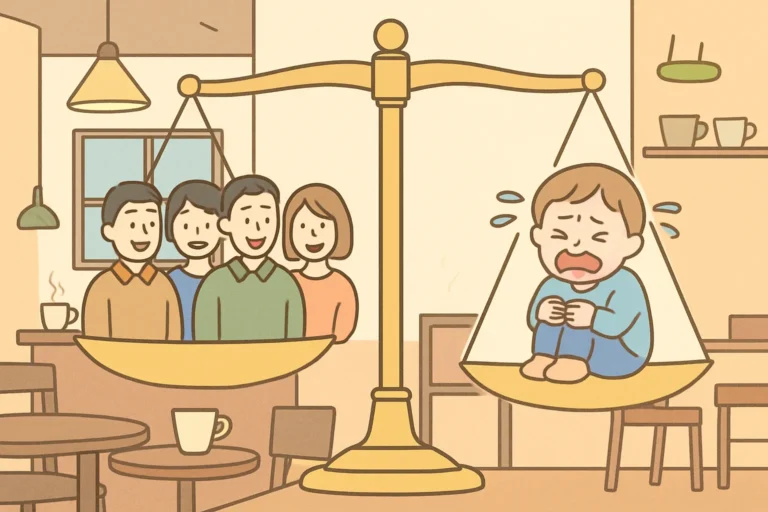
Debating Policy: The Greatest Happiness for the Majority
Introduction
Hello! This is [Daily Hangul], here to upgrade your Korean skills to the next level!
Today, we are diving into a high-level topic suitable for advanced learners: Philosophical Argumentation and Critical Thinking. Specifically, we will learn how to evaluate social policies from the perspective of Utilitarianism (공리주의).
You might wonder, “Why do I need to know philosophy in Korean?” Well, recently in Korea, debates regarding “No Kids Zones” (business establishments that ban children) or the regulation of AI technology have become very heated. To participate in these discussions—whether in a university seminar, a professional meeting, or a serious online forum—you need to go beyond simple opinions and use logical, structured arguments.
Let’s explore how to discuss “The Greatest Happiness for the Greatest Number” in natural, sophisticated Korean!
Key Expressions
Here are 4 high-level expressions to help you argue logically about social policies.
1. 최대 다수의 최대 행복 (Choedae dasu-ui choedae haengbok)
- English: The greatest happiness of the greatest number
- Detailed Explanation: This is the core slogan of Utilitarianism (Jeremy Bentham). In a policy debate, you use this phrase when arguing that a decision should be made based on what benefits the most people, even if a minority might be inconvenienced. It is a very formal and academic phrase used in political or social discussions.
- 💡 Pronunciation Tip:
- [Choe-dae da-su-e choe-dae haeng-bok]
- The particle ‘의’ is officially pronounced [ui], but in spoken Korean, when it indicates possession, it is often pronounced as [e]. So, [da-su-e] sounds more natural than [da-su-ui].
2. 실효성 (Silhyoseong)
- English: Effectiveness / Feasibility / Utility
- Detailed Explanation: This word refers to whether a policy or law actually works in reality, rather than just in theory. You often use it in phrases like “실효성이 있다/없다” (It is effective/ineffective) or “실효성을 검토하다” (To examine the feasibility). It is crucial when criticizing a policy that looks good on paper but fails in practice.
- 💡 Pronunciation Tip:
- [Sil-lyo-seong]
- This is an example of Lateralization (유음화). When the patchim ‘ㄹ(l)’ meets ‘ㅎ(h)’, or when ‘ㄴ’ meets ‘ㄹ’, the sound often flows into a double ‘l’ sound or the ‘h’ becomes silent/weak. Here, ‘실효’ flows smoothly as [sillyo].
3. 공공의 이익 (Gong-gong-ui i-ik)
- English: Public interest / Common good
- Detailed Explanation: This refers to the benefit or well-being of the public as a whole. In debates, this is often pitted against Sa-ik (사익 – private interest). You might argue, “We must prioritize the public interest over individual inconvenience.”
- 💡 Pronunciation Tip:
- [Gong-gong-e i-ik]
- Again, ‘의’ is pronounced as [e]. Also, note the Liaison (연음) rule in ‘이익’. If you say it fast, the patchim ‘ㅇ’ from the previous word might make it sound connected, but try to articulate ‘i-ik’ clearly to emphasize the meaning.
4. 양날의 검 (Yangnal-ui geom)
- English: A double-edged sword
- Detailed Explanation: This idiom describes a situation or policy that has both favorable and unfavorable consequences. It is perfect for showing critical thinking skills. For example, “Strict regulation is a double-edged sword; it ensures safety but may hinder innovation.”
- 💡 Pronunciation Tip:
- [Yang-na-re geom]
- Liaison (연음): The patchim ‘ㄹ’ in ‘날’ moves over to replace the empty consonant place in ‘의’. So ‘날의’ sounds like [나레 (na-re)].
Example Dialogue
Here is a debate between two colleagues, Min-jun and So-yeon, discussing the recent issue of “No Kids Zones” in cafes.
- Min-jun: 이번에 도입된 ‘노키즈존’ 확산 현상에 대해 어떻게 생각하세요? 저는 찬성하는 편입니다.
(What do you think about the recent spread of ‘No Kids Zones’? I tend to agree with it.) - So-yeon: 글쎄요. 업주의 자유도 중요하지만, 특정 대상을 배제하는 건 차별이 아닐까요?
(Well. The owner’s freedom is important, but isn’t excluding a specific group a form of discrimination?) - Min-jun: 공리주의 관점에서 보면, 조용한 분위기를 원하는 다수 손님의 만족도가 높아진다면 최대 다수의 최대 행복에 부합한다고 볼 수 있죠.
(From a utilitarian perspective, if the satisfaction of the majority of customers who want a quiet atmosphere increases, it aligns with the greatest happiness of the greatest number.) - So-yeon: 하지만 장기적으로 보면 그런 배제가 사회적 갈등을 유발해서 공공의 이익을 해칠 수도 있어요. 결국 양날의 검이 될 겁니다.
(But in the long run, such exclusion could cause social conflict and harm the public interest. Eventually, it will become a double-edged sword.) - Min-jun: 일리 있는 말씀입니다. 정책의 실효성을 따져보려면 조금 더 지켜봐야겠네요.
(That’s a valid point. We’ll have to watch a bit longer to weigh the effectiveness of the policy.)
Culture Tip & Trend Analysis: The “No Kids Zone” Debate
In Korea, the concept of “No Kids Zones” (cafes or restaurants banning children under a certain age) has been a massive social trend and a subject of heated debate over the last few years.
- Why is this trending?
As Korean society shifts towards valuing personal rest and individual rights (known as Warabel or Work-Life Balance), many adults seek quiet spaces to relax without disturbance. Supporters argue that business owners have the freedom to choose their customers and that other customers have the “right to not be disturbed.” - The Connection to Today’s Lesson:
This is a classic clash between Utilitarianism (optimizing the environment for the majority of adult customers) and Universal Rights (not discriminating against children and parents). - Advanced Insight:
Recently, the National Human Rights Commission of Korea recommended that banning all children is discriminatory. However, polls often show that a significant portion of the public supports these zones. Using the expression “사회적 합의 (Social Consensus)” along with today’s vocabulary will make you sound like a native intellectual discussing this complex issue!
Conclusion & Practice
Today, we tackled a challenging topic: Philosophical Argumentation regarding Social Policy. We learned how to use terms like “최대 다수의 최대 행복” and “실효성” to build logical arguments.
Remember, mastering these C2-level expressions allows you to participate in the real conversations happening in Korea right now!
📝 Practice Quiz
Fill in the blanks with the expressions we learned today!
- This policy has pros and cons; it is truly a ( _______ ).
- We need to analyze whether this new law actually works in reality, checking its ( _______ ).
(Answers: 1. 양날의 검, 2. 실효성)
Leave a comment below using one of today’s expressions to describe a policy in your country! See you next time!







