

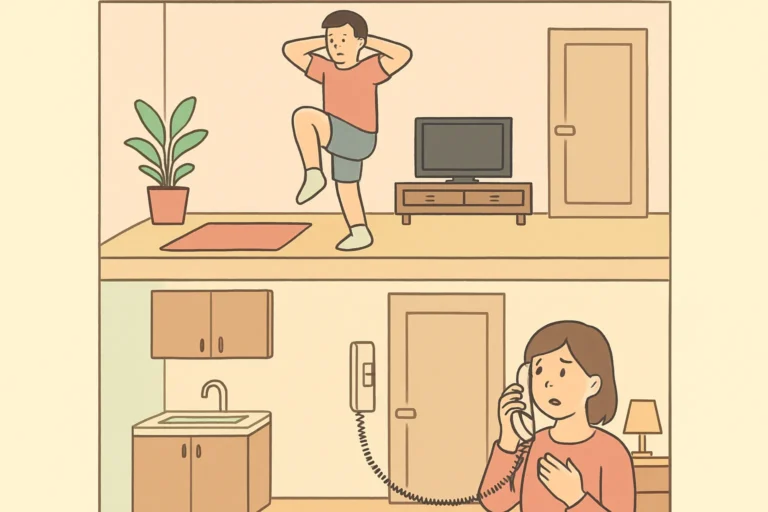
Solving Noise Issues: Polite Korean Phrases for Peace!
Introduction
Hello! It’s [Daily Korean], here to upgrade your Korean skills to the next level! 👋
Today, we are going to tackle a slightly tricky but very important situation: Handling Noise Complaints (Laws and Rules).
Did you know that over 50% of Koreans live in apartments? Because we live so close to each other, “Inter-floor noise” has become a huge social issue in Korea lately. From late-night laundry to home workouts, noise can cause serious disputes! 🏢💥
Knowing how to express your discomfort politely yet firmly is a crucial skill for living in Korea. Let’s learn how to handle this delicate situation like a local!
Key Expressions
Here are 3 essential expressions to help you address noise problems politely.
1. 층간 소음 (Inter-floor noise)
- Pronunciation: [Cheung-gan so-eum]
- English Meaning: Noise between floors (Noise from upstairs/downstairs neighbors)
- Detail: This is the official legal and social term for noise issues in apartment buildings. It combines ‘Floor’ (층) and ‘Between’ (간) with ‘Noise’ (소음). You will hear this word often on the news.
- 💡 Pronunciation Tip:
- In 소음 (so-eum), pronounce each syllable clearly. Be careful not to blend them too much like “sum.” It is so-eum.
- Also, when ‘ㄴ’ (n) meets ‘ㅅ’ (s) in 간 소 (gan-so), the ‘ㅅ’ often sounds slightly tenser, almost like ‘쏘’ (sso), making it sound like [Cheung-gan sso-eum] to native ears.
2. 쿵쿵거리는 소리 (Thumping sound)
- Pronunciation: [Kung-kung-geo-ri-neun so-ri]
- English Meaning: Thumping/Stomping sound
- Detail: ‘쿵쿵’ (Kung-kung) is an onomatopoeia for heavy footsteps or heavy objects dropping. Adding ‘-거리는’ turns it into an adjective describing the sound. It’s very useful to describe exactly what kind of noise is bothering you.
- 💡 Pronunciation Tip:
- Linking Sound (Liaison): When you say the verb form ‘쿵쿵거려요’ (It is thumping), the vowels flow together.
- Let’s look at a similar rule. If you say 발소리 (footstep sound), it is written as bal-so-ri but pronounced as [bal-sso-ri]. This is called ‘Tensification’ (Doen-sori Dwe-gi). The soft ‘s’ becomes a strong ‘ss’ after the ‘l’ sound!
3. 조금만 주의해 주세요 (Please be a little careful)
- Pronunciation: [Jo-geum-man ju-ui-hae ju-se-yo]
- English Meaning: Please be a little careful / Please mind the noise.
- Detail: This is a polite request. Instead of saying “Be quiet!” (조용히 해!), asking someone to “be careful” (주의하다) is much softer and more respectful. It is perfect for maintaining good relationships with neighbors.
- 💡 Pronunciation Tip:
- The tricky ‘의’ (ui): The vowel ‘의’ is often difficult. However, in spoken Korean, when ‘의’ is not the first syllable of a word, it is often pronounced as [이] (i) for ease.
- So, 주의 (ju-ui) is naturally pronounced as [주이] (ju-i).
- Actual Pronunciation: [Jo-geum-man ju-i-hae ju-se-yo]. Try saying it this way—it flows much smoother!
Sample Dialogue
Let’s see how these expressions are used in real life. In Korea, it is safer to use the intercom (interphone) rather than meeting face-to-face.
(A lives in 301, B lives in 401)
- A (301): 여보세요? 윗집인데요. 혹시 지금 운동하고 계신가요?
(Hello? This is the downstairs neighbor. By any chance, are you exercising right now?) - B (401): 아, 네. 홈트레이닝 중이었어요. 시끄러우셨나요?
(Ah, yes. I was doing home training. Was it loud?) - A: 네, 쿵쿵거리는 소리가 너무 크게 들려서요. 밤에는 조금만 주의해 주세요.
(Yes, the thumping sound is too loud. Please be a little careful at night.) - B (401): 정말 죄송합니다. 바로 멈출게요!
(I am really sorry. I will stop right away!)
Culture Tip & Trend Analysis 🇰🇷
“The Rise of the ‘Slippers’ Culture!”
Because 층간 소음 (Inter-floor noise) is such a hot topic in Korea right now, a new etiquette trend has emerged.
- Direct Confrontation is No-No: Recently, going directly to a neighbor’s door to complain is considered rude and sometimes dangerous. It is trending to contact the Management Office (관리사무소) first and let them make the announcement.
- The “Sorry” Gift: If you know you will be noisy (e.g., moving furniture or having guests), it is very trendy and polite to hang a small bag with a note and some fruits or drinks on your neighbor’s doorknob before the noise starts.
- Noise-Canceling Slippers: Almost every Korean household now wears thick slippers indoors, not just for comfort, but to prevent ‘쿵쿵’ (thumping) sounds. If you live in a Korean apartment, buying a pair of these slippers is a sign of good manners! 🩴
Conclusion & Practice
Today we learned how to handle noise issues politely in Korean. Remember, living together requires consideration, and a polite request works better than an angry shout!
📝 Mini Quiz:
Fill in the blank with the correct expression we learned today.
Neighbor A: “Excuse me, the footsteps are too loud.”
Neighbor A: “__________ 좀 줄여 주시겠어요?” (Could you please lower the thumping sound?)
- 층간 소음
- 쿵쿵거리는 소리
- 주의
Answer: (Scroll down to check!)
.
.
.
2. 쿵쿵거리는 소리
Have you ever had a noisy neighbor? How did you handle it? Leave a comment below using today’s expressions!
See you in the next lesson! 👋
Frequently Asked Questions (FAQ)
Q: What does "소음" mean in Korean and how do you pronounce it?
A: In Korean, "소음" is pronounced [so-eum] and means: , pronounce each syllable clearly. Be careful not to blend them too much like "sum." It is
Q: What does "간 소" mean in Korean and how do you pronounce it?
A: In Korean, "간 소" is pronounced [gan-so] and means: , the 'ㅅ' often sounds slightly tenser, almost like '쏘' (sso), making it sound like
Q: What does "The tricky '의'" mean in Korean and how do you pronounce it?
A: In Korean, "The tricky '의'" is pronounced [ui] and means: The vowel '의' is often difficult. However, in spoken Korean, when '의' is not the first syllable of a word, it is often pronounced as
Q: What does "[이]" mean in Korean and how do you pronounce it?
A: In Korean, "[이]" is pronounced [i] and means: for ease.







