

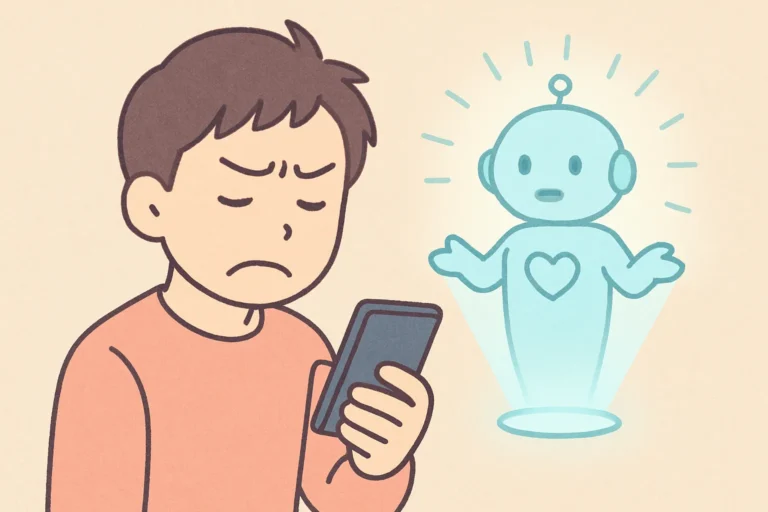
Chatting with AI: Useful Korean Phrases for the Digital Age
Introduction
Hello! This is [Daily Korean], here to upgrade your Korean skills to the next level! 👋
Today, we are diving into a very timely topic: The Future of Artificial Intelligence (AI). Specifically, we will look at how to describe interactions with AI Customer Service Chatbots.
Nowadays in Korea, whether you are ordering delivery, changing a flight ticket, or banking, you will almost certainly encounter an “AI Chatbot” (AI 챗봇) before you can speak to a human. While they are fast and convenient, they can sometimes be frustrating! Being able to express your thoughts on this technology is a perfect way to practice your B2-level Korean.
Let’s learn some essential expressions to navigate this digital trend! 🚀
Key Expressions
Here are 4 key expressions to help you discuss AI interactions like a native speaker.
1. 상담원 연결 (Connecting to an agent)
- Pronunciation: [Sangdamwon yeongyeol]
- English Meaning: Connecting to a (human) consultant/agent
- Detail: This is the phrase everyone looks for when the AI chatbot can’t solve their problem! ‘상담원’ means a consultant or agent, and ‘연결’ means connection. It is a neutral, formal noun phrase often seen on buttons in apps.
- 💡 Pronunciation Tip:
- When pronouncing 연결 (yeongyeol), the ‘ㄴ(n)’ in the first syllable flows into the next syllable. However, the tricky part is the ‘ㅕ(yeo)’ sound. Make sure not to pronounce it just as ‘yung’, but open your mouth slightly wider for the ‘yeo’ sound.
- Also, in 상담원 [Sangdamwon], the ‘ㅁ(m)’ flows into the ‘원(won)’. It sounds smooth like [Sang-da-mwon].
2. 인식이 잘 안 돼요 (It’s not recognized well)
- Pronunciation: [Insigi jal an dwaeyo]
- English Meaning: It’s not being recognized well / It doesn’t understand me.
- Detail: You use this when the AI chatbot (voice or text) fails to understand your input. ‘인식’ means recognition. This is a very common phrase when dealing with technology glitches.
- 💡 Pronunciation Tip:
- Look at 인식이 (insigi). The final consonant ‘ㄱ(k/g)’ of ‘식’ moves over to the empty ‘ㅇ’ place in the next syllable ‘이’.
- So, instead of ‘In-sik-i’, it is pronounced [In-si-gi]. This is called Liaison (연음 법칙). It makes your speech sound much more fluid!
3. 자동으로 처리되다 (To be processed automatically)
- Pronunciation: [Jadong-euro cheoridoeda]
- English Meaning: To be processed automatically
- Detail: This describes the main function of AI. ‘자동으로’ means ‘automatically’ and ‘처리되다’ is passive voice for ‘to be handled/processed’. This is a great B2 level phrase to describe administrative tasks.
- 💡 Pronunciation Tip:
- 자동으로 is pronounced [Jadongeuro]. Again, the ‘ㅇ(ng)’ sound carries over.
- Be careful with 처리 (cheori). The ‘ㅓ(eo)’ vowel is distinct from ‘o’. Keep your jaw relaxed.
4. 답답하다 (To be frustrating/stifling)
- Pronunciation: [Dapdapada]
- English Meaning: To be frustrating / stuffy
- Detail: This is an essential adjective in Korea! You use this when the communication is blocked or things aren’t working out. You can say “AI 챗봇은 답답해요” (AI chatbots are frustrating) when they keep giving the wrong answers.
- 💡 Pronunciation Tip:
- Why is it [Dapdapada] and not ‘Dap-dap-ha-da’?
- This is due to Aspiration (격음화). The final consonant ‘ㅂ(p/b)’ meets the ‘ㅎ(h)’. When they collide, they merge into the strong ‘ㅍ(p)’ sound.
- So, ㅂ + ㅎ = ㅍ. It sounds like [답다파다]!
Example Dialogue
Let’s see how these expressions are used in real life. Minji and Mark are talking about a banking app.
Mark: 민지 씨, 은행 앱을 쓰는데 계속 에러가 나요. 인식이 잘 안 돼요.
(Minji, I’m using the banking app but I keep getting errors. It’s not recognizing my input well.)
Minji: 아, 요즘은 자동으로 처리되는 시스템이 많아서 그래요. 챗봇이랑 대화해 봤어요?
(Ah, that’s because there are many systems that process things automatically these days. Did you try talking to the chatbot?)
Mark: 네, 해봤는데 엉뚱한 대답만 해서 너무 답답해요. 사람하고 이야기하고 싶어요.
(Yes, I tried, but it kept giving me irrelevant answers, so it’s so frustrating. I want to talk to a human.)
Minji: 그럴 때는 채팅창에 ‘상담원 연결‘이라고 입력해 보세요. 바로 직원에게 연결될 거예요.
(In that case, try typing ‘Connect to agent’ in the chat window. You will be connected to a staff member immediately.)
Culture Tip & Trend Analysis: The “Zero-Contact” Society
Did you know that Korea is rapidly moving towards a “Untact” (Un-contact) marketing trend?
Especially after the pandemic, many Korean companies prefer AI chatbots over call centers to increase efficiency.
* Trend: “AI Counselors” (AI 상담사) operate 24/7.
* Issue: While convenient for Gen Z, many people feel the “Digital Fatigue.” A recent drama even featured a protagonist struggling to order food from a kiosk/robot, highlighting this social issue.
If you say “챗봇이 편하긴 한데, 가끔은 사람 냄새가 그리워요” (Chatbots are comfortable, but sometimes I miss the human touch), Koreans will be very impressed by your deep understanding of the culture!
Wrap-up & Quiz
Today we explored the future of AI and how to express frustration or success with chatbots in Korean. Being able to explain why something is convenient or frustrating is a key skill for the Intermediate (B2) level!
📝 Let’s Practice!
Fill in the blank with the correct expression we learned today:
“The AI didn’t understand my voice, so I felt really __________.”
(AI가 제 목소리를 이해하지 못해서 정말 [ ? ] 했어요.)
- 상담원 연결
- 답답
Leave your answer in the comments below! Also, tell us: Do you prefer AI chatbots or human agents? (저는 AI보다 사람이 좋아요!)
See you in the next lesson! 👋
Frequently Asked Questions (FAQ)
Q: What does "연결" mean in Korean and how do you pronounce it?
A: In Korean, "연결" is pronounced [yeongyeol] and means: , the 'ㄴ(n)' in the first syllable flows into the next syllable. However, the tricky part is the
Q: What does "상담원" mean in Korean and how do you pronounce it?
A: In Korean, "상담원" is pronounced [Sangdamwon] and means: , the 'ㅁ(m)' flows into the '원(won)'. It sounds smooth like [Sang-da-mwon].
Q: What does "인식이" mean in Korean and how do you pronounce it?
A: In Korean, "인식이" is pronounced [insigi] and means: . The final consonant 'ㄱ(k/g)' of '식' moves over to the empty 'ㅇ' place in the next syllable '이'.
Q: What does "처리" mean in Korean and how do you pronounce it?
A: In Korean, "처리" is pronounced [cheori] and means: . The 'ㅓ(eo)' vowel is distinct from 'o'. Keep your jaw relaxed.







