

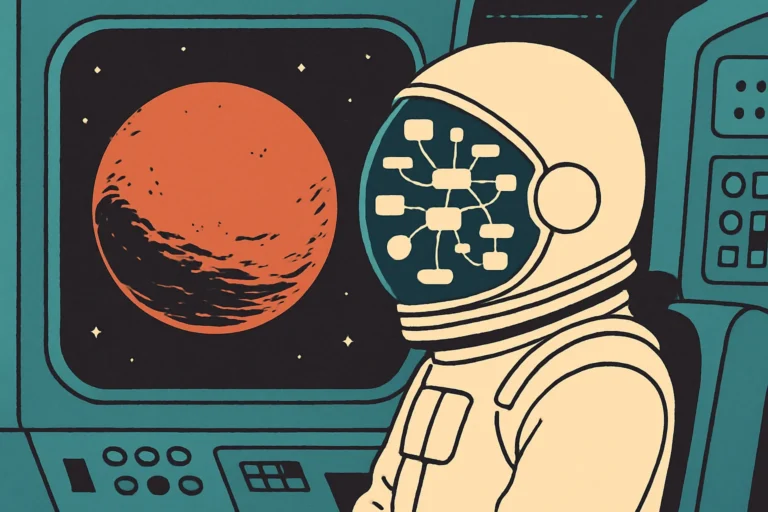
Space Travel: Is Your Mind Ready?
Introduction
Hello! This is [Daily Hangeul], here to upgrade your Korean skills to the next level! 🚀
Today, we are going to dive into a fascinating and highly professional topic: Analyzing the psychological impact of long-term spaceflight.
With the recent establishment of KASA (Korea AeroSpace Administration) and the global buzz surrounding Mars exploration missions, space is no longer just a subject for sci-fi movies. In Korea, discussions are shifting from just “rocket technology” to the “human factors”—specifically, how humans can mentally survive in the harsh environment of space.
If you are preparing for a job in a technical field, academia, or simply want to discuss high-level topics like a native intellectual, this lesson is for you. Let’s explore the Korean expressions used to describe the human mind in the cosmos!
Key Expressions
Here are 4 advanced expressions to help you discuss psychology and space exploration professionally.
1. 고립감 (Isolation / Sense of isolation)
- Pronunciation: [Go-rip-gam]
- English Meaning: A feeling of isolation
- Detail: This word combines 고립 (isolation) and 감 (feeling). It is frequently used in medical or sociological reports to describe the feeling of being cut off from society or family. In space, this is the biggest enemy of an astronaut.
- 💡 Pronunciation Tip:
- Look at the patchim ㅂ (p) in ‘립 (rip)’ followed by ㄱ (g) in ‘감 (gam)’.
- When a stop sound like ㅂ meets ㄱ, the ㄱ hardens into a tense sound [ㄲ (kk)].
- So, it is pronounced [고립깜 (Go-rip-kkam)]. This rule is called Glottalization (Tensification).
2. 심리적 안정 (Psychological stability)
- Pronunciation: [Sim-ni-jeok an-jeong]
- English Meaning: Psychological stability
- Detail: This is a formal phrase used in academic papers, news reports, or workplace evaluations. You wouldn’t use this with a close friend over a beer, but you would definitely use it in a presentation.
- 💡 Pronunciation Tip:
- This involves Nasalization.
- Written as ‘심리’ (Sim-ri), but the ㅁ (m) influences the ㄹ (r).
- The ㄹ changes to an ㄴ (n) sound.
- So, say it as [심니 (Sim-ni)], not [Sim-ri]. It flows much smoother!
3. 필수 불가결하다 (Indispensable / Absolutely necessary)
- Pronunciation: [Pil-ssu bul-ga-gyeol-ha-da]
- English Meaning: To be indispensable; essential
- Detail: This is a C1/C2 level idiom. It means something is so essential that it is impossible to proceed without it. Use this when you want to emphasize the critical nature of a factor (like mental health care).
- 💡 Pronunciation Tip:
- In 필수 (pil-su), the ㄹ makes the following ㅅ sound tense. It sounds like [필쑤 (Pil-ssu)].
- In 불가결 (bul-ga-gyeol), pronounce the ㄹ clearly as an ‘l’ sound because it is at the end of a syllable.
4. 대인 관계 갈등 (Interpersonal conflict)
- Pronunciation: [Dae-in gwan-gye gal-deung]
- English Meaning: Interpersonal relationship conflict
- Detail: Long-term missions mean living in tight quarters. This phrase refers to the friction that occurs between people. ‘갈등’ (conflict) is a very common word in news and literature.
Example Dialogue
Let’s see how these words are used in a professional discussion between two researchers analyzing a Mars mission simulation.
Researcher A: 이번 화성 탐사 모의 훈련 결과를 보셨습니까?
(Did you see the results of this Mars exploration simulation?)
Researcher B: 네, 기술적인 문제는 없었지만, 대원들의 고립감이 생각보다 심각했습니다.
(Yes, there were no technical issues, but the crew’s sense of isolation was more serious than expected.)
Researcher A: 맞습니다. 폐쇄된 우주선 안에서는 대인 관계 갈등이 발생하기 쉽죠.
(That’s correct. Inside a closed spaceship, interpersonal conflicts are easy to occur.)
Researcher B: 성공적인 임무 수행을 위해서는 대원들의 심리적 안정 지원이 필수 불가결하다고 봅니다.
(I believe that supporting the crew’s psychological stability is indispensable for a successful mission.)
Culture Tip & Trend Analysis
🚀 The Era of “K-Sci-Fi” and Humanism
Recently, Korean content (K-Content) has been exploring space not just as a setting for action, but as a place to test human limits. Movies like “The Moon” (더 문) and series like “The Silent Sea” (고요의 바다) have sparked conversations in Korea about the mental toll of space travel.
In the past, Korean news focused on “How much does the rocket cost?” or “How far can it go?”. However, with the launch of KASA, the focus is shifting to “Astronaut Welfare” (우주인 복지).
If you use expressions like “심리적 안정” (psychological stability) or “고립감 해결” (resolving isolation) when discussing these movies or news with your Korean colleagues, they will be impressed by your depth of understanding and your ability to analyze the human aspect of the trend!
Conclusion & Practice
Today, we explored high-level vocabulary related to space exploration and psychology. These words are not only useful for science topics but can also be applied to business management and sociology!
📝 Mini Quiz:
Fill in the blank with the correct expression we learned today.
“장기간의 해외 근무에서는 직원들의 __________을/를 유지하는 것이 중요합니다.”
(In long-term overseas work, it is important to maintain the employees’ [psychological stability].)
Answer: 심리적 안정 (Did you remember the pronunciation? It’s Sim-ni-jeok!)
Try using one of today’s expressions in the comments below! Maybe write a sentence about how you handle stress or isolation.
See you next time for more useful Korean! 👋
Frequently Asked Questions (FAQ)
Q: What does "필수" mean in Korean and how do you pronounce it?
A: In Korean, "필수" is pronounced [pil-su] and means: , the
Q: What does "불가결" mean in Korean and how do you pronounce it?
A: In Korean, "불가결" is pronounced [bul-ga-gyeol] and means: , pronounce the
Q: What does ""고립감 해결"" mean in Korean and how do you pronounce it?
A: In Korean, ""고립감 해결"" is pronounced [resolving isolation] and means: when discussing these movies or news with your Korean colleagues, they will be impressed by your depth of understanding and your ability to analyze the







