

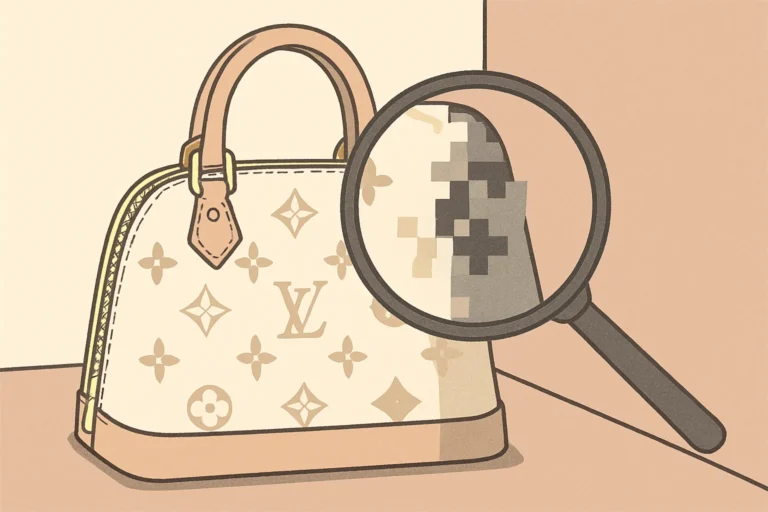
Real vs. Fake: The Battle of Luxury Brands in Korea
Introduction
Hello! This is [Daily Hangul], ready to upgrade your Korean proficiency to a professional level!
Today, we are diving into a sophisticated and highly relevant topic: Issues in Intellectual Property Law, specifically analyzing the impact of counterfeit goods on luxury brands.
In Korea, the demand for luxury goods is incredibly high—you’ve probably heard of the “Open Run” (queuing up before a store opens) phenomenon at department stores. However, alongside this passion for genuine articles, the market for “Super Fakes” (high-quality counterfeits) has also become a hot topic. Recently, Korean news has been flooded with reports on stricter crackdowns on these goods and the legal battles ensuing between global brands and local distributors.
For C2 learners, being able to discuss the legal and economic implications of this trend is crucial. Let’s learn how to express these complex ideas like a true expert!
Key Expressions
Here are 4 advanced expressions to help you discuss Intellectual Property Law and brand economics.
1. 지적 재산권 침해 (Infringement of intellectual property rights)
- Pronunciation: [Jijeok jaesan-kkwon chimhae]
- Meaning: Infringement of intellectual property rights
- Detailed Explanation: This is a formal legal term used to describe the violation of rights such as copyrights, patents, or trademarks. In news or academic debates, you wouldn’t just say “copying” (베끼기); you would use this phrase to sound professional.
- 💡 Pronunciation Tip:
- Pay attention to ‘권 (gwon)’. Because of the ‘n’ sound in ‘산(san)’, the following ‘g’ sound undergoes Tensification (경음화) and is pronounced as [kkwon/꿘].
- So, it sounds like [Jijeok jaesan-kkwon], not [jaesan-gwon].
2. 진품 여부 (Authenticity)
- Pronunciation: [Jinpum yeobu]
- Meaning: Whether an item is genuine or not (Authenticity)
- Detailed Explanation: ‘진품’ means a genuine article, and ‘여부’ means “whether strictly yes or no.” This phrase is commonly used in sentences like “We are verifying the authenticity” (진품 여부를 확인하고 있습니다).
- 💡 Pronunciation Tip:
- This is relatively straightforward, but focus on the Resyllabification (연음) rules if particles follow.
- If you say “진품 여부를 (the authenticity + object particle),” read it smoothly as [Jinpum yeobu-reul]. Keep the rhythm steady without chopping the words.
3. 법적 제재 (Legal sanctions)
- Pronunciation: [Beop-jjeok jejae]
- Meaning: Legal sanctions / Legal penalties
- Detailed Explanation: When discussing the consequences of selling counterfeit goods, this is the go-to phrase. It implies formal punishment or restrictions imposed by the law.
- 💡 Pronunciation Tip:
- Look at ‘법적 (beop-jeok)’. The final consonant ‘ㅂ (p)’ in ‘법’ is an obstruent. When it meets the ‘ㅈ (j)’ in ‘적’, the ‘j’ tenses into a ‘ㅉ (jj)’ sound.
- Therefore, pronounce it clearly as [Beop-jjeok].
4. 브랜드 가치 희석 (Dilution of brand value)
- Pronunciation: [Beuraendeu gachi huiseok]
- Meaning: Dilution of brand value
- Detailed Explanation: This is a high-level economic concept. It explains how the widespread availability of fake goods lowers the exclusivity and prestige of the original luxury brand. ‘희석’ literally means ‘dilution’ (like adding water to juice), but here it’s used metaphorically.
- 💡 Pronunciation Tip:
- ‘가치 (gachi)’: Similar to the word ‘together (gachi)’, the ‘t’ sound in ‘ㅌ’ meets ‘ㅣ’ and becomes ‘ch’ (Palatalization/구개음화).
- ‘희석 (huiseok)’: The ‘ui (ㅢ)’ sound can be tricky. In this word, pronouncing it slightly closer to ‘i (ㅣ)’ as in [hiseok] is also acceptable in standard pronunciation, but try to maintain the rounded ‘ui’ shape for precision.
Example Dialogue
Let’s see how these expressions are used in a discussion between two colleagues analyzing a recent market report.
Min-ji: Did you see the news about the crackdown on online platforms selling fake goods?
(민지: 온라인 플랫폼 위조 상품 단속에 대한 뉴스 봤어?)
Hyun-woo: Yes. It seems the infringement of intellectual property rights has reached a serious level.
(현우: 응. **지적 재산권 침해가 심각한 수준에 이른 것 같더라고.)**
Min-ji: Exactly. With “Super Fakes” becoming so common, it’s getting harder for consumers to determine the authenticity of products.
(민지: 맞아. ‘슈퍼 짝퉁’이 흔해지면서 소비자들이 **진품 여부를 가리는 게 점점 더 어려워지고 있어.)**
Hyun-woo: If this continues, the dilution of brand value for luxury companies will be inevitable. They need stronger legal sanctions.
(현우: 이대로 가면 명품 기업들의 **브랜드 가치 희석은 피할 수 없을 거야. 더 강력한 법적 제재가 필요해.)**
Culture Tip & Trend Analysis
Did you know? The shift from “Jjak-tung” to “Dupe”.
In Korea, counterfeit goods have long been called ‘Jjak-tung’ (짝퉁). While buying 짝퉁 was once done quietly, the conversation is changing among Gen Z.
- The Stigma: There is a growing social stigma against buying fakes to pretend one is rich. It is often criticized as “lacking self-esteem.”
- The “Dupe” Culture: Interestingly, instead of illegal fakes with stolen logos, “Dupes” (저렴이 version)—products that mimic the style or function of luxury items but without the logo—are becoming popular.
- Legal Awareness: As Korean content (K-Pop, K-Dramas) grows globally, Koreans are becoming more sensitive to copyright issues. Protecting the intellectual property of BTS or Squid Game is seen as equal to protecting Chanel or Louis Vuitton. Using the term ‘지적 재산권’ correctly shows you understand this modern mindset!
Conclusion & Practice
Today, we explored the complex world of Intellectual Property Law and counterfeit goods. Being able to discuss brand dilution and legal sanctions places your Korean skills firmly in the Advanced (C2) category.
📝 Mini Quiz
Fill in the blanks with the expressions we learned today:
- Selling fake goods is a clear act of ( ___________ ).
(위조 상품 판매는 명백한 ___________ 행위입니다.) - The police are investigating the ( ___________ ) of the seized bags.
(경찰은 압수한 가방의 ___________를 조사하고 있습니다.)
[Answer Key]
1. 지적 재산권 침해 (Infringement of intellectual property rights)
2. 진품 여부 (Authenticity)
How would you describe the counterfeit market in your country using these Korean terms? Leave a comment below!
See you in the next post!







