

Title: Creation Myths: Unlocking the Deep Roots of K-Culture
Introduction
Hello! This is [Daily Hangeul], here to upgrade your Korean proficiency to a master level!
Today, we are diving into a sophisticated and fascinating topic: Comparing Creation Myths of Various Cultures (여러 문화권의 창조 신화 비교 분석하기).
Recently in Korea, there has been a massive resurgence of interest in “K-Fantasy” and the humanities. From webtoons like Omniscient Reader’s Viewpoint to dramas like Tale of the Nine Tailed, modern content is actively reinterpreting ancient stories. To truly understand the depth of these narratives and participate in high-level intellectual discussions, understanding the foundational myths—specifically the Dangun Myth (단군 신화)—is essential.
Let’s explore the vocabulary and expressions you need to discuss these profound topics like a native intellectual!
Core Expressions
Here are 4 high-level expressions to help you discuss mythology and symbolism fluently.
1. 건국 신화 (Geonguk sinhwa)
- Pronunciation: [Geon-guk-sin-hwa]
- English Meaning: Founding myth / Foundation myth
- Detailed Explanation: This refers to the myth related to the establishment of a nation. While Western myths often focus on the creation of the world itself (Cosmogony), Korean mythology places a heavy emphasis on the foundation of the nation and the legitimacy of its people.
- 💡 Pronunciation Tip:
- Pronounce the ‘ㄱ’ (k) in ‘국’ (guk) shortly and firmly as a stop sound, rather than dragging it out. It flows into ‘신’ (sin).
- [Geon-guk-ssin-hwa]: Sometimes, the ‘ㅅ’ (s) in ‘신화’ can sound slightly tenser, like ‘ss’, due to the impact of the preceding ‘ㄱ’ (k) sound (Glottalization).
2. 홍익인간 (Hongik Ingan)
- Pronunciation: [Hong-ik-in-gan]
- English Meaning: Devotion to the welfare of mankind / To broadly benefit the human world
- Detailed Explanation: This is the founding philosophy of Gojoseon, the first Korean kingdom. It is the core of the Korean worldview. Unlike myths where gods punish humans, this concept highlights a humanistic (인본주의적) approach where the divine descends to help humanity flourish. It is still the official educational motto of South Korea today.
- 💡 Pronunciation Tip:
- Liaison (연음): When you say this quickly, the final consonants carry over to the vowels.
- Instead of ‘Hong-ik-in-gan’, it flows like [Hong-i-gin-gan]. The ‘ㄱ’ (k) in ‘익’ moves to ‘인’, making it sound like ‘gin’. This makes your speech sound much more fluent and natural.
3. 천손강림 (Cheonson gangnim)
- Pronunciation: [Cheon-son-gang-nim]
- English Meaning: The descent of the heavenly grandchild
- Detailed Explanation: This is a motif found in Northeast Asian mythology where a descendant of the Sky God comes down to Earth to rule. It legitimizes the ruler’s authority. In the Dangun myth, Hwanung (the son of the Sky God) descends to Earth.
- 💡 Pronunciation Tip:
- Nasalization (비음화): Look at ‘강림’ (gangnim). The ‘ㅇ’ (ng) and ‘ㄹ’ (l/r) meet. In Korean, ‘ㄹ’ often changes to ‘ㄴ’ (n) when following a nasal sound like ‘ㅇ’.
- So, it is pronounced [Cheon-son-gang-nim], not [gang-lim].
4. 금기 (Geumgi)
- Pronunciation: [Geum-gi]
- English Meaning: Taboo
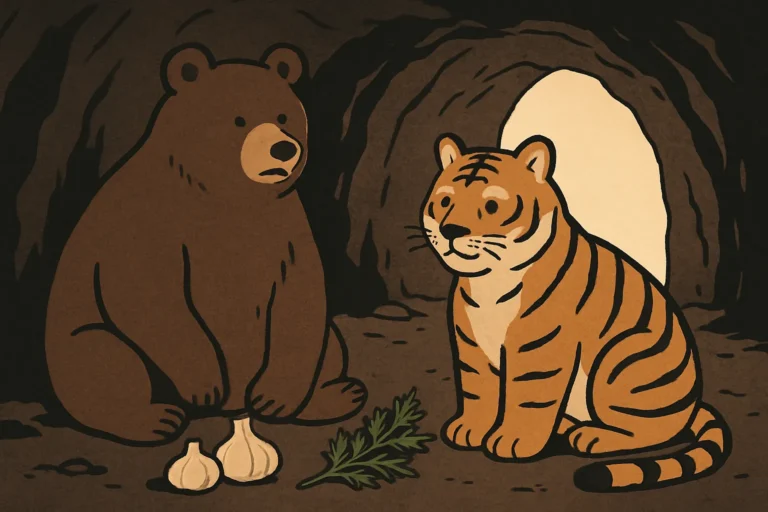
- Detailed Explanation: In myths, characters often have to endure a trial or avoid a taboo to achieve their goal. In the Korean myth, the tiger failed to endure the darkness and garlic/mugwort diet, while the bear succeeded. This “breaking or keeping of a taboo” is a crucial element in comparative mythology.
- 💡 Pronunciation Tip:
- Pronounce the ‘ㅁ’ (m) clearly. It is a soft, nasal sound. Ensure your lips close fully for the ‘m’ before moving to ‘gi’.
Example Dialogue
Let’s see how these expressions are used in an academic or serious discussion between two friends, Minji and Daniel.
Minji: 다니엘, 이번 인문학 과제 주제 정했어?
(Daniel, have you decided on the topic for this humanities assignment?)
Daniel: 응, 나는 건국 신화를 비교 분석하려고 해. 특히 한국의 단군 신화와 서양의 창조 신화의 차이점에 관심이 생겼거든.
(Yes, I’m planning to compare and analyze founding myths. I’m particularly interested in the differences between Korea’s Dangun myth and Western creation myths.)
Minji: 오, 흥미로운데? 가장 큰 차이점이 뭐라고 생각해?
(Oh, that’s interesting. What do you think is the biggest difference?)
Daniel: 서양 신화는 신의 절대적인 권위를 강조하지만, 단군 신화는 홍익인간 정신을 바탕으로 인간 세상을 이롭게 하는 것에 더 집중하는 것 같아.
(Western myths emphasize the absolute authority of gods, but the Dangun myth seems to focus more on benefiting the human world based on the spirit of Hongik Ingan.)
Minji: 맞아. 곰이 인간이 되기 위해 쑥과 마늘을 먹으며 금기를 지키는 과정도 인간의 인내심을 강조하는 부분이지.
(That’s right. The process where the bear endures eating mugwort and garlic, keeping the taboo to become human, also highlights human patience.)
Culture Tip & Trend Deep Dive
“Why is the Bear (Ungnyeo) so important in K-Culture?”
In recent trends, scholars and creators are re-examining the Dangun Myth not just as a story of a nation’s birth, but as a story of Integration and Harmony.
- Totemism Reinterpreted: Historically, the marriage between Hwanung (Sky deity) and Ungnyeo (Bear-woman) symbolizes the union of an incoming tribe (worshipping the sky) and a native tribe (worshipping the bear).
- Modern Media: You might notice that in Korean dramas or games, “Tigers” are often portrayed as chaotic or villainous spirits (because the tiger failed the test in the myth!), while “Bears” are seen as wise







