

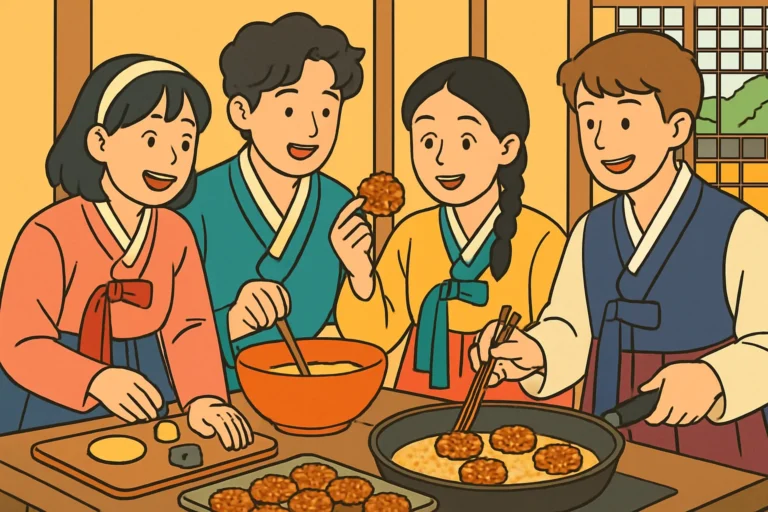
Book Like a Local: Trendy Korean Tradition Classes!
👋 Introduction
Hello! This is [Daily Korean], here to upgrade your Korean skills to the next level!
Today, we are going to learn how to inquire about Traditional Culture Experience Programs.
Have you heard? Lately in Korea, experiencing traditional culture is considered extremely “Hip”! From wearing Hanbok at Gyeongbokgung Palace to making Yakgwa (traditional honey cookies), young Koreans are loving these activities and posting them all over social media. It’s part of the “Hip-Tradition” (Hip + Tradition) trend.
Do you want to join a class but don’t know how to ask? Don’t worry! With today’s expressions, you can book these popular classes just like a local!
📚 Key Expressions
Here are 3 essential expressions you need when asking about programs.
1. 예약은 어떻게 하나요?
- Pronunciation: [Yeyageun eotteoke hanayo?]
- English: How do I make a reservation?
- Details: This is the most standard and useful phrase. You can use this for hotels, restaurants, or classes. It is polite and clear.
- 💡 Pronunciation Tip (Liaison):
- Notice how 예약은 sounds like [Yeyageun], not [Yeyak-eun].
- When a final consonant (batchim) like ‘ㄱ(k)’ meets a vowel like ‘ㅇ(ng/silent)’, the sound carries over to the next block. So, it flows smoothly as [예야근].
2. 혹시 자리가 남아 있나요?
- Pronunciation: [Hoksi jariga nama innayo?]
- English: Do you happen to have any seats left?
- Details: Popular classes fill up fast! Use “혹시 (Hoksi)” (by any chance) to sound softer and more polite. It’s a great way to ask if you can still join.
- 💡 Pronunciation Tip (Nasalization):
- Look at 있나요. It is written as ‘it-na-yo’ but pronounced [innayo].
- This is because the ‘ㅆ(t sound)’ changes to an ‘ㄴ(n sound)’ when it meets the ‘ㄴ’ in ‘나’. It makes it much easier to say!
3. 친구랑 같이 신청하고 싶어요.
- Pronunciation: [Chingurang gachi sincheonghago sipeoyo.]
- English: I want to apply together with a friend.
- Details: Cultural experiences are more fun with friends! Use this to tell them you are not alone.
- 💡 Pronunciation Tip (Palatalization):
- This is very important! ‘같이’ is written as ‘gat-i’ but pronounced [gachi].
- When the batchim ‘ㅌ(t)’ meets the vowel ‘이(i)’, the sound changes to ‘ㅊ(ch)’. This is called ‘Palatalization’ (구개음화).
- Don’t say “Ga-ti”, say “Ga-chi”! It sounds much more natural, just like the word “Hae-daji” (Sunrise) becomes [Hae-doji].
🗣️ Example Dialogue
Let’s see how these expressions are used in real life.
(Scenario: You are calling a cultural center to book a trendy “Yakgwa Making Class”.)
- Staff: 안녕하세요, 한국 전통 문화 센터입니다. (Hello, Korea Traditional Culture Center.)
- You: 안녕하세요! 약과 만들기 수업을 듣고 싶은데요. 예약은 어떻게 하나요? (Hello! I want to take the Yakgwa making class. How do I make a reservation?)
- Staff: 홈페이지에서 하시면 됩니다. (You can do it on our website.)
- You: 아, 그렇군요. 이번 주 토요일에 혹시 자리가 남아 있나요? (Ah, I see. Do you happen to have any seats left for this Saturday?)
- Staff: 네, 두 자리 남았습니다. (Yes, there are two seats left.)
- You: 다행이네요! 친구랑 같이 신청하고 싶어요. (That’s a relief! I want to apply together with a friend.)
🎨 Culture Tip & Trend Deep Dive
Why is “Traditional Culture” so popular now?
Recently, the term “Halmaenial” (Halmoni + Millennial) has been trending in Korea. It refers to the younger generation enjoying tastes and hobbies that were traditionally associated with grandmothers!
- Food: Traditional snacks like Yakgwa (honey cookies) and Injeolmi (rice cake) are sold out in convenience stores instantly.
- Activities: Making Najeonchilgi (Mother-of-pearl crafts) or visiting palaces in Hanbok is considered very “Instagrammable.”
If you use the expression “친구랑 같이 (with a friend)” to book a Yakgwa class, Korean friends will be surprised and say, “Wow, you really know the trends!” (와, 완전 ‘인싸’네요!)
📝 Wrap-up & Quiz
Today, we learned how to inquire about cultural programs. You are now ready to enjoy the “Hip-Tradition” of Korea!
Let’s practice! (Fill in the blanks)
- “How do I make a reservation?”
= __________은 어떻게 하나요? - “Do you happen to have seats left?”
= __________ 자리가 남아 있나요?
Answers: 1. 예약 (Yeyak), 2. 혹시 (Hoksi)
Did you get them right? Try using these expressions in the comments below if you want to visit Korea! See you next time!







