

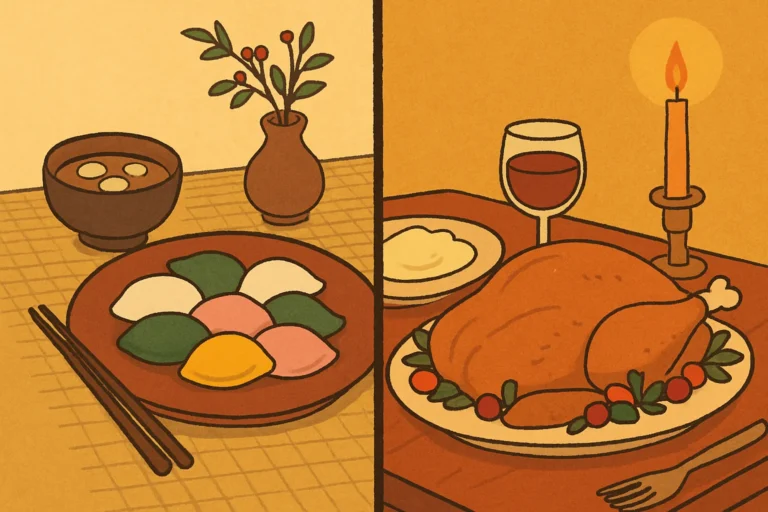
Chuseok vs. Thanksgiving: How Are They Different?
Introduction
Hello! This is [Daily Hangeul], here to upgrade your Korean skills! 👋
Today, we are going to dive into a very interesting topic: Comparing Holidays (명절 비교하기). Have you ever tried to explain your country’s holidays to a Korean friend, or wondered how they differ from Korean holidays?
Recently in Korea, the way people spend traditional holidays like Chuseok or Seollal is changing rapidly. While they used to be strictly about large family gatherings, nowadays, many people—especially the younger generation—choose to travel abroad or enjoy a “staycation” alone to rest.
Let’s learn some essential expressions to compare these cultural differences and similarities like a pro!
Key Expressions
Here are 3 key expressions to help you compare cultures and discuss holidays fluently.
1. ~와/과 달리 (Unlike ~)
- Pronunciation: [~wa/gwa dalli]
- English Meaning: Unlike ~
- Explanation: This is a crucial grammar pattern for B2 learners. You use it to highlight a difference between two things. Use 와 (wa) after a vowel and 과 (gwa) after a consonant.
- Example: 한국과 달리 미국에서는… (Unlike Korea, in the US…)
2. 같이 모이다 (To gather together)
- Pronunciation: [Gachi moida]
- English Meaning: To gather together
- Explanation: Holidays are all about gathering! This phrase is used when family or friends come together in one place.
- 💡 Pronunciation Tip (Palatalization):
- Wait, did you notice the pronunciation? You might think ‘같이’ is pronounced ‘gat-i’, but it is actually pronounced [gachi].
- This is a rule called Palatalization (구개음화). When the final consonant ‘ㅌ(t)’ meets the vowel ‘이(i)’, the sound changes to ‘치(ch)’ for smoother pronunciation.
- So, don’t say “Ga-ti”, say “Ga-chi” naturally!
3. 명절을 쇠다 (To celebrate a holiday)
- Pronunciation: [Myeongjeoleul soeda]
- English Meaning: To celebrate/observe a holiday
- Explanation: While you can say “to have a party,” for traditional holidays, Koreans use the verb ‘쇠다’. It sounds much more sophisticated and native-like than just saying “보내다 (to spend).”
- Example: 설날은 어떻게 쇠요? (How do you celebrate New Year’s?)
Real-Life Dialogue
Let’s see how these expressions are used in a conversation between Minji (Korean) and Daniel (American).
Daniel: Minji, Chuseok is coming up soon! It seems similar to Thanksgiving in my country.
Minji: That’s right! But 미국과 달리 (unlike the US), we usually eat Songpyeon (rice cakes) instead of turkey.
Daniel: Oh, I see. Do all your relatives 같이 모여요 (gather together)?
Minji: Usually, yes. But these days, to avoid stress, some families just go on a trip.
Daniel: Really? That’s a new trend!
Minji: Yes, many people want to 명절을 편하게 쇠고 (celebrate the holiday comfortably) want to rest.
Culture Tip & Trend Analysis 🕵️♀️
“Holiday Syndrome (명절 증후군)” and the New Trend
Have you heard of the term ‘Myeongjeol Syndrome’ (Holiday Syndrome)?
In the past, Korean holidays involved a lot of intense labor, such as cooking enormous amounts of food for ancestral rites (Charye). This caused a lot of stress for many people!
Because of this, the trend is shifting.
1. Hocance (Hotel + Vacance): Many young Koreans and families now prefer spending the holiday resting at a hotel instead of cooking at home.
2. Simplification: Families are simplifying the ceremonial table (Charye-sang) or ordering pre-made food to reduce the burden.
If you mention, “Nowadays, I heard many people prefer traveling over traditional gatherings,” your Korean friends will be surprised by your deep understanding of modern Korean culture!
Wrap-up & Quiz
Today, we learned how to compare holidays and discussed the changing trends in Korea. Being able to explain differences using “~와/과 달리” will make your Korean sound much more advanced!
📝 Mini Quiz:
Fill in the blank with the correct expression we learned today.
“In Korea, families usually __________ during Chuseok to eat and talk.”
(한국에서는 보통 추석에 가족들이 __________ 밥을 먹고 이야기를 해요.)
Answer: __________ (Check the ‘Key Expressions’ section!)
Leave a comment below telling us how your country’s holidays are different from Korea’s!
See you in the next lesson! 👋
Frequently Asked Questions (FAQ)
Q: What does "와" mean in Korean and how do you pronounce it?
A: In Korean, "와" is pronounced [wa] and means: after a vowel and
Q: What does "과" mean in Korean and how do you pronounce it?
A: In Korean, "과" is pronounced [gwa] and means: after a consonant.
Q: What does "미국과 달리" mean in Korean and how do you pronounce it?
A: In Korean, "미국과 달리" is pronounced [unlike the US] and means: , we usually eat Songpyeon (rice cakes) instead of turkey.
Q: What does "명절을 편하게 쇠고" mean in Korean and how do you pronounce it?
A: In Korean, "명절을 편하게 쇠고" is pronounced [celebrate the holiday comfortably] and means: want to rest.







