

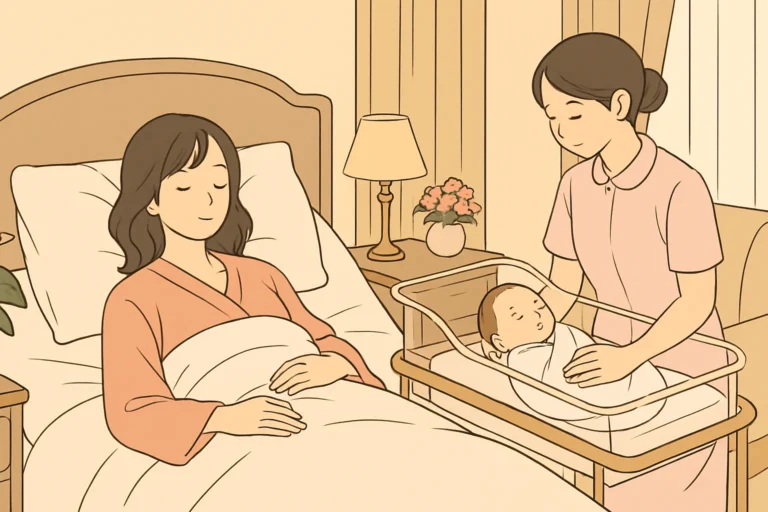
Your K-Drama Guide to Postpartum Care in Korea
Hello! This is [Daily Hangul], here to upgrade your Korean skills!
Have you ever watched a K-drama where a new mother goes to a luxurious, hotel-like facility after giving birth? You’re not just watching fiction—you’re seeing a unique and essential part of modern Korean culture! Today, we’re diving into the world of Korean postpartum care, or 산후조리 (sanhujori).
Nowadays in Korea, planning for postpartum recovery is just as important as planning for the birth itself. Understanding this concept and its related vocabulary is key to understanding Korean family culture and will be incredibly useful if you or your friends experience childbirth in Korea. Let’s get started!
✨ Core Expressions for Postpartum Planning
Here are the essential phrases you need to know to talk about planning for after-baby care like a native.
1. 산후조리 (Sanhujori)
- Pronunciation [Romanization]: San-hu-jo-ri
- English Meaning: Postpartum care
- Detailed Explanation: This isn’t just about medical recovery.
산후조리is a holistic concept that involves a period of intense rest and recuperation for the new mother, typically for at least three weeks. It includes eating specific nutritious foods (like seaweed soup!), staying warm, and avoiding strenuous activity to help the body heal properly. It’s a deeply ingrained cultural practice. - 💡 Pronunciation Tip: The ‘ㅎ’ (h) in ‘후’ (hu) should be a light, airy sound, almost like a sigh. Be careful not to pronounce ‘리’ (ri) with a strong, rolled ‘r’ like in Spanish. In Korean, the ‘ㄹ’ (r/l) at the beginning of a syllable sounds like a soft ‘r’ or a flap ‘d’ sound.
2. 산후조리원 (Sanhujoriwon)
- Pronunciation [Romanization]: San-hu-jo-ri-won
- English Meaning: Postpartum care center
- Detailed Explanation: This is the famous facility you see in dramas! A
산후조리원is a place where new mothers stay after leaving the hospital. It offers 24/7 care for both the mother and the baby. Mothers get massages, healthy meals, and classes on childcare, while nurses look after the newborns. It’s like a recovery resort for moms! They are very popular, so you have to book them months in advance. - 💡 Pronunciation Tip: Let’s break it down: 산(san) + 후(hu) + 조(jo) + 리(ri) + 원(won). Practice saying it slowly at first, then speed up. The rhythm is quite even across all syllables.
3. 알아보다 (Araboda)
- Pronunciation [Romanization]: A-ra-bo-da
- English Meaning: To look into; to research; to find out
- Detailed Explanation: This is a crucial verb for any kind of planning. When you need to find a good postpartum care center, you would say
산후조리원을 알아봐야 해요(I need to look into postpartum care centers). It implies a process of searching, comparing, and gathering information before making a decision. - 💡 Pronunciation Tip: This is a perfect example of a Korean sound-linking rule called 연음 (yeoneum). The word is written as ‘알-아-보-다’ (al-a-bo-da). However, the final consonant ‘ㄹ’ (l) from the first syllable ‘알’ moves over to the next syllable, which starts with a vowel. So, it’s pronounced smoothly as [아라보다 / araboda], not “al-a-boda.”
4. 몸조리 잘하다 (Momjori jalhada)
- Pronunciation [Romanization]: Mom-jo-ri jal-ha-da
- English Meaning: To recover well; to take good care of your body (after childbirth)
- Detailed Explanation: This is a set phrase you say to a new mother. It’s the Korean equivalent of “Wishing you a speedy recovery.”
몸(mom) means ‘body,’ and조리(jori) means ‘care’ or ‘recuperation.’ It’s a warm and caring expression that shows you understand the importance of the recovery period. - 💡 Pronunciation Tip: In the word
잘하다(jalhada), the final consonant ‘ㄹ’ (l) of ‘잘’ is a light ‘l’ sound. Make sure the tip of your tongue touches the back of your upper teeth. For the ‘ㅎ’ (h) that follows, it can sometimes be pronounced very softly or even blend with the next sound, making it sound almost like [자라다 / jarada] in fast speech, but practice it as [jalhada] for clarity.
💬 Example Dialogue
Let’s see how these expressions are used in a real conversation between two friends, Mina (who is pregnant) and Sujin.
A: 수진 (Sujin): 미나야, 곧 아기 나오겠다! 산후조리 계획은 세웠어?
Minaya, got agi naogetda! Sanhujori gyehoegeun sewosseo?
(Mina, the baby is coming soon! Have you made your postpartum care plan?)
B: 미나 (Mina): 응, 좋은 산후조리원을 알아보고 있어. 경쟁이 너무 치열해!
Eung, joeun sanhujoriwoneul arabogo isseo. Gyeongjaeng-i neomu chiyeolhae!
(Yeah, I’m researching a good postpartum care center. The competition is so fierce!)
A: 수진 (Sujin): 정말? 그래도 가장 중요하니까, 꼭 좋은 데로 가. 나중에 몸조리 잘해야 해!
Jeongmal? Geuraedo gajang jung-yohanikka, kkok joeun dero ga. Najunge momjori jalhaeya hae!
(Really? But it’s the most important thing, so make sure you go to a good place. You have to take good care of your body later!)
B: 미나 (Mina): 고마워, 수진아!
Gomawo, Sujin-a!
(Thanks, Sujin!)
วัฒนธรรม & Trend Deep Dive
The popularity of the 산후조리원 in Korea reflects a major societal shift. With more nuclear families and fewer multi-generational households, the traditional support system where a mother or mother-in-law would care for the new mom has weakened. The 산후조리원 fills this gap professionally.
K-Drama Connection: If you want a deep (and hilarious) dive into this world, you must watch the K-drama “Birthcare Center” (산후조리원). It perfectly captures the experiences, anxieties, and funny moments that happen inside these exclusive centers. Watching it will give you a fantastic cultural context for all the vocabulary we learned today!
Insider Tip: When talking to Korean friends about this, you can mention that you learned about 산후조리 from a drama. They will be impressed that you know such a specific and important cultural concept! Using a phrase like 몸조리 잘하세요 (momjori jalhaseyo – the formal version) will make you sound incredibly thoughtful and culturally aware.
📝 Let’s Practice!
Time to check your understanding. You can do it!
- Fill in the blank:
My friend just had a baby, so I sent her a message saying, “You must be tired. ______ 잘하세요!”
(Hint: What do you wish for a new mother?) -
Sentence Making:
Imagine you are pregnant and living in Korea. Using the verb 알아보다, write a short sentence in Korean about what you are currently researching. (e.g., “I am researching postpartum care centers in Seoul.”)
That’s all for today! Understanding 산후조리 culture is a big step toward fluency in both the Korean language and its culture.
Why not try using one of today’s phrases in the comments below? See you next time
Frequently Asked Questions (FAQ)
Q: What does "연음" mean in Korean and how do you pronounce it?
A: In Korean, "연음" is pronounced [yeoneum] and means: . The word is written as '알-아-보-다' (al-a-bo-da). However, the final consonant 'ㄹ' (l) from the first syllable '알' moves over to the next syllable, which starts with a vowel. So, it's pronounced smoothly as
Q: What does "A: 수진" mean in Korean and how do you pronounce it?
A: In Korean, "A: 수진" is pronounced [Sujin] and means: 미나야, 곧 아기 나오겠다!
Q: What does "B: 미나" mean in Korean and how do you pronounce it?
A: In Korean, "B: 미나" is pronounced [Mina] and means: 응, 좋은
Q: What does "A: 수진" mean in Korean and how do you pronounce it?
A: In Korean, "A: 수진" is pronounced [Sujin] and means: 정말? 그래도 가장 중요하니까, 꼭 좋은 데로 가. 나중에







