

Same Language, Different Worlds: A Guide to North & South Korean
Hello! Welcome to Maeil Hangeul, the place to upgrade your Korean skills!
Today, we’re diving into a topic that fascinates many advanced learners: the intriguing differences between the Korean spoken in South Korea (표준어, Pyojun-eo) and North Korea (문화어, Munhwaeo). You might wonder, “When would I ever use this?” Well, if you’re a fan of Korean dramas and films, understanding these differences will give you a much deeper appreciation for the story. Recently, with the global popularity of series like Crash Landing on You, curiosity about the North Korean language has exploded. You’ve probably heard words that sound Korean, but not quite the Korean you’ve learned. Let’s decode them together and explore the fascinating story of a language divided.
Core Expressions: Same Meaning, Different Words
Here are three key examples that beautifully illustrate the linguistic divergence on the Korean peninsula.
1. Friend
- South Korean: 친구 (Chingu)
- Pronunciation [Romanization]: [Chingu]
- English Meaning: Friend
- North Korean: 동무 (Dongmu)
- Pronunciation [Romanization]: [Dongmu]
- English Meaning: Comrade; Friend
-
Detailed Explanation: This is perhaps the most famous example. Before the division of Korea, 동무 was a common, heartwarming word for ‘friend’ across the entire peninsula. However, after the Korean War, it was adopted by North Korea to mean “comrade” in a socialist context. Because of this strong political connotation, the word fell out of use in South Korea, where 친구 became the universal term for a friend. Using ‘동무’ in Seoul today would sound very archaic or politically charged.
-
💡 Pronunciation Tip:
The ‘ㅊ’ (ch) in 친구 [Chingu] is an aspirated consonant. This means you should release a strong puff of air as you say it, like the ‘ch’ in “charge.” In contrast, the ‘ㄷ’ (d) in 동무 [Dongmu] at the beginning of a word is unaspirated, sounding like a soft sound between an English ‘d’ and ‘t’.
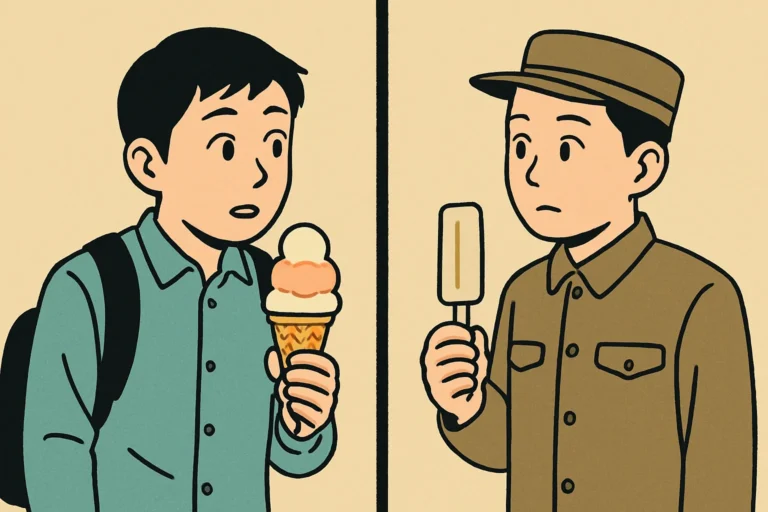
2. Ice Cream
- South Korean: 아이스크림 (Aiseukeurim)
- Pronunciation [Romanization]: [Aiseukeurim]
- English Meaning: Ice cream
- North Korean: 얼음과자 (Eoreumgwaja)
- Pronunciation [Romanization]: [Eoreumgwaja]
-
English Meaning: Lit. “Ice snack”
-
Detailed Explanation: This pair showcases a major linguistic policy difference. South Korean readily adopts loanwords, and 아이스크림 is a direct transliteration of the English “ice cream.” North Korea, on the other hand, has a policy of linguistic purism, actively creating native Korean words to replace foreign terms. 얼음과자 is a compound of the pure Korean words 얼음 (ice) and 과자 (snack).
-
💡 Pronunciation Tip:
In 얼음과자 [Eoreumgwaja], the final consonant ‘ㅁ’ (m) in ‘얼음’ smoothly connects to the next syllable. The key is the ‘과’ [gwa] sound. It’s a single, quick syllable, not two separate sounds like ‘gu-a’. Practice gliding from the ‘g’ to the ‘wa’ sound seamlessly.
3. It’s Okay / No Problem
- South Korean: 괜찮아 (Gwaenchana)
- Pronunciation [Romanization]: [Gwaenchana]
- English Meaning: It’s okay; It’s alright; No problem.
- North Korean: 일없다 (Ireopda)
- Pronunciation [Romanization]: [I-reop-tta]
-
English Meaning: There is no issue; It’s fine.
-
Detailed Explanation: While both expressions convey a similar meaning of “it’s fine,” their origins and nuances differ. 괜찮아 is an extremely common, versatile expression in the South. 일없다 is the North Korean equivalent, literally translating to “there is no work/matter/issue.” To a South Korean ear, it can sound quite direct and perhaps a little blunt, highlighting a subtle difference in conversational style.
-
💡 Pronunciation Tip:
The pronunciation of 일없다 is a great example of consonant assimilation for advanced learners. The final ‘ㅂ’ (b) in ‘없’ is followed by ‘ㄷ’ (d). In this case, the ‘ㄷ’ becomes a tensed, “double” consonant sound, ‘ㄸ’ (tt). So, instead of [Ireop-da], the natural pronunciation is [이럽따 / I-reop-tta]. This is a key feature that makes Korean sound fluid and natural.
Example Dialogue
Let’s see how these words might appear in a conversation between two friends, Sora (South Korean) and David (a K-drama fan).
- David: 소라 씨, 요즘 ‘사랑의 불시착’ 다시 보고 있어요. 북한 군인들이 서로 “동무!”라고 부르는 게 정말 흥미로워요.
(Sora, I’m re-watching ‘Crash Landing on You’ these days. It’s so interesting how the North Korean soldiers call each other “Dongmu!”). - 소라 (Sora): 맞아요. 저희는 친구라고 하니까 정말 다르게 들리죠. 드라마에서 그들이 “얼음과자“를 먹는 장면도 있었나요? 우리는 “아이스크림“이라고 부르는데!
(That’s right. Since we say “Chingu,” it sounds really different, doesn’t it? Was there a scene where they ate “Eoreumgwaja“? We call it “Aiseukeurim“!) - David: 네, 있었어요! 그리고 누가 고맙다고 하니까, 대답으로 “일없습니다“라고 했어요. 저는 “괜찮습니다“를 예상했는데요.
(Yes, there was! And when someone said thank you, they replied, “Ireopseumnida.” I was expecting “Gwaenchanseumnida.”) - 소라 (Sora): 와, 데이비드 씨, 정말 열심히 공부했네요! 같은 언어인데도 이렇게 다른 점이 많다는 게 신기하죠?
(Wow, David, you’ve really studied hard! Isn’t it amazing how many differences there are, even though it’s the same language?)
Culture Tip: The “Munhwaeo” (문화어) Policy
The divergence between North and South Korean isn’t just a matter of accents; it’s a result of deliberate policy. After the division, North Korea established 문화어 (Munhwaeo), or “Cultured Language,” as its standard. Based on the Pyongyang dialect, its goal was to create a “pure” Korean language, free from foreign influence—especially English and Japanese loanwords that are common in the South.
This is why you see systematic differences:
* Loanwords: 주스 (juseu) in the South is 과일단물 (gwaildanmul), or “sweet fruit water,” in the North.
* Intonation: Munhwaeo is known for its more dramatic, song-like intonation compared to the relatively flatter Seoul dialect.
When you hear these differences in media, you’re not just hearing a different accent; you’re hearing the result of over 70 years of separate linguistic history and national identity-building.
Wrap-up & Let’s Practice!
Today, we saw how one language can evolve into two distinct dialects due to history and politics. We learned about key vocabulary differences like 친구 (chingu) / 동무 (dongmu), the approach to loanwords with 아이스크림 (aiseukeurim) / 얼음과자 (eoreumgwaja), and common expressions like 괜찮아 (gwaenchana) / 일없다 (ireopda).
Now, test your knowledge!
- Fill-in-the-blank: You are watching a North Korean film where a character is offered help but doesn’t need it. They would most likely say: “아닙니다, ___________.” (Answer in Munhwaeo)
-
Translate the Concept: How would you express the concept of a “shampoo” (샴푸) in the spirit of North Korea’s linguistic purism? (Hint: Think about its function. A possible answer is 머리비누, lit. “head soap.”)
What other North or South Korean word pairs do you know? Share your discoveries in the comments below
Frequently Asked Questions (FAQ)
Q: What does "친구" mean in Korean and how do you pronounce it?
A: In Korean, "친구" is pronounced [Chingu] and means: is an aspirated consonant. This means you should release a strong puff of air as you say it, like the 'ch' in "charge." In contrast, the 'ㄷ' (d) in
Q: What does "동무" mean in Korean and how do you pronounce it?
A: In Korean, "동무" is pronounced [Dongmu] and means: at the beginning of a word is unaspirated, sounding like a soft sound between an English 'd' and 't'.
Q: What does "얼음과자" mean in Korean and how do you pronounce it?
A: In Korean, "얼음과자" is pronounced [Eoreumgwaja] and means: , the final consonant 'ㅁ' (m) in '얼음' smoothly connects to the next syllable. The key is the '과' [gwa] sound. It’s a single, quick syllable, not two separate sounds like 'gu-a'. Practice gliding from the 'g' to the 'wa' sound seamlessly.
Q: What does "소라" mean in Korean and how do you pronounce it?
A: In Korean, "소라" is pronounced [Sora] and means: 맞아요. 저희는







