

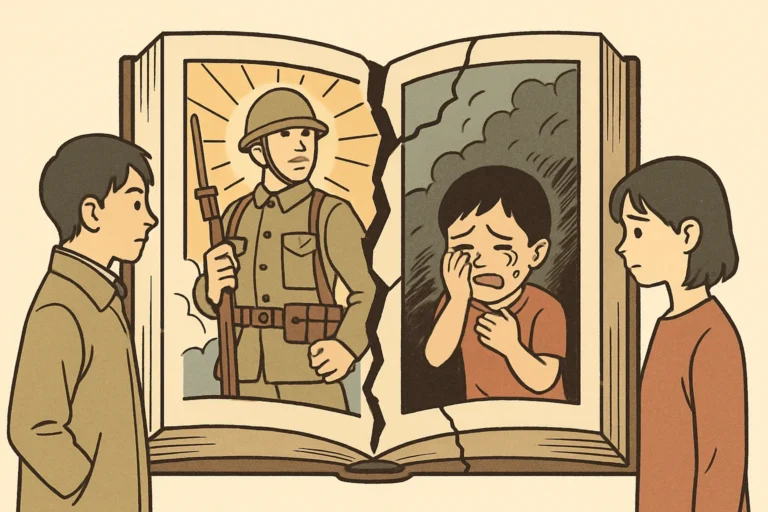
One War, Different Memories: Debating History in Korean
Hello everyone! Welcome back to [Maeil Hangeul], your go-to source for leveling up your Korean skills!
Today, we’re diving into a deep and fascinating topic: how to discuss history like an intellectual. Specifically, we’ll explore how different countries can have vastly different interpretations of the same historical event. Have you ever noticed how a new historical drama or film in Korea can spark intense online debates? That’s because history isn’t just about the past; it’s a living conversation. This lesson will give you the sophisticated vocabulary you need to understand and participate in these high-level discussions, moving beyond simple facts to analyze perspectives and biases.
Let’s get started!
Core Expressions for Historical Debate
Here are five essential terms you’ll need to navigate complex historical discussions in Korean.
1. 사관 (史觀) / 역사관 (歷史觀)
- Pronunciation [Romanization]: sagwan / yeoksagwan
- English Meaning: Historical perspective; a view of history.
- Detailed Explanation: This is a crucial term in any serious historical discussion. It’s derived from Hanja: 史 (history) and 觀 (view).
사관refers to the specific framework or ideology through which a historian or a group interprets historical events. It’s not just an opinion; it’s a structured viewpoint. For example, a Marxist사관would interpret history through the lens of class struggle, while a nationalist사관would focus on the development and glory of the nation-state. - 💡 Pronunciation Tip: In
역사관[역싸관/yeokssagwan], the ‘ㄱ’ 받침 (final consonant) followed by ‘사’ causes the ‘ㅅ’ to be tensed, producing a sound similar to ‘ss’. This is a standard phonological rule called ‘된소리되기’ (tensing).
2. 재해석하다 (再解釋하다)
- Pronunciation [Romanization]: jaehaeseokada
- English Meaning: To reinterpret.
- Detailed Explanation: From the Hanja 再 (again) and 解釋 (interpretation), this verb means to analyze and interpret something—in this case, a historical event—from a new perspective, often with new evidence or a different
사관. History is constantly being재해석되다(reinterpreted) as societies evolve. This word is key to discussing how our understanding of the past changes over time. - 💡 Pronunciation Tip: The final consonant ‘ㄱ’ in ‘해석’ links to the following ‘하’, making the sound [해석카다/haeseokada]. This is a common aspiration rule where a plain consonant (ㄱ, ㄷ, ㅂ, ㅈ) followed by ‘ㅎ’ becomes an aspirated consonant (ㅋ, ㅌ, ㅍ, ㅊ).
3. 편향되다 (偏向되다)
- Pronunciation [Romanization]: pyeonhyangdoeda
- English Meaning: To be biased; to be skewed.
- Detailed Explanation: This adjective describes a viewpoint or narrative that is not neutral and leans unfairly in one direction. It comes from Hanja 偏 (leaning/one-sided) and 向 (direction). When comparing different countries’ historical accounts of a war, you will almost certainly find that each version is
편향되어 있다(is biased) to favor its own national narrative. - 💡 Pronunciation Tip: The ‘ㄴ’ 받침 before ‘ㅎ’ in
편향causes the ‘ㅎ’ sound to be very soft or almost disappear, while the ‘ㄴ’ sound remains clear. The pronunciation is a smooth [편향/pyeonhyang], not a choppy “pyeon-hyang.”
4. 아전인수 격으로 (我田引水 격으로)
- Pronunciation [Romanization]: ajeon-insu gyeogeuro
- English Meaning: In a self-serving way; interpreting something to one’s own advantage.
- Detailed Explanation: This is a fantastic four-character idiom (사자성어) that will make you sound incredibly fluent. Literally, it means “drawing water to one’s own rice paddy” (我 my, 田 field, 引 draw, 水 water). It perfectly describes the act of twisting facts or situations to benefit oneself. In a historical context, it refers to a country interpreting events
아전인수 격으로to portray itself as the victim or the hero. - 💡 Pronunciation Tip: The phrase is pronounced smoothly as a single unit. Pay attention to the liaison in
인수where the ‘ㄴ’ from인connects to the ‘ㅅ’, but here ‘ㅅ’ is pronounced as a tensed [ㅆ/ss] sound after a consonant, resulting in [인쑤/inssu]. So, the full sound is closer to [아저닌쑤 껴그로/ajeon-inssu kkyeogeuro].
5. 불가피하다 (不可避하다)
- Pronunciation [Romanization]: bulgapihada
- English Meaning: To be inevitable; unavoidable.
- Detailed Explanation: From Hanja 不 (not), 可 (able), and 避 (avoid). This adjective is central to debates about causality in history. Was a particular war
불가피했는가(Was it inevitable?), or could it have been avoided? Historians often argue about the불가피성(inevitability) of major historical turning points. - 💡 Pronunciation Tip: The ‘ㄱ’ 받침 in ‘불’ followed by ‘가’ results in the second ‘ㄱ’ being tensed. So, it’s pronounced [불가피하다/bulgapihada], with a slightly stronger ‘g’ sound in ‘ga’ that’s closer to ‘kka’.
Example Dialogue
Two university students, Min-jun (A) and Sofia (B), are discussing a documentary they watched about the Korean War.
A: 소피아, 어제 본 6.25 전쟁 다큐멘터리 정말 흥미롭지 않았어? 참전국마다 사관이 완전히 다르더라.
(Sofia, wasn’t that documentary on the Korean War we watched yesterday fascinating? Each participating country has a completely different historical perspective.)
B: 맞아. 특히 전쟁의 원인을 설명하는 방식이 너무 편향되어 있었어. 각자 자기들 입장에서 아전인수 격으로 서술하더라고.
(I know. The way they explained the cause of the war was so biased. Each side described it in a self-serving way to fit their own narrative.)
A: 맞아. 일부 학자들은 새로운 자료를 바탕으로 사건을 재해석하려고 하지만, 여전히 논쟁이 많지.
(Exactly. Some scholars try to reinterpret the events based on new materials, but there’s still so much debate.)
B: 그러게 말이야. 과연 그 전쟁이 정말 불가피했는지 다시 생각하게 되더라.
(Tell me about it. It really makes you reconsider whether that war was truly inevitable.)
Culture Tip: Navigating Korea’s “History Wars”
The vocabulary we learned today is not just academic; it’s used frequently in what Koreans call **’역사 전쟁’ (yeoksa jeonjaeng) or







