

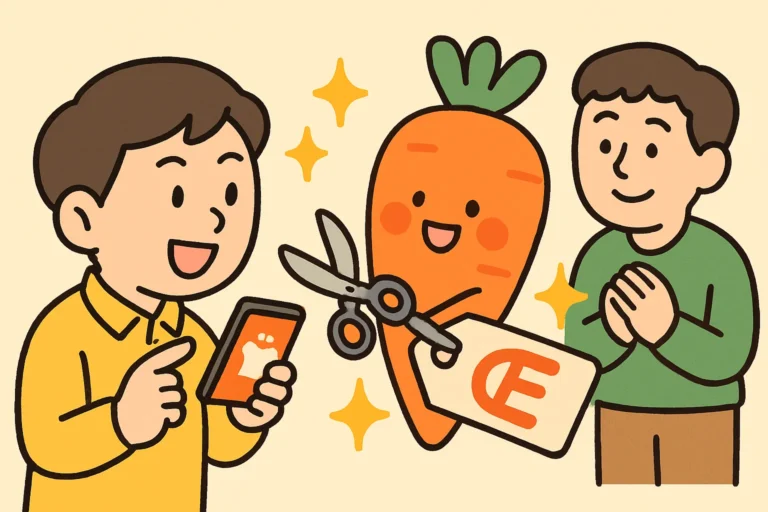
Karrot Market Pro: Let’s ‘Nego’ in Korean!
Hello! Welcome to [Daily Hangul], where we upgrade your Korean skills!
Have you ever wanted to buy something from a Korean online market but were too scared to ask for a better price? You’re in luck! Today, we’re diving into the exciting world of Korean second-hand shopping and learning how to bargain like a pro.
These days in Korea, everyone is using apps like Karrot Market (당근마켓) to find amazing deals and practice sustainable shopping. It’s a huge trend! Knowing how to ask for a discount, or “네고 (nego)” as Koreans say, is an essential skill. Let’s learn how to do it politely and effectively!
Core Expressions for Smart Shoppers
Here are the key phrases you need to master to become a Karrot Market expert.
1. 혹시 네고 가능한가요? (Is a discount possible?)
- Pronunciation [Romanization]: Hoksi nego ganeunghangayo?
- English Meaning: Is the price negotiable, by any chance?
- Detailed Explanation: This is the golden phrase to start any negotiation. “네고 (nego)” is a very common slang word that comes from the English word “negotiation.” Adding “혹시 (hoksi)” at the beginning makes your question sound much softer and more polite, which is very important when bargaining!
- 💡 Pronunciation Tip:
The final consonant ‘ㄱ’ in ‘혹 (hok)’ and the ‘ㅅ’ in ‘시 (si)’ are pronounced separately and clearly: [hok-si]. In “가능한가요 (ganeunghangayo),” the ‘ㅎ (h)’ sound is very soft, almost silent, so it sounds more like [가능앙가요 (ganeung-angayo)] in natural, fast speech.
2. 조금만 깎아주세요. (Please give me a small discount.)
- Pronunciation [Romanization]: Jogeumman kkakka-juseyo.
- English Meaning: Please cut the price a little.
- Detailed Explanation: This is a more direct but still polite way to ask for a discount. “깎다 (kkakda)” literally means “to shave” or “to peel,” but here it means “to cut the price.” By saying “조금만 (jogeumman),” which means “just a little,” you show that you are asking for a reasonable discount.
- 💡 Pronunciation Tip:
The double consonant ‘ㄲ (kk)’ is a tense sound. It’s stronger and sharper than a single ‘ㄱ (g)’. Make the sound at the back of your throat with a burst of air, but without aspiration. When ‘깎아 (kkak-a)’ is pronounced, the sound links together smoothly to become [까까, kkakka].
3. 택배비 포함해서 15,000원에 가능할까요? (Would 15,000 won be possible, including shipping?)
- Pronunciation [Romanization]: Taekbaebi pohamhaeseo man-ocheon-won-e ganeunghalkkayo?
- English Meaning: Would it be possible for 15,000 won, including the shipping fee?
- Detailed Explanation: This is how you make a specific offer. It’s very useful because it clarifies the total price. Let’s break it down:
- 택배비 (taekbaebi): shipping fee
- 포함해서 (pohamhaeseo): including
- OOO원에 가능할까요? (…won-e ganeunghalkkayo?): Would it be possible for OOO won?
- 💡 Pronunciation Tip:
In ‘포함해서 (pohamhaeseo)’, the ‘ㅎ (h)’ sound can be very weak when spoken quickly, but try to pronounce it clearly. Also, notice how the sounds link in ‘만오천원 (man-o-cheon-won)’. It flows together as [마노처눤, manocheonwon] in natural conversation.
Example Dialogue on Karrot Market
Let’s see how these expressions are used in a real chat between a buyer (A) and a seller (B) talking about a popular K-drama script book.
- A: 안녕하세요! 혹시 이 드라마 대본집 아직 판매하시나요?
- (Hello! Are you still selling this drama script book, by any chance?)
- B: 네, 안녕하세요! 아직 구매 가능합니다.
- (Yes, hello! It’s still available for purchase.)
- A: 정말요? 다행이네요! 혹시 네고 가능한가요?
- (Really? That’s a relief! Is the price negotiable, by any chance?)
- B: 음… 얼마를 생각하세요?
- (Hmm… What price are you thinking of?)
- A: 택배비 포함해서 20,000원에 가능할까요? 바로 입금할 수 있어요!
- (Would 20,000 won be possible, including the shipping fee? I can pay right away!)
- B: 좋아요! 그렇게 해요.
- (Okay! Let’s do that.)
Culture Tip & Trend Deep Dive
In Korea, the second-hand market culture is all about “good manners.” On apps like Karrot Market, there’s even a “매너온도 (maeneoon-do)” or “Manner Temperature” for each user. Your temperature goes up when you have positive interactions!
- The Power of Politeness: When you “nego” (네고), always be polite! Using phrases like “혹시 (hoksi)” and adding a friendly emoji like 😊 can make the seller more willing to give you a discount. A rude request will almost certainly be rejected.
- Become a “쿨거래” Master: A new trendy term is “쿨거래 (kul-georae),” which is a combination of the English word “Cool” and the Korean word for transaction, “거래 (georae).” It means a quick, easy, no-hassle deal. If you promise a “쿨거래,” sellers are much more likely to accept your offer! You can say: “쿨거래 할게요! (Kulgeorae halgeyo!)” – “I’ll make it a quick and easy deal!”
Let’s Review & Practice!
Great job today! You’ve learned how to ask for a price, make a specific offer, and understand the culture of online bargaining in Korea.
Now, let’s test your skills!
- Fill in the Blank: You found a cute hat you want to buy. How do you politely ask if the price is negotiable?
혹시 ______ 가능한가요?
- Make a Sentence: A book is listed for 10,000 won. You want to offer 8,000 won, including the shipping fee. How would you write that sentence in Korean?
Don’t be shy! Leave your answers in the comments below using the expressions you learned today! We can’t wait to see your bargaining skills in action. Happy shopping! 😊
Frequently Asked Questions (FAQ)
Q: What does "택배비" mean in Korean and how do you pronounce it?
A: In Korean, "택배비" is pronounced [taekbaebi] and means: shipping fee
Q: What does "포함해서" mean in Korean and how do you pronounce it?
A: In Korean, "포함해서" is pronounced [pohamhaeseo] and means: including
Q: What does "OOO원에 가능할까요?" mean in Korean and how do you pronounce it?
A: In Korean, "OOO원에 가능할까요?" is pronounced [...won-e ganeunghalkkayo?] and means: Would it be possible for OOO won?







