

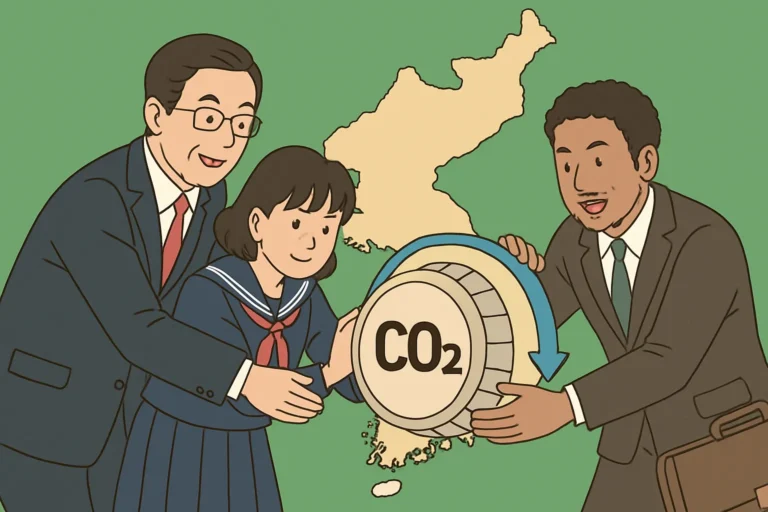
Upgrading Your Climate Game: How to Debate Korea’s NDC Like a Policy Pro
Hello! Welcome back to Maeil Hangeul, the place to upgrade your Korean skills from fluent to phenomenal!
Ever felt like you’ve mastered conversational Korean but want to dive into deeper, more complex topics? Today, we’re tackling a subject that’s shaping the future of Korea and the world: climate policy. Specifically, we’ll learn the essential vocabulary to discuss the drafting of a country’s climate commitments.
Lately in Korea, there’s a huge national conversation happening around the 2050 Carbon Neutrality goal (2050 탄소중립). From news headlines to parliamentary debates, the pressure is on to create effective environmental policies. Understanding this discourse is key to grasping modern Korea. Ready to sound like a policy expert? Let’s begin!
Core Expressions for Climate Policy
Here are the key terms you need to know to discuss Korea’s Nationally Determined Contribution (NDC).
1. 온실가스 감축 목표 (Onsil-gasu Gamchuk Mokpyo)
- Pronunciation [Romanization]: [Onsilkkaseu gamchung mokpyo]
- English Meaning: Greenhouse Gas (GHG) Reduction Target
- Detailed Explanation: This is the cornerstone of any climate policy. It’s a compound noun made of 온실가스 (greenhouse gas), 감축 (reduction, a formal word derived from Hanja), and 목표 (target/goal). This phrase refers to the specific percentage by which a country commits to cutting its emissions by a certain year. It’s the most critical figure in any NDC document.
- 💡 Pronunciation Tip:
- Notice how 온실가스 is pronounced [온실까스, onsilkkaseu]. This is due to a phonological rule called ‘Sai-siot’ (사이시옷) or consonant tensification in compound words. When a noun ending in a vowel is followed by certain consonants (like ㄱ, ㄷ, ㅂ, ㅅ, ㅈ), the consonant often becomes tensed. So, 가스 (gaseu) becomes 까스 (kkaseu).
- Similarly, in 감축 (gamchuk), the ‘ㄱ’ (g) at the end of the first syllable influences the ‘ㅈ’ (j) in the second, often making it sound closer to a ‘ㅊ’ (ch) sound.
2. 상향 조정하다 (Sanghyang Jojonghada)
- Pronunciation [Romanization]: [Sanghyang jojonghada]
- English Meaning: To adjust upwards; to raise (a target)
- Detailed Explanation: This verb is crucial for policy discussions. 상향 (上向) means ‘upward direction’ and 조정하다 means ‘to adjust’. You’ll use this when a country decides to make its climate goals more ambitious. The opposite, 하향 조정하다 (hahyang jojonghada), means to adjust downwards. It’s a formal and precise term used frequently in official documents and news reports.
- 💡 Pronunciation Tip:
- The combination of the final consonant ‘ㅇ’ (ng) in 상 (sang) and the initial ‘ㅎ’ (h) in 향 (hyang) flows very smoothly. There’s no stop or break; it’s a continuous nasal sound flowing into the next syllable: [sang-hyang].
3. 이행 계획 (Ihaeng Gyehoek)
- Pronunciation [Romanization]: [Ihaeng gyehoek]
- English Meaning: Implementation Plan
- Detailed Explanation: A goal is just a number without a plan to achieve it. 이행 (履行) means ‘implementation’ or ‘fulfillment’, and 계획 means ‘plan’. An 이행 계획 is the detailed roadmap outlining the specific policies, technologies, and regulations a government will use to meet its 온실가스 감축 목표.
- 💡 Pronunciation Tip:
- The vowel ‘ㅚ’ in 계획 (gyehoek) can be tricky. While its official pronunciation is a single vowel sound [ø], in modern Seoul Korean, it’s almost always pronounced as a diphthong, like ‘we’ in ‘wet’. So, pronouncing it as [계획, gye-hwek] will sound very natural.
4. 사회적 합의 (Sahoejeok Habui)
- Pronunciation [Romanization]: [Sahoejeok habui]
- English Meaning: Social Consensus
- Detailed Explanation: This concept is incredibly important in Korean policymaking. 사회적 means ‘social’, and 합의 means ‘agreement’ or ‘consensus’. Major policy shifts that affect the entire economy, like transitioning away from fossil fuels, cannot be pushed through by the government alone. They require extensive public discussion and broad agreement—a 사회적 합의—to be successful and legitimate.
- 💡 Pronunciation Tip:
- This is a perfect example of linking sounds, or 연음 (yeoneum). The final consonant ‘ㄱ’ (k) in 적 (jeok) moves over to the empty vowel position of the next syllable. So, instead of
sahoe-jeok / habui, it’s pronounced smoothly as [사훼저카븨, sahoejeo-kabui]. Mastering this will make your Korean sound incredibly fluid.
- This is a perfect example of linking sounds, or 연음 (yeoneum). The final consonant ‘ㄱ’ (k) in 적 (jeok) moves over to the empty vowel position of the next syllable. So, instead of
Example Dialogue: Policy Analysts at Work
Let’s see how these terms play out in a conversation between two policy analysts discussing Korea’s new NDC draft.
A: 새로운 국가 온실가스 감축 목표(NDC) 초안 보셨어요? 이번 온실가스 감축 목표가 상당히 야심 차던데요.
(Bosyeosseoyo? Ibeon onsil-gasu gamchuk mokpyo-ga sangdanghi yasim chadeondeyo.)
Have you seen the new draft NDC? The GHG reduction target is quite ambitious this time.
B: 네, 이전 목표를 대폭 상향 조정하기로 했더군요. 진짜 과제는 이제부터죠. 구체적인 이행 계획이 관건일 겁니다.
(Ne, ijeon mokpyo-reul daepok sanghyang jojonghagiro haetdeogunyo. Jinjja gwajeneun ijebuteojyo. Guchejeogin ihaeng gyehoek-i gwangeonil geomnida.)
Yes, they decided to raise the previous target significantly. The real challenge starts now. The specific implementation plan will be the key.
A: 맞아요. 산업계의 반발도 고려해야 하고요. 폭넓은 사회적 합의를 이루는 과정이 쉽지 않겠어요.
(Majayo. San-eopgye-ui banbaldo goryeohaeya hagoyo. Pongneolbeun sahoejeok habui-reul iruneun gwajeong-i swipji ankesseoyo.)
Exactly. We have to consider the backlash from the industrial sector, too. The process of achieving a broad social consensus won’t be easy.
B: 다음 주에 열리는 공청회가 그래서 중요해요. 다양한 이해관계자들의 의견을 수렴해야 하니까요.
(Daeum ju-e yeollineun gongcheonghoe-ga geuraeseo jung-yohaeyo. Dayanghan ihaegwangyejadeul-ui uigyeon-eul suryeomhaeya hanikkayo.)
That’s why the public hearing next week is so important. We need to gather opinions from various stakeholders.
Cultural Tip & Trend Deep Dive
In Korea, the term 기후위기 (gihuwigi – climate crisis) is now more commonly used in media and activism than the softer 기후변화 (gihubyeonhwa – climate change), reflecting a growing sense of urgency.
When the Korean government significantly raised its NDC in 2021, it was a major news story. The government declared its goal of “2050 탄소중립 (2050 Tanso Jungnip – 2050 Carbon Neutrality),” and news articles were filled with the vocabulary we learned today. Youth climate groups on platforms like Instagram and YouTube often use terms like 상향 조정 to pressure the government for more ambitious targets.
By using these expressions, you’re not just showing off advanced vocabulary; you’re demonstrating a deep understanding of the contemporary social and political landscape of Korea. You can now read the opinion section of a Korean newspaper or watch a policy debate and follow the core arguments.
Let’s Practice!
Time to put your new knowledge to the test!
- Fill in the Blank:
- 정부는 새로운 ___________을(를) 달성하기 위한 구체적인 ___________을(를) 발표했다.
- (The government announced a detailed ___________ to achieve its new ___________.)
- Quick Question:
- If a policy think tank argues that a country’s climate target is too weak and needs to be strengthened, which verb would they demand the government use? (Hint: It means “to adjust upwards.”)
Great job today! You’ve unlocked a whole new level of sophisticated conversation.
Now, try using one of today’s expressions in the comments! Tell us about a climate target or an implementation plan from your own country. We can’t wait to read your expert analysis
Frequently Asked Questions (FAQ)
Q: What does "감축" mean in Korean and how do you pronounce it?
A: In Korean, "감축" is pronounced [gamchuk] and means: , the 'ㄱ' (g) at the end of the first syllable influences the 'ㅈ' (j) in the second, often making it sound closer to a 'ㅊ' (ch) sound.
Q: What does "상향" mean in Korean and how do you pronounce it?
A: In Korean, "상향" is pronounced [上向] and means: means 'upward direction' and
Q: What does "하향 조정하다" mean in Korean and how do you pronounce it?
A: In Korean, "하향 조정하다" is pronounced [hahyang jojonghada] and means: , means to adjust downwards. It's a formal and precise term used frequently in official documents and news reports.
Q: What does "상" mean in Korean and how do you pronounce it?
A: In Korean, "상" is pronounced [sang] and means: and the initial 'ㅎ' (h) in







