

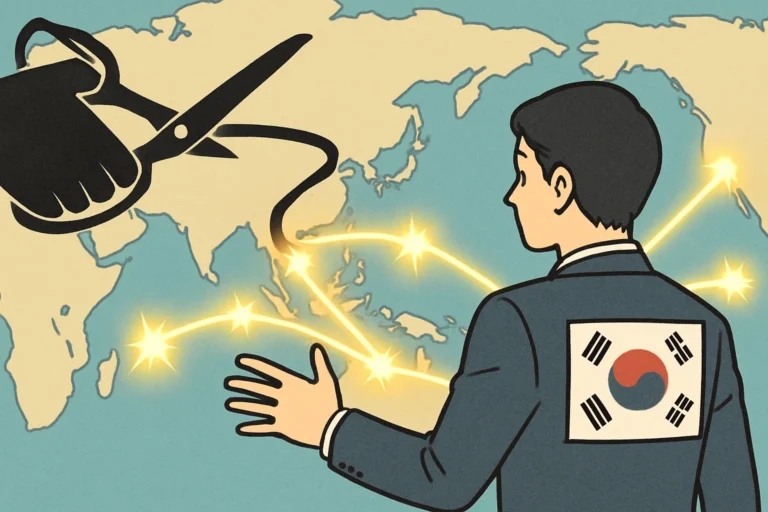
Mastering the Language of Korea’s Resource Diplomacy
Hello! Welcome to Daily Korean, where we upgrade your Korean skills to the highest level!
Today, we’re diving deep into a topic you’ll hear in presidential speeches and see on the front page of economic newspapers: the geopolitics of critical mineral supply chains. This isn’t just for diplomats; understanding this vocabulary is essential for anyone who wants to grasp the high-stakes challenges facing Korea’s world-leading tech industries.
These days in Korea, the “resource war” (자원 전쟁) is a hot topic. As global powers compete for the materials that power everything from smartphones to electric vehicles, Korea is making strategic moves. Let’s learn the exact vocabulary used by policymakers and industry leaders to discuss these critical issues.
Core Expressions for Geopolitical Analysis
Here are the key terms you need to know to sound like a policy expert.
1. 핵심 광물 (Haeksim Gwangmul)
- Pronunciation [Romanization]: Haeksim Gwangmul
- English Meaning: Critical Minerals
- Detailed Explanation: This term combines 핵심 (haeksim), meaning “core” or “key,” and 광물 (gwangmul), meaning “mineral.” It refers to minerals like lithium, cobalt, nickel, and rare earth elements that are designated by the government as vital for national and economic security. They are the essential building blocks for strategic industries such as semiconductors, EV batteries, and advanced defense technology. The use of “핵심” elevates these materials from mere commodities to strategic assets.
-
💡 Pronunciation Tip: The first syllable 핵 (haek) has an aspirated ‘ㅋ’ (k) sound, so release a strong puff of air. For 광물 (gwangmul), the initial ‘ㄱ’ (g) is unaspirated, making it softer than the ‘ㅋ’ (k) in English words like “king.” It sounds closer to the ‘g’ in “go.”
2. 공급망 다변화 (Gonggeummang Dabyeonhwa)
- Pronunciation [Romanization]: Gonggeummang Dabyeonhwa
- English Meaning: Supply Chain Diversification
-
Detailed Explanation: Let’s break this down: 공급망 (gonggeummang) means “supply chain,” and 다변화 (dabyeonhwa) means “diversification.” This phrase describes a crucial strategy for governments and corporations to reduce their reliance on a single country for essential goods. By establishing multiple sources for 핵심 광물, a nation can mitigate the risks of geopolitical tensions or trade disputes disrupting its economy. It’s the proactive answer to supply chain vulnerability.
-
💡 Pronunciation Tip: In 공급망 (gong-geum-mang), the final consonant ‘ㅂ’ (p) in ‘급’ is unreleased. This means you form the ‘p’ sound with your lips but don’t release the puff of air. It creates a subtle stop. The word 다변화 (da-byeon-hwa) flows smoothly, but be sure to pronounce the ‘ㅕ’ (yeo) vowel clearly.
3. 자원 안보 (Jawon Anbo)
- Pronunciation [Romanization]: Jawon Anbo
- English Meaning: Resource Security
-
Detailed Explanation: This term pairs 자원 (jawon), “resources,” with 안보 (anbo), “security” (the same word used in “national security,” 국가 안보). This powerful phrase frames the stable procurement of resources not just as an economic goal, but as a fundamental component of national sovereignty and survival. When you hear this term, it signals that the issue has top-priority status.
-
💡 Pronunciation Tip: The pronunciation is quite straightforward. The ‘ㅈ’ (j) in 자원 (jawon) is unaspirated, similar to the ‘j’ in “judge” but slightly softer. The ‘ㅂ’ (b) in 안보 (anbo) is also unaspirated, sounding like a ‘b’, not a ‘p’.
4. 특정국 의존도 (Teukjeongguk Uijondo)
- Pronunciation [Romanization]: Teukjeongguk Uijondo
- English Meaning: Degree of Dependence on a Specific Country
-
Detailed Explanation: This is a highly specific and analytical term. 특정국 (teukjeongguk) means “a specific country” or “a particular nation,” and 의존도 (uijondo) means “degree of dependence.” It is a key metric used in reports and news articles to quantify vulnerability. You will almost always see it used with verbs like 낮추다 (to lower) or 줄이다 (to reduce), as in “특정국 의존도를 낮추는 것이 시급한 과제이다” (Lowering the degree of dependence on a specific country is an urgent task).
-
💡 Pronunciation Tip: The ‘ㅉ’ in 특정 (teukjeong) is a tensed consonant. It has no aspiration and is produced with more tension in the vocal tract than ‘ㅈ’. The trickiest part is the vowel ‘의’ in 의존도 (uijondo). While its official pronunciation is a diphthong combining ‘으’ and ‘이’, in this position, it is often pronounced simply as [의존도/uijondo] or even simplified to [이존도/ijondo] in fast speech.
Example Dialogue
Here’s how these terms might be used in a conversation between two policy analysts.
A: 최근 한국 정부의 공급망 다변화 전략에 대한 보고서를 읽었는데, 특히 핵심 광물 확보에 대한 내용이 인상 깊었어요.
(Choegeun hanguk jeongbu-ui gonggeummang dabyeonhwa jeollyage daehan bogoseoreul ilgeonneunde, teuki haeksim gwangmul hwakbo-e daehan naeyongi insang gipeosseoyo.)
(I recently read a report on the Korean government’s supply chain diversification strategy, and the section on securing critical minerals was particularly impressive.)
B: 맞아요. 반도체와 배터리 산업의 미래가 걸린 문제니까요. 특정국 의존도를 낮추는 것이 자원 안보의 핵심 과제죠.
(Majayo. Bandochae-wa baeteori saneobui mirae-ga geollin munjenikkayo. Teukjeongguk uijondo-reul natchuneun geosi jawon anbo-ui haeksim gwajejyo.)
(Exactly. The future of the semiconductor and battery industries is at stake. Lowering the degree of dependence on a specific country is the core task for our resource security.)
Cultural Tip & Trend Deep Dive
In contemporary Korean discourse, the concept of “economic security” (경제 안보) has become inseparable from 자원 안보 (resource security). The Korean government is actively pursuing “resource diplomacy” (자원 외교) to form new partnerships with resource-rich nations in regions like Southeast Asia, Africa, and Latin America.
When you watch Korean news, listen for the term 자원 무기화 (jawon mugihwa), meaning the “weaponization of resources.” This refers to the act of a country restricting exports of critical materials to exert political pressure. This concept is the primary driver behind Korea’s aggressive push for 공급망 다변화 and investment in domestic recycling technologies. Understanding this fear of “weaponization” provides the full context for why these policies are considered so urgent.
Wrap-up & Practice
Today we learned four sophisticated terms—핵심 광물, 공급망 다변화, 자원 안보, and 특정국 의존도—that will allow you to understand and discuss complex geopolitical and economic issues in Korean.
Now, let’s test your knowledge!
- Fill in the Blank:
To protect its EV battery industry, it is crucial for Korea to lower its ______________ on China for graphite.
(Hint: “degree of dependence on a specific country”) -
Short Answer:
In one or two sentences in Korean, briefly explain the relationship between 핵심 광물 and 자원 안보.
Great job today! Try using one of these new terms in a sentence about a current event. Leave your answers and sentences in the comments below
Frequently Asked Questions (FAQ)
Q: What does "핵심" mean in Korean and how do you pronounce it?
A: In Korean, "핵심" is pronounced [haeksim] and means: , meaning "core" or "key," and
Q: What does "광물" mean in Korean and how do you pronounce it?
A: In Korean, "광물" is pronounced [gwangmul] and means: , meaning "mineral." It refers to minerals like lithium, cobalt, nickel, and rare earth elements that are designated by the government as vital for national and economic security. They are the essential building blocks for strategic industries such as semiconductors, EV batteries, and advanced defense technology. The use of "핵심" elevates these materials from mere commodities to strategic assets.
Q: What does "핵" mean in Korean and how do you pronounce it?
A: In Korean, "핵" is pronounced [haek] and means: has an aspirated 'ㅋ' (k) sound, so release a strong puff of air. For
Q: What does "광물" mean in Korean and how do you pronounce it?
A: In Korean, "광물" is pronounced [gwangmul] and means: , the initial 'ㄱ' (g) is unaspirated, making it softer than the 'ㅋ' (k) in English words like "king." It sounds closer to the 'g' in "go."







