

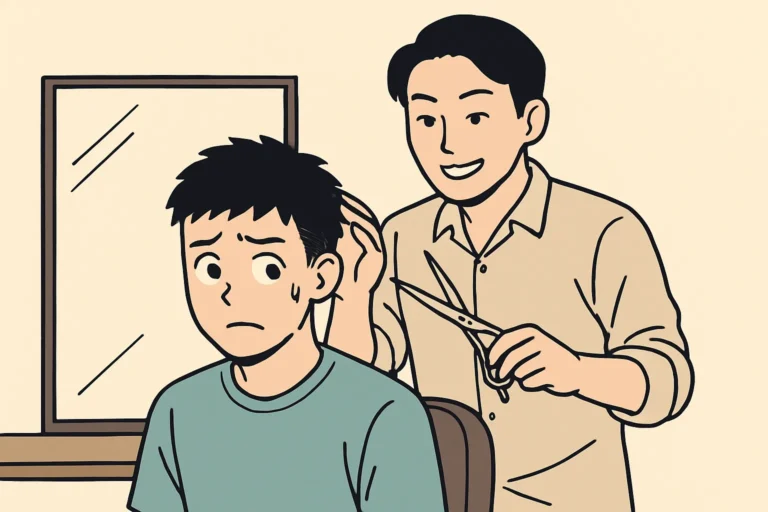
Korean Salon 101: How to Get the “Sports” Haircut!
Hello! This is Maeil Hangul (Daily Korean), here to upgrade your Korean skills!
Ever walked into a Korean hair salon, pointed at a picture, and hoped for the best? Today, we’re going to fix that! We’ll learn how to confidently ask for one of the most popular men’s hairstyles in Korea: the “sports” cut.
Lately in Korea, you’ll see this short, sharp, and clean hairstyle everywhere – from K-pop idols to the leading men in your favorite K-dramas. It’s a classic for a reason! So, if you want a fresh, low-maintenance look, let’s learn the essential phrases to get it done right!
Core Expressions You Need to Know
Here are the key phrases that will make you sound like a pro at the salon.
1. 스포츠 머리 (Seupocheu meori)
- Pronunciation [Romanized]: [Seupocheu meori]
- English Meaning: “Sports” hair (similar to a crew cut or a buzz cut)
- Detailed Explanation: This is the name of the style! It’s a general term for a very short men’s haircut where the hair on top is slightly longer than the sides and back. It’s clean, practical, and very popular. When you say “스포츠 머리,” the hairstylist will immediately know the general style you’re looking for.
- 💡 Pronunciation Tip: The Korean word for “sports” is 스포츠 (seupocheu). Notice the last syllable, 츠 (cheu). It’s not a “choo” sound like in “choose.” It’s a flatter sound made by touching your tongue to the roof of your mouth and releasing a puff of air, almost like a “t” and “s” combined: [ts-eu].
2. 짧게 잘라 주세요 (Jjalpge jalla juseyo)
- Pronunciation [Romanized]: [Jjalpge jalla juseyo]
- English Meaning: Please cut it short.
- Detailed Explanation: This is your main instruction. Let’s break it down:
- 짧게 (jjalpge): Shortly / short (adverb)
- 잘라 (jalla): Cut (from the verb 자르다, jareuda)
- 주세요 (juseyo): Please do (for me)
This is a polite and clear way to ask for a short haircut. You can use it for any style, not just the sports cut!
- 💡 Pronunciation Tip: The first word, 짧게, looks like “jjalp-ge” but is actually pronounced [짤께 / jjalKKe]. Why? The ‘ㅂ’ (b/p) sound at the end of a syllable, when followed by ‘ㄱ’ (g/k), makes the ‘ㄱ’ sound stronger, turning it into ‘ㄲ’ (kk). This is a common Korean sound change rule called 된소리되기 (doensoridwegi), or “tensing.” It makes your pronunciation sound much more natural!
3. 구레나룻은 살려 주세요 (Gurenatruseun sallyeo juseyo)
- Pronunciation [Romanized]: [Gurenaruseun sallyeo juseyo]
- English Meaning: Please leave the sideburns.
- Detailed Explanation: Want to customize your look? This phrase is perfect.
- 구레나룻 (gurenarut): Sideburns
- 은 (eun): Topic marker
- 살려 주세요 (sallyeo juseyo): Please save it / leave it (literally “please make it live”)
You can also say 구레나룻은 밀어 주세요 (gurenaruseun mireo juseyo) if you want them shaved off.
- 💡 Pronunciation Tip: Look at 구레나룻은 (gurenarut-eun). The final consonant ‘ㅅ’ (s) from ‘나룻’ moves over to the next syllable, which starts with a vowel. So, instead of “gurenarut-eun,” it flows together and is pronounced [구레나루슨 / gurenaruseun]. This is called 연음 (yeoneum), or “liaison,” and it’s a fundamental rule that makes Korean sound smooth.
Example Dialogue at the Salon
Let’s see how these phrases work in a real conversation. (A = Hairstylist, B = You)
A: 어서 오세요. 어떻게 해드릴까요?
(Eoseo oseyo. Eotteoke haedeurilkkayo?)
Welcome. How would you like your hair done?B: 안녕하세요. 스포츠 머리로 하고 싶어요. 전체적으로 짧게 잘라 주세요.
(Annyeonghaseyo. Seupocheu meori-ro hago sipeoyo. Jeonchejeogeuro jjalpge jalla juseyo.)
Hello. I’d like a sports cut. Please cut it short overall.A: 네, 알겠습니다. 구레나룻은 어떻게 할까요?
(Ne, algesseumnida. Gurenaruseun eotteoke halkkayo?)
Okay, I understand. What should I do with the sideburns?B: 아, 구레나룻은 살려 주세요.
(A, gurenaruseun sallyeo juseyo.)
Ah, please leave the sideburns.A: 알겠습니다!
(Algesseumnida!)
Got it!
Culture Tip & Trend Deep Dive
The “sports hair” is more than just a haircut in Korea; it’s a cultural icon. You’ll often see male K-pop idols and actors get this cut right before they begin their mandatory military service. It has become a symbol of masculinity and a rite of passage.
Recently, actor Song Kang sported a similar short haircut for his enlistment, and it became a hot topic on social media! When you get this haircut, you’re not just getting a simple trim; you’re tapping into a major Korean trend.
Pro Tip: To make sure you get the exact style you want, always bring a photo! You can show it to the hairstylist and say:
“이 사진처럼 잘라 주세요.” (I sajin-cheoreom jalla juseyo.) – Please cut it like this photo.
Let’s Review and Practice!
Great job today! You’ve learned how to ask for a popular Korean hairstyle, give specific instructions, and even customize your sideburns.
Practice Time!
Fill in the blank for the sentence below. You want to tell the hairstylist to leave your sideburns. What do you say?
구레나룻은 ______ 주세요.
(Answer: 살려)
Now it’s your turn! Try creating your own request for a haircut in the comments below using the phrases we learned today. See you next time
Frequently Asked Questions (FAQ)
Q: What does "스포츠" mean in Korean and how do you pronounce it?
A: In Korean, "스포츠" is pronounced [seupocheu] and means: . Notice the last syllable,
Q: What does "츠" mean in Korean and how do you pronounce it?
A: In Korean, "츠" is pronounced [cheu] and means: . It's not a "choo" sound like in "choose." It's a flatter sound made by touching your tongue to the roof of your mouth and releasing a puff of air, almost like a "t" and "s" combined: [ts-eu].
Q: What does "짧게" mean in Korean and how do you pronounce it?
A: In Korean, "짧게" is pronounced [jjalpge] and means: Shortly / short (adverb)
Q: What does "잘라" mean in Korean and how do you pronounce it?
A: In Korean, "잘라" is pronounced [jalla] and means: Cut (from the verb 자르다,







