

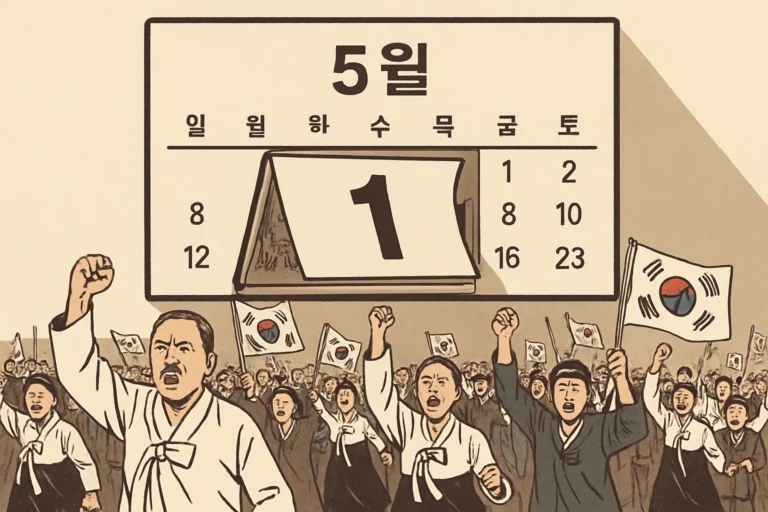
From K-Dramas to Holidays: Master Korean History Talk
Hello! This is Maeil Hangeul, here to upgrade your Korean skills!
Have you ever wondered why you get a day off on certain days in Korea? They aren’t just holidays; they are days full of history and meaning! Today, we’re going to learn how to talk about the historical significance of Korean national holidays. This will be super useful when you want to have deeper conversations with your Korean friends.
Lately in Korea, historical dramas like the hit series “Seoul Echoes” are incredibly popular, making everyone more curious about the country’s past. So, let’s dive in and learn how to discuss these important events like a true insider!
Core Expressions You Need to Know
Here are three essential expressions to help you explain the meaning behind Korea’s national days.
1. 독립운동 (Dongnip Undong)
- Pronunciation [Romanization]: Dongnip Undong
- English Meaning: The Independence Movement
- Detailed Explanation: This is a crucial term in modern Korean history. 독립 (dongnip) means ‘independence’ and 운동 (undong) means ‘movement’. It specifically refers to the long struggle for freedom from Japanese colonial rule (1910-1945). Many national holidays, like March 1st (삼일절), are directly related to this movement. It’s a term filled with respect and patriotism.
- 💡 Pronunciation Tip:
The final ‘ㅂ’ in 독립 (dongnip) is not pronounced like a hard ‘b’. In Korean, when a ‘ㅂ’ (b/p) is a final consonant (받침), it’s pronounced as an unreleased [p] sound. So, it sounds more like “dong-nip” than “dong-nib.”
2. ~을/를 기념하다 (eul/reul Ginyeomhada)
- Pronunciation [Romanization]: Ginyeomhada
- English Meaning: To commemorate / To celebrate
- Detailed Explanation: This is the verb you need when talking about observing an important day. You attach it to the event you are commemorating. For example, “독립운동을 기념해요” (We commemorate the Independence Movement). It’s a formal and respectful verb, perfect for discussing national holidays.
- 💡 Pronunciation Tip:
Listen closely to 기념하다 [ginyeomhada]. The ‘ㅁ’ sound at the end of ‘념’ (nyeom) smoothly connects to the ‘하’ (ha) that follows. This is called liaison (연음). Instead of a pause like “gi-nyeom… hada,” the sounds flow together naturally into “gi-nyeom-ha-da.”
3. 깊은 뜻이 있어요 (Gipeun Tteusi Isseoyo)
- Pronunciation [Romanization]: Gipeun tteusi isseoyo
- English Meaning: It has a deep meaning / There’s a profound significance.
- Detailed Explanation: This phrase is perfect for adding emotional weight to your explanation. 깊은 (gipeun) means ‘deep’, 뜻 (tteut) means ‘meaning’, and 있어요 (isseoyo) means ‘there is’. Use this to explain that a holiday is more than just a day off.
- 💡 Pronunciation Tip:
The pronunciation of 뜻이 [tteusi] is a great example of another liaison rule. The final consonant ‘ㅅ’ (s) in ‘뜻’ moves to the next syllable, but it becomes a tensed sound, [сси]. So, it’s not pronounced “tteut-i” but sounds like [뜨시 | tteusi]. Similarly, the ‘ㅆ’ in 있어요 [isseoyo] is already a tensed sound, so make it sharp and strong!
Example Dialogue
Let’s see how these expressions work in a real conversation!
A (Alex): Hey, we have a holiday next week! What day is it?
B (Sumin): It’s Samiljeol (삼일절), March 1st Movement Day. It’s a very important day for Koreans.
A (Alex): Oh, I think I heard about that while watching the drama “Seoul Echoes”! Can you tell me more?
B (Sumin): Of course! It’s a day to 기념하는 (ginyeomhaneun) the 1919 독립운동 (dongnip undong). For us, it 깊은 뜻이 있어요 (gipeun tteusi isseoyo).
A (Alex): Wow, I see. So it’s not just a day to rest, but a day to remember history.
B (Sumin): Exactly! I’m glad you’re interested.
Culture Tip & Trend Deep Dive
In Korea, national holidays are powerful reminders of the nation’s history of struggle and resilience. They are taught from a young age and respected by everyone.
Recently, historical K-dramas and movies have become a huge trend, especially among the younger Z generation. They aren’t just watching; they’re creating content about it! You’ll see TikToks analyzing the historical accuracy of costumes in “Seoul Echoes” or Instagram posts quoting powerful lines from characters who were independence activists.
Pro Tip: If you’re talking to a Korean friend about a national holiday, using a phrase like “그냥 쉬는 날이 아니라, 정말 깊은 뜻이 있네요” (Geunyang swineun nari anira, jeongmal gipeun tteusi inneyo – It’s not just a day off, it truly has a deep meaning) will really impress them! It shows you understand and respect the culture beyond the surface level.
Let’s Wrap It Up & Practice!
Great job today! We learned three key expressions—독립운동 (Independence Movement), 기념하다 (to commemorate), and 깊은 뜻이 있어요 (it has a deep meaning)—to help you talk about Korean history like a pro.
Now, it’s your turn to practice!
- Fill in the blank: Korea’s Liberation Day (광복절) is on August 15th. How would you say, “It’s a day that commemorates the Independence Movement”?
독립운동을 ___________ 날이에요.
- Your turn! Think about a holiday in your own country. Using the expressions we learned today, try to write one sentence in Korean explaining its significance.
Share your answers in the comments below! We are excited to see what you come up with. Keep up the great work
Frequently Asked Questions (FAQ)
Q: What does "독립" mean in Korean and how do you pronounce it?
A: In Korean, "독립" is pronounced [dongnip] and means: means 'independence' and
Q: What does "운동" mean in Korean and how do you pronounce it?
A: In Korean, "운동" is pronounced [undong] and means: means 'movement'. It specifically refers to the long struggle for freedom from Japanese colonial rule (1910-1945). Many national holidays, like March 1st (삼일절), are directly related to this movement. It’s a term filled with respect and patriotism.
Q: What does "독립" mean in Korean and how do you pronounce it?
A: In Korean, "독립" is pronounced [dongnip] and means: is not pronounced like a hard 'b'. In Korean, when a 'ㅂ' (b/p) is a final consonant (받침), it's pronounced as an unreleased [p] sound. So, it sounds more like "dong-nip" than "dong-nib."
Q: What does "기념하다" mean in Korean and how do you pronounce it?
A: In Korean, "기념하다" is pronounced [ginyeomhada] and means: . The 'ㅁ' sound at the end of '념' (nyeom) smoothly connects to the '하' (ha) that follows. This is called







