

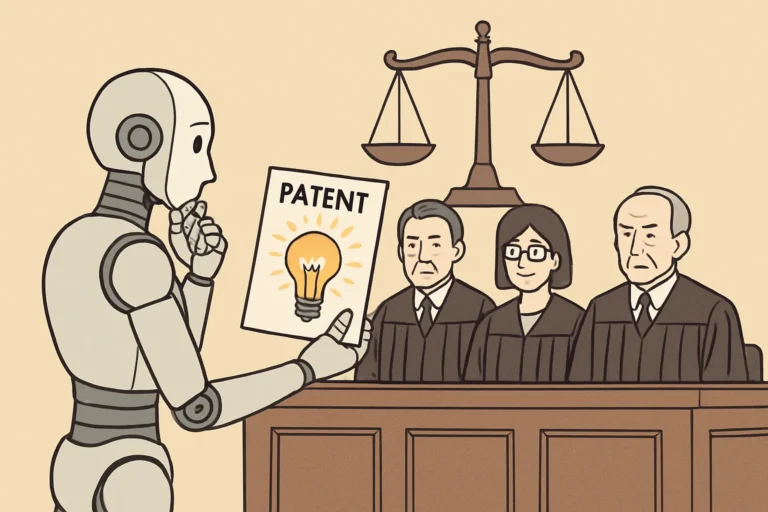
AI as an Inventor? Korea’s Hot Patent Debate!
Hello! Welcome to [Maeil Hangeul], your go-to source for upgrading your Korean skills to the highest level!
Are you ready to dive into a topic that’s challenging even for native speakers? Today, we’re moving beyond everyday conversation and into the heart of a cutting-edge debate happening in Korea right now: Can an Artificial Intelligence be an inventor? As Korea is a global tech leader, the legal and ethical discussions surrounding AI are incredibly intense. We’ll explore the complex Korean vocabulary and expressions being used in courtrooms and news headlines to discuss this fascinating ethical dilemma. Let’s get started!
Core Expressions for the AI Debate
Here are some essential terms you need to know to understand and participate in this high-level discussion.
1. 발명자 (balmyeongja)
- Pronunciation [Romanization]: [bal-myeong-ja]
- English Meaning: Inventor
- Detailed Explanation: This word is a combination of 발명 (balmyeong), meaning “invention,” and the Hanja character 자 (ja, 者), which means “person” or “-er.” Traditionally and legally, 발명자 has always referred to a human being. The core of the current debate is whether this definition can be expanded to include a non-human entity like an AI. It’s a formal and technical term used in legal documents and academic papers.
-
💡 Pronunciation Tip:
The pronunciation is quite straightforward and follows the spelling. Ensure you clearly articulate each syllable: [발/bal], [명/myeong], [자/ja].
2. 특허권을 부여하다 (teukeogwoneul buyeohada)
- Pronunciation [Romanization]: [teu-keo-gwo-neul bu-yeo-ha-da]
- English Meaning: To grant patent rights
-
Detailed Explanation: This is a crucial phrase in intellectual property law. Let’s break it down: 특허권 (teukeogwon) means “patent rights,” and 부여하다 (buyeohada) is a formal verb meaning “to grant,” “to bestow,” or “to confer.” You’ll see 부여하다 used in contexts involving rights, authority, or official status. It carries a much more formal weight than the simpler verb 주다 (juda – to give).
-
💡 Pronunciation Tip:
The word 특허권 has two aspirated consonants, ㅌ(t) and ㅋ(k), which require a strong puff of air. It’s not [du-ko-kwon] but [teu-keo-gwon]. The final consonant of 권 (n) links to the following particle 을, making the sound smooth: [teukeogwoneul].
3. 법적 쟁점 (beopjeok jaengjeom)
- Pronunciation [Romanization]: [beop-jjeok jaeng-jjeom]
- English Meaning: Legal issue; point of contention
-
Detailed Explanation: This is a key piece of advanced vocabulary for any debate. 법적 (beopjeok) is an adjective meaning “legal” or “related to the law.” 쟁점 (jaengjeom) refers to the central point of an argument or dispute. Together, 법적 쟁점 identifies the specific legal question that is being fiercely debated. The question “Can AI be a 발명자?” is the central 법적 쟁점 in this case.
-
💡 Pronunciation Tip:
Due to a phonological rule called ‘tensing’ (경음화), the ‘ㅈ’ sounds in both 적 and 쟁점 become tense, like ‘ㅉ’. So, instead of [beop-jeok jaeng-jeom], the natural pronunciation is [beop-jjeok jaeng-jjeom]. This tensing happens after a stop consonant like ‘ㅂ’.
4. 전례 없는 (jeollye eomneun)
- Pronunciation [Romanization]: [jeol-lye eom-neun]
- English Meaning: Unprecedented
-
Detailed Explanation: This adjective describes a situation that has never happened before. 전례 (jeollye) means “precedent,” and 없는 (eomneun) means “non-existent.” This phrase perfectly captures the novelty of the AI inventor case. Because there is no legal history or precedent to follow, courts and lawmakers must create new interpretations. It emphasizes the groundbreaking and challenging nature of the situation.
-
💡 Pronunciation Tip:
There are two important sound changes here. First, in 전례, the ‘ㄴ(n)’ sound before ‘ㄹ(r/l)’ causes the ‘ㄴ’ to change to an ‘ㄹ’ sound. This is called ‘liquidization.’ So, it is pronounced [절례/jeol-lye]. Second, in 없는, the ‘ㅂ’ sound in the final position of the first syllable links to the next syllable, so you pronounce it clearly as [엄는/eom-neun].
Example Dialogue
Let’s see how these terms are used in a natural conversation between two colleagues discussing the latest tech news.
A: 요즘 뉴스 보셨어요? 인공지능 발명에 특허권을 부여하는 문제가 한국에서 주요 법적 쟁점이 되고 있대요.
(Did you see the news? The issue of granting patent rights to AI inventions is becoming a major legal issue in Korea.)
B: 네, 저도 봤어요. 인공지능 ‘다부스(DABUS)’를 공식적인 발명자로 인정할지에 대한 법원의 판단은 정말 전례 없는 일이죠.
(Yes, I saw that too. The court’s decision on whether to recognize the AI ‘DABUS’ as an official inventor is truly unprecedented.)
A: 맞아요. 인공지능의 창작물을 법적으로 어떻게 보호해야 할지, 사회적 합의가 시급해 보여요.
(Exactly. It seems we urgently need a social consensus on how to legally protect the creations of AI.)
B: 이 판결이 미래 산업과 기술 발전에 미칠 영향이 엄청날 거예요.
(The impact of this ruling on future industries and technological development will be enormous.)
Culture & Trend Deep Dive
This isn’t just a theoretical exercise; it’s a real-life drama unfolding in the Korean legal system. The AI in question, named DABUS, has applied for patents worldwide. While many countries have rejected its application, the case has reached the Supreme Court of Korea (대법원).
This makes Korea a key battleground for the future of intellectual property. Why? Because as a nation that prides itself on technological innovation and has one of the highest rates of patent applications per capita, the outcome will set a significant global precedent.
In Korean media, this debate is often described with the term 갑론을박 (gaplon-eulbak), which means a “fierce and heated debate” with strong arguments on both sides. On one side, people argue that denying AI inventorship could stifle innovation. On the other, many believe that inventorship is a fundamentally human concept tied to consciousness and intent. By following this 법적 쟁점, you’re not just learning Korean; you’re gaining insight into the complex ethical challenges a technologically advanced society like South Korea is facing head-on.
Wrap-up & Practice!
Today, we explored the sophisticated language used to discuss the ethical dilemma of AI inventorship. We learned key terms like 발명자 (inventor), 특허권을 부여하다 (to grant patent rights), 법적 쟁점 (legal issue), and 전례 없는 (unprecedented).
Now it’s your turn to be the expert!
Practice Question:
In your opinion, should an AI be recognized as an inventor? Using the advanced expressions we learned today, write a short paragraph in Korean expressing your viewpoint.
인공지능을 발명자로 인정해야 할까요? 오늘 배운 표현(예: 법적 쟁점, 전례 없는)을 사용하여 여러분의 의견을 댓글로 남겨주세요!
We can’t wait to read your insightful opinions. Keep pushing the boundaries of your Korean
Frequently Asked Questions (FAQ)
Q: What does "발명" mean in Korean and how do you pronounce it?
A: In Korean, "발명" is pronounced [balmyeong] and means: , meaning "invention," and the Hanja character
Q: What does "자" mean in Korean and how do you pronounce it?
A: In Korean, "자" is pronounced [ja, 者] and means: , which means "person" or "-er." Traditionally and legally,
Q: What does "특허권" mean in Korean and how do you pronounce it?
A: In Korean, "특허권" is pronounced [teukeogwon] and means: means "patent rights," and
Q: What does "부여하다" mean in Korean and how do you pronounce it?
A: In Korean, "부여하다" is pronounced [buyeohada] and means: is a formal verb meaning "to grant," "to bestow," or "to confer." You'll see







