

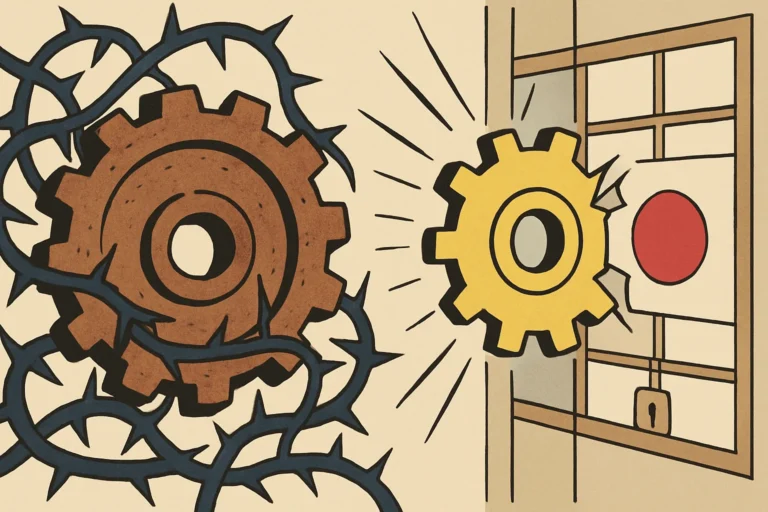
Korea’s Take: Why Russia & Japan’s Industrial Revolutions Stalled
Hello! Welcome to [Maeil Hangeul], the place to upgrade your Korean skills to the next level!
Ready to move beyond everyday chats and dive into some high-level discourse? Today, we’re tackling a fascinating academic topic: analyzing why industrialization was delayed in certain regions, like Russia and Japan. You might wonder, “Why learn this?” In Korea, discussing history, economics, and social structures is a common feature of intellectual conversations, academic papers, and even popular YouTube channels that break down complex issues. Mastering this vocabulary will empower you to participate in these deep and engaging discussions, sounding like a true expert.
Let’s get started!
Core Expressions for Advanced Analysis
Here are four essential expressions you’ll need to analyze historical and social phenomena like a pro.
1. -으로 기인하다 (euro giin-hada)
- English Meaning: to be attributed to; to result from; to be caused by
- Detailed Explanation: This is a formal, academic phrase used to pinpoint the root cause of a phenomenon. It’s far more sophisticated than simply using ‘때문에’ (because of). It comes from the Hanja characters 起 (to begin) and 因 (cause), literally meaning “to originate from a cause.” Use this in presentations, essays, or formal debates to sound highly educated.
- 💡 Pronunciation Tip: In a phrase like ‘여러 요인으로 기인하다’ (yeoreo yoin-euro giin-hada), notice the smooth connection. The final consonant ‘ㄴ’ (n) in ‘요인’ (yoin) links directly to the following vowel ‘으’ (eu), creating the sound [요인으로 | yoineuro]. This linking rule, called yeon-eum (연음), is key to fluent Korean pronunciation.
2. 고질적인 문제 (gojil-jeogin munje)
- English Meaning: a chronic problem; a deep-rooted issue
- Detailed Explanation: ‘고질적’ describes a problem that is long-standing, persistent, and extremely difficult to solve, much like a chronic illness (고질병). It implies the issue is embedded within the very structure of a system or society. It’s the perfect term for describing issues like systemic corruption, deep-seated inequality, or, in our historical context, serfdom.
- 💡 Pronunciation Tip: The ‘ㅈ’ in ‘고질적인’ is a standard ‘j’ sound. However, pay attention to the aspiration in a verb often used with it, like ‘저해했다’ [jeohae-haetda] (hindered). The ‘ㅎ’ (h) sound should be a distinct puff of air. Practice distinguishing between ‘해’ (hae) and ‘애’ (ae) to master this nuance.
3. 폐쇄적인 정책 (pyeswae-jeogin jeongchaek)
- English Meaning: an isolationist policy; a closed-door policy
- Detailed Explanation: Coming from the Hanja 閉 (to close) and 鎖 (to lock), ‘폐쇄적’ means “closed off” or “exclusionary.” It’s the definitive term for discussing policies like Japan’s Sakoku (쇄국 정책) during the Edo period. You can also use it to describe a closed-off society, an exclusive community, or even a person with a reserved personality.
- 💡 Pronunciation Tip: This phrase contains a “tense” or fortis consonant. The ‘쇄’ in ‘폐쇄적’ is pronounced like [sswae], with more tension and no aspiration, similar to ‘ㅆ’. Likewise, the ‘책’ in ‘정책’ is pronounced like [chaek] but with the tension of ‘ㅉ’. Mastering these tense sounds (ㄲ, ㄸ, ㅃ, ㅆ, ㅉ) is a hallmark of an advanced speaker.
4. 더딘 개혁 (deodin gaehyeok)
- English Meaning: sluggish reform; slow-paced reform
- Detailed Explanation: ‘더디다’ is a beautiful native Korean adjective meaning “to be slow, tardy, or sluggish.” While you could say ‘느린 개혁’ (neurin gaehyeok), ‘더딘 개혁’ carries a stronger nuance of frustration or a lack of momentum. It implies that the reforms are not just slow, but are proceeding at a disappointingly sluggish pace.
- 💡 Pronunciation Tip: Here’s a pro tip for sounding natural. The possessive particle ‘의’ (ui) is often pronounced as [에 | e] in conversational and even formal speech, especially after a consonant. So, ‘개혁의 원인’ (gaehyeog-ui won-in) is fluidly pronounced as [개혁에 원인 | gaehyeoge won-in]. Applying this small change will make your speech flow much more smoothly.
Example Dialogue
Let’s see these terms in a conversation between two university students.
A: 러시아의 산업화 지연에 대한 발표를 준비 중인데, 정말 복합적이네요.
(Reosia-ui saneop-hwa jiyeon-e daehan balpyo-reul junbi jung-inde, jeongmal bokhap-jeogineyo.)
(I’m preparing a presentation on Russia’s delayed industrialization, and it’s so complex.)
B: 맞아요. 특히 농노제와 같은 고질적인 문제가 경제 발전의 발목을 잡았다고 봐요.
(Majayo. Teuki nongnoje-wa gateun gojil-jeogin munje-ga gyeongje baljeon-ui balmok-eul jabatdago bwayo.)
(I agree. I think chronic problems like serfdom really held back economic development.)
A: 저도 동의해요. 일본이 폐쇄적인 정책을 버리고 빠르게 근대화에 성공한 것과는 대조적이죠.
(Jeodo dong-uihaeyo. Ilbon-i pyeswae-jeogin jeongchaek-eul beorigo ppareuge geundaehwa-e seonggong-han geot-gwaneun daejojeog-ijyo.)
(I agree. It’s a stark contrast to Japan, which succeeded in modernizing quickly after abandoning its isolationist policy.)
B: 물론 일본도 처음에는 더딘 개혁으로 어려움을 겪었죠. 모든 변화가 다수의 저항으로 기인한 것이니까요.
(Mullon ilbondo cheoeum-eneun deodin gaehyeok-euro eoryeoum-eul gyeokkeotjyo. Modeun byeonhwa-ga dasu-ui jeohang-euro giin-han geosinikkayo.)
(Of course, Japan also struggled with sluggish reforms at first. After all, all the changes were caused by resistance from the majority.)
Cultural Tip & Trend Deep Dive
In contemporary Korea, this type of analytical language is everywhere. You’ll hear commentators on economic news channels use ‘고질적인 문제’ to describe issues like the declining birth rate or the real estate bubble. They might analyze a company’s downfall by saying its failure ‘으로 기인했다’ to a rigid corporate culture.
Furthermore, understanding the historical context of Japan’s ‘폐쇄적인 정책’ and its subsequent rapid change is crucial because it’s often used as a point of comparison when Koreans discuss their own nation’s dramatic development, the famous “Miracle on the Han River” (한강의 기적). By using these terms, you’re not just speaking Korean; you’re participating in the ongoing national conversation about Korea’s past, present, and future.
Let’s Practice!
Time to put your knowledge to the test.
- Fill in the blank: The crisis was ultimately ______ a lack of communication.
그 위기는 궁극적으로 소통의 부재____ ____. - Sentence Challenge: Using ‘더딘 개혁’, write a short sentence about a reform process you know of (in any country!).
You are now equipped with the vocabulary to discuss complex historical and social issues with nuance and precision. Great job!
Try creating your own sentence in the comments below using one of today’s expressions. We can’t wait to see your amazing skills!







