

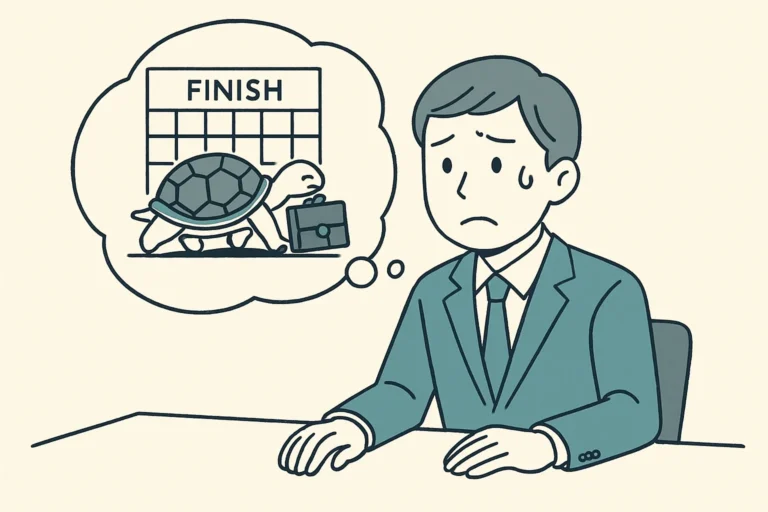
Project Delays? Master Korean Phrases for “What If” Scenarios!
Hello! Welcome to [Maeil Hangul], your go-to blog for upgrading your Korean skills!
Have you ever been in a meeting, worried about a potential problem, but didn’t know how to bring it up politely in Korean? Today, we’re going to tackle exactly that! We’ll learn how to express hypotheses and speculation, especially in a business context.
In today’s fast-paced Korean work culture, unexpected issues are common. Being able to discuss “what if” scenarios, like a project falling behind schedule, not only shows your language skills but also makes you look like a proactive and reliable team member. Let’s learn how to navigate these tricky conversations with confidence!
Core Expressions for Speculation
Here are three essential patterns for discussing potential future problems at work.
1. -(으)ㄹ 텐데 (I suppose/expect that…)
- Korean Expression: 보고서 마감이 늦어질 텐데, 걱정이에요.
- Pronunciation [Romanization]: Bogoseo magam-i neujeojil tende, geokjeong-ieyo.
- English Meaning: I expect the report deadline will be late, so I’m worried.
- Detailed Explanation: This pattern is used when you have a strong reason to believe or expect something will happen. It’s not just a wild guess. The
-(으)ㄹ 텐데part sets up the expected situation, and the clause that follows usually expresses a related concern, suggestion, or question. It’s a polite and common way to introduce a potential issue in the workplace. - 💡 Pronunciation Tip:
The key is the sound of텐데[ten-de]. The ‘ㅌ’ (t) sound is aspirated, meaning you should feel a small puff of air when you say it, making it stronger than a simple ‘t’. Think of the ‘t’ in “top”. In늦어질[neu-jeo-jil], the final consonant ‘ㅈ’ (j) of늦links to the next syllable어, creating a smooth [jeo] sound. It’s not “neut-eo-jil,” but a fluid “neu-jeo-jil.”
2. -는/ㄴ다고 가정하면 (Assuming that…)
- Korean Expression: 클라이언트가 디자인을 안 좋아한다고 가정하면, 어떻게 하죠?
- Pronunciation [Romanization]: Keullaieonteu-ga dijain-eul an joahandago gajeonghamyeon, eotteoke hajyo?
- English Meaning: Assuming the client doesn’t like the design, what do we do?
- Detailed Explanation: This is your go-to phrase for creating a clear hypothetical situation for discussion.
가정하다literally means “to assume.” By using this pattern, you can openly explore worst-case scenarios and plan countermeasures with your team without causing panic. It’s a very logical and productive way to problem-solve. - 💡 Pronunciation Tip:
In안 좋아한다[an jo-a-han-da], the ‘ㅎ’ (h) sound is often very weak or silent when sandwiched between other sounds. So, it sounds more like [안 조아한다 (an jo-a-han-da)]. This natural weakening of ‘ㅎ’ is very common in spoken Korean and will make you sound much more fluent!
3. -(으)ㄹ지도 모르다 (It might… / It’s possible that…)
- Korean Expression: 예산이 부족해질지도 몰라요.
- Pronunciation [Romanization]: Yesan-i bujokaejilji-do mollayo.
- English Meaning: We might run out of budget. / It’s possible the budget will become insufficient.
- Detailed Explanation: This expression is perfect for mentioning a possibility in a softer, less direct way. It conveys uncertainty. Instead of stating “We will run out of budget,” which sounds alarming, this phrase gently introduces a potential risk that needs to be considered. It’s a great way to show foresight while maintaining team harmony.
- 💡 Pronunciation Tip:
Pay attention to부족해질지도[bu-jo-kae-jil-ji-do]. Here, the final consonant ‘ㄱ’ (g/k) from족meets the ‘ㅎ’ (h) from해. They combine to create a strong, aspirated ‘ㅋ’ (k) sound. This sound change rule (consonant aspiration) is why the pronunciation is [부조캐질지도] and not [부족해질지도]. It’s a fantastic trick to make your Korean sound more natural!
Example Dialogue
Let’s see how Team Leader Park (A) and Manager Kim (B) use these expressions to discuss their new app development project.
A (박 팀장): 김 대리, 우리 앱 출시일이 조금 늦어질 텐데, 괜찮을까요?
(Gim daeri, I expect our app launch date will be a bit delayed, will that be okay?)
B (김 대리): 음… 원래 계획보다 늦는다고 가정하면, 마케팅팀과 일정을 다시 조율해야 합니다.
(Hmm… Assuming it will be later than originally planned, we need to re-coordinate the schedule with the marketing team.)
A (박 팀장): 맞아요. 그리고 추가 개발 비용이 발생할지도 몰라요.
(That’s right. And it’s also possible that additional development costs will arise.)
B (김 대리): 네, 그 부분도 미리 확인해서 보고드리겠습니다.
(Okay, I will check on that part in advance and report back to you.)
Culture Tip & Trend Deep Dive
In Korean work culture (직장 문화), being proactive and demonstrating foresight is highly valued. This is often described as having good 눈치 (nunchi) — the subtle art of sensing a situation and reacting appropriately.
Using speculative expressions like -(으)ㄹ 텐데 or -(으)ㄹ지도 몰라요 is a key part of this. It shows you are thinking ahead (미리미리 생각하다) and considering potential risks. Instead of waiting for a problem to become a crisis, you are flagging it for discussion early on.
This approach is seen as responsible and considerate. It allows the team to prepare solutions together, rather than placing blame after something goes wrong. So, next time you’re in a meeting, don’t be afraid to use these phrases. Your Korean colleagues will be impressed with your thoughtful communication style!
Wrap-up & Practice Time!
Today we learned three powerful ways to talk about “what if” scenarios:
- -(으)ㄹ 텐데: To state a strong expectation and raise a concern.
- -는/ㄴ다고 가정하면: To set up a clear hypothetical for discussion.
- -(으)ㄹ지도 모르다: To gently suggest a possibility.
Now, it’s your turn to practice!
1. Fill in the blank:
내일 회의가 예상보다 길어질 ________, 점심 약속을 취소해야겠어요.
(I expect the meeting tomorrow will be longer than expected, so I should probably cancel my lunch plans.)
2. Create a sentence:
How would you say, “Assuming the flight is cancelled, what is our backup plan?” using
-는/ㄴ다고 가정하면?
Share your answers in the comments below using one of the expressions we learned today! We’d love to see what you come up with. Keep up the great work







