

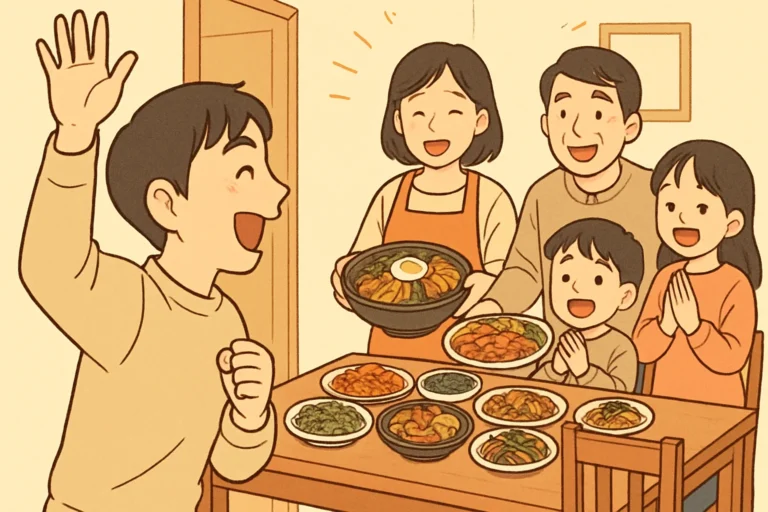
K-Drama Family Dinner? Yes, I’m Coming!
Hello! This is Maeil Hangul, here to upgrade your Korean skills!
Have you ever been invited to a Korean friend’s home for a meal? It’s an exciting experience! But how do you say “Yes, I’d love to!” in a natural and friendly way?
These days in Korea, the family drama ‘The Kim Family’s Secret Recipe’ (김가네 비법 레시피) is a huge hit, and everyone is dreaming of being invited to their warm, delicious family dinners. Today, let’s learn how to accept an invitation just like that, so you’re ready when your moment comes!
Core Expressions You Need to Know
Here are three simple but powerful expressions to accept an invitation with a smile.
1. 네, 갈게요! (Ne, galgeyo!)
- Pronunciation [네, 갈께요 / ne, galkkeyo]
- English Meaning: Yes, I’ll go! / Yes, I’ll be there!
- Detailed Explanation: This is the most direct and common way to accept an invitation to go somewhere. It’s polite (
-요ending) but also friendly and shows your clear intention to go. The grammar point-(으)ㄹ게요expresses a promise or the speaker’s will. - 💡 Pronunciation Tip:
Even though it’s written as갈게요 (gal-ge-yo), Koreans actually pronounce it as [갈께요 (galkkeyo)]. Why? When the grammar ending-ㄹ게(요)follows a verb stem, theㄱ(g)sound naturally becomes tense, like theㄲ(kk)sound. This makes your speech sound much more fluid and native!
2. 좋아요! (Joayo!)
- Pronunciation [조아요 / joayo]
- English Meaning: Sounds good! / Great! / I’d love to!
- Detailed Explanation: This is a fantastic, all-purpose expression to show your positive feelings about a suggestion. You can use it before saying “네, 갈게요!” to add more enthusiasm. It literally means “it is good.”
- 💡 Pronunciation Tip:
Notice the last letter of the first block isㅎ(h). When a syllable ending inㅎ(h)is followed by a vowel (like ‘아’), theㅎ(h)becomes silent! So, you don’t pronounce it asjoh-a-yo. Instead, the sounds blend together smoothly to become [jo-a-yo]. The same rule applies to괜찮아요 (gwaenchanayo), which is pronounced [괜차나요 / gwaenchanayo].
3. 기대돼요! (Gidaedwaeyo!)
- Pronunciation [기대돼요 / gidaedwaeyo]
- English Meaning: I’m looking forward to it! / I’m excited!
- Detailed Explanation: After you’ve accepted the invitation, use this phrase to show your genuine excitement. It will make the person who invited you feel great! It’s a wonderful way to express positive anticipation.
- 💡 Pronunciation Tip:
The돼(dwae)sound can be tricky. It’s a combination of ‘d’ + ‘wae’. Think of saying the English word “dweeb” but stopping before the ‘b’. Practice making a ‘w’ sound right after the ‘d’ sound: dwae. Once you get it, you’ll sound super natural!
Example Dialogue
Let’s see how these expressions work in a real conversation. Imagine your friend Min-jun invites you to his family dinner.
- A (Min-jun): 이번 주말에 우리 가족 다 같이 저녁 먹는데, 너도 올래? 완전 ‘김가네 비법 레시피’ 드라마처럼!
- (This weekend, my whole family is having dinner together. Do you want to come? It’ll be just like the drama ‘The Kim Family’s Secret Recipe’!)
- B (You): 와, 정말? 좋아요! 네, 갈게요!
- (Wow, really? Sounds good! Yes, I’ll go!)
- A (Min-jun): 잘됐다! 토요일 저녁 6시야.
- (Awesome! It’s Saturday at 6 PM.)
- B (You): 알겠어! 너무 기대돼요!
- (Got it! I’m so excited!)
✨ Culture Tip & Trend Deep Dive
In Korea, being invited to a family meal is a sign of close friendship and acceptance. Dramas like ‘The Kim Family’s Secret Recipe’ are popular because they highlight the importance of 정 (jeong), a special Korean concept of deep connection, warmth, and affection that is often shared over food.
Want to be the perfect guest? When you accept an invitation to someone’s home, it’s a common and thoughtful gesture to bring a small gift. It doesn’t have to be expensive! A box of juice, some seasonal fruits, or a small cake are all popular choices. This small act shows your gratitude and will definitely impress your friend’s family!
Let’s Practice!
Time to check what you’ve learned!
1. Fill in the blank:
Your friend asks, “Wanna go see a movie with me?” (영화 보러 갈래?). You want to show you think it’s a great idea. You say:
“______! What movie?” (______! 무슨 영화?)
2. What would you say?
You’ve just been invited to a birthday party next week. How do you say, “I’m looking forward to it!” in Korean?
You did an amazing job today! Now you’re ready to accept any invitation that comes your way.
Leave a comment below using one of today’s expressions! We’d love to see you practice
Frequently Asked Questions (FAQ)
Q: What does "정" mean in Korean and how do you pronounce it?
A: In Korean, "정" is pronounced [jeong] and means: , a special Korean concept of deep connection, warmth, and affection that is often shared over food.







