

Hello! Welcome to [Maeil Hangeul], here to upgrade your Korean skills!
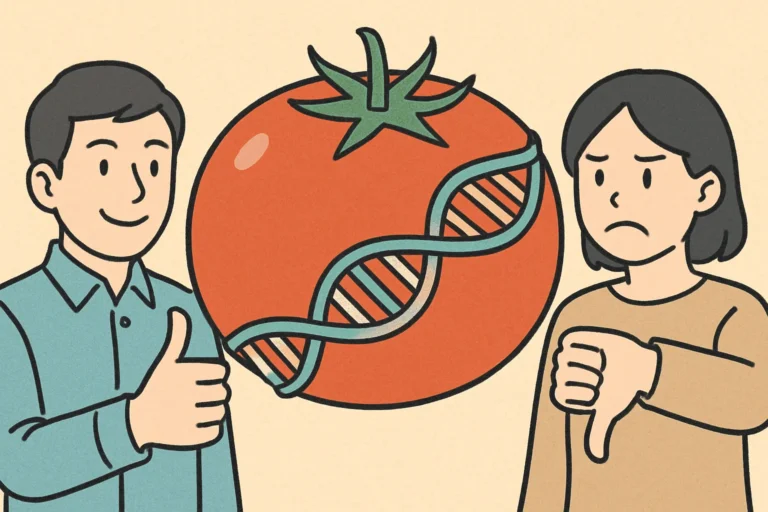
Have you ever talked about a serious topic with your Korean friends? Today, we’re going to tackle a subject that’s getting more and more attention worldwide: Genetically Modified Foods, or GMOs. Lately in Korea, there’s a huge interest in food safety and organic products (유기농), making GMOs a hot topic in the news and at the dinner table. Learning how to express your opinion on this will not only boost your vocabulary but also allow you to have deeper, more meaningful conversations. Let’s get started!
Core Expressions for the GMO Debate
Here are the essential phrases you need to state your case clearly and respectfully.
1. 유전자 변형 식품 (Yujeonja byeonhyeong sikpum)
- Pronunciation [Romanized]: Yujeonja byeonhyeong sikpum
- English Meaning: Genetically Modified Food (GMO)
- Detailed Explanation: This is the formal term for GMOs. Let’s break it down: 유전자 (yujeonja) means ‘gene’, 변형 (byeonhyeong) means ‘modification’ or ‘transformation’, and 식품 (sikpum) means ‘food product’. You’ll see this term in articles, news reports, and formal discussions.
- 💡 Pronunciation Tip:
The ‘ㅕ’ (yeo) sound in 변형 (byeonhyeong) can be tricky. It’s a quick combination of ‘y’ and ‘eo’ (like the ‘u’ in ‘but’). Practice saying “yuh” quickly. Try to make it one smooth sound: [byeon-hyeong].
2. -에 대해 찬성하다/반대하다 (-e daehae chanseonghada/bandaehada)
- Pronunciation [Romanized]: -e daehae chanseong-hada / bandae-hada
- English Meaning: To be in favor of / To be against…
- Detailed Explanation: This is the perfect grammar pattern to clearly state your position. You attach it to the noun you’re discussing. For example, “저는 유전자 변형 식품에 대해 찬성해요.” (I am in favor of GMOs.) or “저는 반대하는 입장이에요.” (I am in the position of opposing it.)
- 💡 Pronunciation Tip:
In 찬성하다 (chanseonghada), the first syllable ‘찬’ has an aspirated ‘ㅊ’ (ch) sound, so release a puff of air like you’re saying “chance.” In 반대하다 (bandaehada), the ‘ㄷ’ (d) in the second syllable becomes a tense, strong sound, almost like a ‘ㄸ’ (tt). It is pronounced [반대하다 (bandaehada)], not [ban-dae-ha-da].
3. 장단점이 있다 (Jangdanjeomi itda)
- Pronunciation [Romanized]: Jangdanjeomi itda
- English Meaning: It has pros and cons.
- Detailed Explanation: This is a fantastic, neutral phrase to start a balanced discussion. 장점 (jangjeom) means ‘advantage’ or ‘pro,’ and 단점 (danjeom) means ‘disadvantage’ or ‘con.’ It shows that you understand the complexity of the issue.
- 💡 Pronunciation Tip:
This is a great example of a Korean linking sound rule called ‘연음 (yeoneum)’. The final consonant ‘ㅁ’ (m) from 점 (jeom) moves into the empty consonant spot of the next syllable ‘이 (i)’. So, instead ofjang-dan-jeom-i, it is pronounced smoothly as [장단저미 (jangdanjeomi)].
4. ~기는 하지만 (~gi-neun hajiman)
- Pronunciation [Romanized]: ~gi-neun hajiman
- English Meaning: Although it is true that… / It does… but…
- Detailed Explanation: This advanced structure is perfect for acknowledging the other person’s point before presenting your own argument. It makes you sound very fluent and considerate. You attach it to a verb stem. Example: “생산량을 늘릴 수 있기는 하지만, 안전성이 아직 걱정돼요.” (Although it’s true that it can increase production, I am still worried about its safety.)
- 💡 Pronunciation Tip:
Focus on connecting the parts smoothly. The core isVerb Stem + 기는 하지만. The rhythm is key. Think of it as: “(Fact is true)… but… (my opinion).”
Example Dialogue
Let’s see how these expressions work in a real conversation between two friends, Minjun and Sora.
A (Minjun): 소라야, 어제 뉴스 봤어? 새로운 유전자 변형 식품이 개발됐대.
(Sora, did you see the news yesterday? They said a new GMO food was developed.)
Sora-ya, eoje nyuseu bwasseo? Saeroun yujeonja byeonhyeong sikpumi gaebaldwaetdae.
B (Sora): 아, 진짜? 그 문제에 대해서는 항상 장단점이 있는 것 같아.
(Oh, really? I feel like that issue always has its pros and cons.)
A, jinjja? Geu munje-e daehaeseoneun hangsang jangdanjeomi inneun geot gata.
A (Minjun): 맞아. 식량 부족 문제를 해결할 수 있기는 하지만, 장기적인 영향은 아무도 모르잖아.
(That’s right. Although it can solve food shortages, nobody knows the long-term effects.)
Maja. Singnyang bujok munjereul haegyeolhal su itgineun hajiman, jang-gijeogin yeonghyang-eun amudo moreujana.
B (Sora): 내 말이 그 말이야. 그래서 나는 개인적으로 GMO에 대해 반대하는 편이야. 넌 어때?
(That’s exactly what I mean. That’s why I personally tend to be against GMOs. What about you?)
Nae mari geu mariya. Geuraeseo naneun gaeinjeogeuro GMO-e daehae bandaehaneun pyeoniya. Neon eottae?
Culture Tip & Trend Deep Dive
In Korea, food transparency is a big deal. Walk into any major supermarket like E-Mart or Lotte Mart, and you’ll see many products proudly labeled “무농약” (mu-nong-yak – pesticide-free), “유기농” (yuginong – organic), or even “Non-GMO”.
The Korean government has strict labeling laws, and consumers, especially the health-conscious MZ generation and parents, actively seek out products they perceive as natural and safe. While the debate on the science of GMOs continues, the cultural trend in Korea leans heavily towards caution. So, if you use a phrase like “장단점이 있는 것 같아요” (I think it has pros and cons), you’ll sound like a thoughtful person who understands the local sentiment. Mentioning your concern for “안전성” (anjeonseong – safety) will also make your argument very relatable to Korean listeners.
Wrap-up & Practice Time!
Great job today! We learned how to discuss the complex topic of GMOs using four key expressions:
* 유전자 변형 식품 (GMO)
* -에 대해 찬성하다/반대하다 (to favor/oppose)
* 장단점이 있다 (to have pros and cons)
* -기는 하지만 (Although…, but…)
Now it’s your turn to practice!
Quiz: Fill in the blank with the correct phrase.
You believe GMOs are a good solution for world hunger. How would you express this?
저는 GMO가 식량 문제를 해결할 수 있다고 생각해서 GMO에 대해 _________.
(I think GMOs can solve the food problem, so I _________ GMOs.)(찬성해요 / 반대해요)
What is your real opinion? Try to make your own sentence using one of today’s expressions! Share your thoughts on GMOs in the comments below! We’d love to see you practice.
Frequently Asked Questions (FAQ)
Q: What does "유전자" mean in Korean and how do you pronounce it?
A: In Korean, "유전자" is pronounced [yujeonja] and means: means 'gene',
Q: What does "변형" mean in Korean and how do you pronounce it?
A: In Korean, "변형" is pronounced [byeonhyeong] and means: means 'modification' or 'transformation', and
Q: What does "식품" mean in Korean and how do you pronounce it?
A: In Korean, "식품" is pronounced [sikpum] and means: means 'food product'. You'll see this term in articles, news reports, and formal discussions.
Q: What does "변형" mean in Korean and how do you pronounce it?
A: In Korean, "변형" is pronounced [byeonhyeong] and means: can be tricky. It's a quick combination of 'y' and 'eo' (like the 'u' in 'but'). Practice saying "yuh" quickly. Try to make it one smooth sound:







