

Feeling Under the Weather? Korean Phrases to Say “Get Well Soon!”
Hello! This is Maeil Hangeul (매일한글), here to upgrade your Korean skills!
Have you ever wanted to show you care when a Korean friend or colleague is feeling sick? Knowing how to wish someone a speedy recovery is a wonderful way to express your kindness. Lately in Korea, as the seasons change, it seems like everyone is catching a cold. You might even see your favorite K-pop idols posting that they’re not feeling their best! So, today is the perfect day to learn some warm and comforting Korean phrases to say, “Get well soon!”
Core Expressions You Need to Know
Here are some essential phrases to have in your vocabulary.
1. 아프지 마세요 (Ap-euji maseyo)
- Pronunciation [Romanization]: A-peu-ji ma-se-yo
- English Meaning: Please don’t be sick.
- Detailed Explanation: This is a very common and heartfelt expression. Instead of saying “get better,” you’re asking the person not to be sick in the first place. It shows a deep level of care and is polite enough to use with colleagues, elders, or anyone you want to show respect to. For a close friend, you can drop the ‘세요 (seyo)’ and say 아프지 마 (ap-euji ma).
- 💡 Pronunciation Tip: The ‘ㅈ’ (j) sound in ‘지 (ji)’ is a soft ‘j’, somewhere between the ‘j’ in “jungle” and the ‘ch’ in “church.” Try to make the sound without a strong puff of air.
2. 빨리 나으세요 (Ppalli na-euseyo)
- Pronunciation [Romanization]: Ppal-li na-eu-se-yo
- English Meaning: Please get well soon.
- Detailed Explanation: This is the most direct and standard way to say “Get well soon.” 빨리 (ppalli) means “quickly” or “fast,” and 나으세요 (na-euseyo) is the polite form of the verb “to heal” or “to recover.” It’s a clear and kind message for anyone who is sick.
- 💡 Pronunciation Tip: The double consonant ‘ㅃ’ (pp) is a “tense” sound. To make this sound, press your lips together firmly as if you’re about to say ‘p’, but release the sound without any puff of air. It’s stronger and tighter than a regular ‘ㅂ’ (b/p).
3. 괜찮아요? (Gwaenchanayo?)
- Pronunciation [Romanization]: Gwaen-cha-na-yo?
- English Meaning: Are you okay?
- Detailed Explanation: This is often the very first thing you’ll ask when you see someone who doesn’t look well. It’s a simple but crucial way to show your concern. The ‘요 (yo)’ at the end makes it polite. To ask a close friend, you can say 괜찮아? (gwaenchana?).
- 💡 Pronunciation Tip: The syllable ‘찮’ looks tricky! The 받침 (bottom consonant) ‘ㄴㅎ’ has a special rule. When ‘ㅎ’ is followed by a vowel (like ‘아’), the ‘ㅎ’ sound becomes silent. So, you pronounce it as if it were written ‘괜차나요’ [gwaen-cha-na-yo]. The ‘ㄴ’ sound links to the next syllable!
4. 푹 쉬세요 (Puk swiseyo)
- Pronunciation [Romanization]: Puk swi-se-yo
- English Meaning: Please get plenty of rest.
- Detailed Explanation: Rest is the best medicine! 푹 (puk) is a wonderful adverb that means “deeply,” “thoroughly,” or “plenty of.” It adds emphasis, so you’re not just saying “rest,” but “get really good rest.” 쉬세요 (swiseyo) is the polite command form of “to rest.”
- 💡 Pronunciation Tip: The final ‘ㄱ’ (k) in ‘푹’ (puk) is an “unreleased” stop. This means you move your tongue to the ‘k’ position but don’t release a puff of air. It creates a soft, clipped sound at the end of the syllable.
Example Dialogue
Let’s see how these phrases work in a real conversation. Imagine two friends, A (Sumin) and B (Brian), are talking.
A (Sumin): 브라이언, 얼굴이 안 좋아 보여요. 괜찮아요?
(Brian, you don’t look so good. Are you okay?)B (Brian): 어제부터 목이 아팠어요. 감기인 것 같아요.
(My throat has been sore since yesterday. I think it’s a cold.)A (Sumin): 저런! 약은 먹었어요? 오늘은 집에 가서 푹 쉬세요.
(Oh no! Did you take any medicine? You should go home and get plenty of rest today.)B (Brian): 네, 그래야겠어요. 고마워요.
(Yeah, I should do that. Thanks.)A (Sumin): 아프지 마세요! 빨리 나으세요!
(Please don’t be sick! Get well soon!)
Culture Tip & Trend Deep Dive
In Korea, showing concern for someone’s health is a big part of 정 (jeong), a unique cultural concept of deep affection and connection. Sending these messages is a simple way to show your jeong.
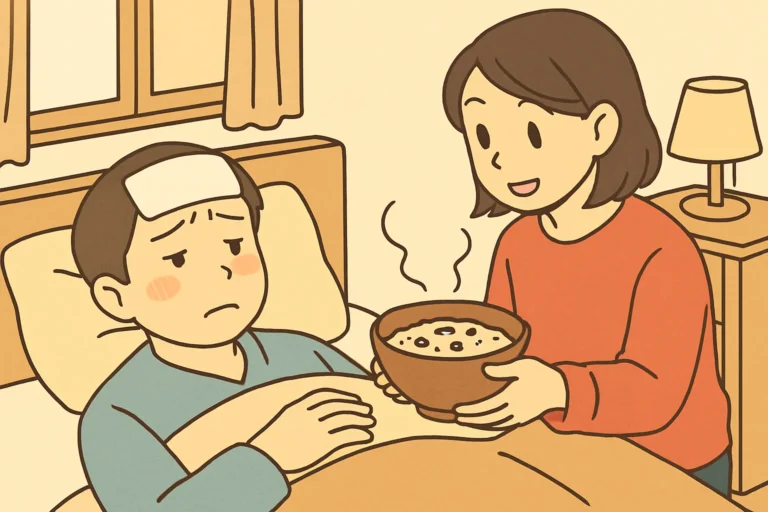
Another way Koreans show they care is by offering food! It’s very common to bring a sick friend warm porridge, called 죽 (juk), or a healthy vitamin drink. So, if you send a message like “푹 쉬세요!”, you can sound even more like a native by adding, “맛있는 죽 사 갈까요?” (Masinneun juk sa galkkayo? – “Shall I buy you some delicious porridge?”).
You’ll also see this caring culture in the K-pop world. Idols often write messages to their fans on apps like Weverse or Bubble, saying things like “우리 아미, 아프지 마요!” (Uri ARMY, ap-euji mayo! – “Our ARMY, don’t be sick!”). It’s a sweet, personal way they connect with and care for their fans.
Let’s Practice!
Ready to check your understanding?
- Fill in the blank: Your friend texts you, “I have a headache.” What could you reply?
“어머! _______ _______.”
- O / X Quiz: It is appropriate to say the informal phrase “빨리 나아 (ppalli naa)” to your teacher. (True or False?)
Great job today! Learning these phrases will help you build stronger and warmer relationships with your Korean friends.
Why not try using one of today’s expressions in the comments below?
아프지 마시고 (Don’t get sick), and see you in the next lesson
Frequently Asked Questions (FAQ)
Q: What does "빨리" mean in Korean and how do you pronounce it?
A: In Korean, "빨리" is pronounced [ppalli] and means: means "quickly" or "fast," and
Q: What does "나으세요" mean in Korean and how do you pronounce it?
A: In Korean, "나으세요" is pronounced [na-euseyo] and means: is the polite form of the verb "to heal" or "to recover." It’s a clear and kind message for anyone who is sick.
Q: What does "푹" mean in Korean and how do you pronounce it?
A: In Korean, "푹" is pronounced [puk] and means: is a wonderful adverb that means "deeply," "thoroughly," or "plenty of." It adds emphasis, so you're not just saying "rest," but "get
Q: What does "쉬세요" mean in Korean and how do you pronounce it?
A: In Korean, "쉬세요" is pronounced [swiseyo] and means: is the polite command form of "to rest."







