

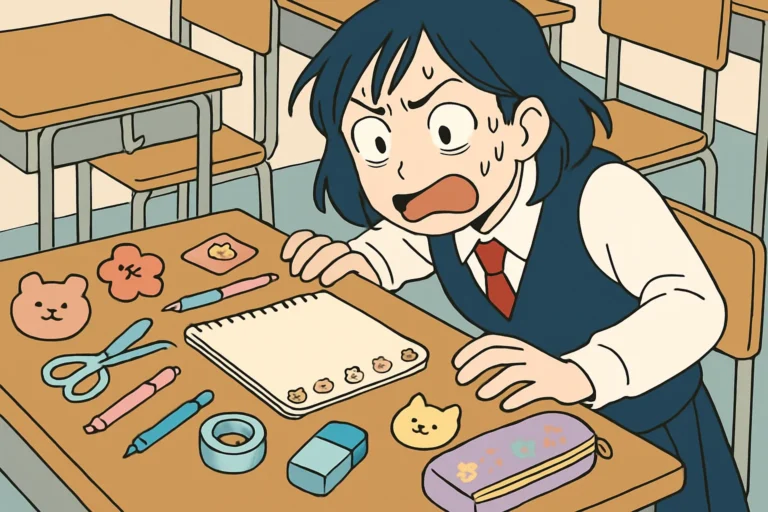
My Pencil Disappeared! Korean for When You’ve Lost Something
Hello! Welcome to [Maeil Hangeul], here to upgrade your Korean skills!
Have you ever been in class and suddenly realized your favorite pen is gone? Or maybe you’re at a cool stationery shop in Korea and can’t find the notebook you were just holding. Panic! What do you say? Don’t worry! Today, we’re going to learn the essential Korean phrases for saying you’ve lost something.
Lately in Korea, collecting unique and cute stationery is a huge trend among students. Losing one of these special items would be so sad! So, let’s learn how to ask for help like a pro.
Core Expressions You Need to Know
Here are three key expressions to help you find your missing items!
1. 없어졌어요 (eop-seo-jyeo-sseo-yo)
- Korean: 없어졌어요
- Pronunciation [Romanized]: Eopseojyeosseoyo
- English Meaning: It disappeared / It’s gone.
- Detailed Explanation: This is the most natural way to say something is missing. It comes from the verb 없어지다 (eopseojida), which means “to disappear” or “to get lost.” It’s in the past tense and has the polite -요 (-yo) ending, so you can use it with teachers, older students, or staff in a store.
- 💡 Pronunciation Tip:
The pronunciation of 졌어요 (jyeosseoyo) can be tricky.- The syllable ‘졌’ (jyeot) is pronounced by combining the ‘ㅈ’ (j) sound with the vowel ‘ㅕ’ (yeo). It sounds like the ‘jyo’ in “major.”
- When the next syllable starts with a vowel like ‘어’ (eo), the final consonant sound from the previous block often moves over. So, 졌어 (jyeot-eo) is pronounced smoothly as [저써 / jeosseo]. The double ‘ㅆ’ (ss) creates a tense ‘s’ sound, like the “ss” in “hiss.”
2. 제 연필 (je yeon-pil)
- Korean: 제 연필
- Pronunciation [Romanized]: Je yeonpil
- English Meaning: My pencil
- Detailed Explanation: 제 (je) is the polite way to say “my.” You would use this with people you don’t know well or who are older than you. If you’re talking to a close friend, you can use 내 (nae) instead. You can easily replace 연필 (yeonpil) with other items!
- 지우개 (jiugae): eraser
- 펜 (pen): pen
- 책 (chaek): book
- 가방 (gabang): bag
- 💡 Pronunciation Tip:
For 연필 [yeon-pil], make sure to pronounce the ‘ㄴ’ (n) sound at the end of the first syllable ‘연’ clearly before moving to ‘필’. It’s “yeon,” not “yeo.”
3. 혹시 봤어요? (hok-si bwa-sseo-yo?)
- Korean: 혹시 봤어요?
- Pronunciation [Romanized]: Hoksi bwasseoyo?
- English Meaning: By any chance, did you see it?
- Detailed Explanation: This is a very polite and gentle way to ask a question. 혹시 (hoksi) adds the nuance of “by any chance” or “perhaps,” which makes you sound much softer and less demanding. 봤어요? (bwasseoyo?) is the polite past tense of the verb 보다 (boda), meaning “to see.”
- 💡 Pronunciation Tip:
In 봤어요 [bwasseoyo], the double consonant ‘ㅆ’ (ss) at the bottom of ‘봤’ makes a crisp [t] sound when it’s the final sound. However, just like in ‘없어졌어요’, when it’s followed by a vowel like ‘어’, the ‘ㅆ’ sound carries over and is pronounced as a tense [ss]. So, you pronounce it smoothly as [bwas-seo-yo].
Example Dialogue
Let’s see how these phrases work in a real conversation between two students, A and B.
A: 어떡해! 제 연필이 없어졌어요.
(Eotteokae! Je yeonpiri eopseojyeosseoyo.)
Oh no! My pencil disappeared.
B: 정말? 혹시 가방 안에 없어?
(Jeongmal? Hoksi gabang ane eopseo?)
Really? Is it not in your bag, by any chance?
A: 네, 찾아봤는데 없어요. 새로 산 캐릭터 펜인데…
(Ne, chajabwanneunde eopseoyo. Saero san kaerikteo peninde…)
Yeah, I looked, but it’s not there. It’s a new character pen I just bought…
B: 괜찮아, 같이 찾아보자!
(Gwaenchana, gachi chajaboja!)
It’s okay, let’s look for it together!
Culture Tip & Trend Deep Dive
In Korea, stationery isn’t just a tool—it’s a form of self-expression! This is especially true for the Z generation. The trend is called ‘다꾸’ (dakku), which is short for ‘다이어리 꾸미기’ (daieori kkumigi) and means “decorating a diary.”
Students will spend hours decorating their planners with cute stickers, special pens, and washi tape from famous stores like Artbox or Hottracks. K-pop idols often show off their decorated diaries and favorite pens in their vlogs, causing those items to sell out instantly!
So, when your Korean friend sadly says, “제 펜이 없어졌어요,” they might be talking about a very special, limited-edition pen they waited weeks to buy. Now you know why it’s such a big deal!
Let’s Review & Practice!
Great job today! You learned how to say something is gone with 없어졌어요, how to talk about your belongings with 제 + (item), and how to politely ask for help with 혹시 봤어요?.
Now, let’s test your knowledge!
- Fill in the blank: How would you say, “My book disappeared”?
제 ______이/가 없어졌어요.
- Sentence Building: You lost your eraser (지우개). How do you ask a classmate, “By any chance, did you see my eraser?”
Let us know your answers in the comments below! Try making your own “I lost my…” sentence, too. We can’t wait to see them
Frequently Asked Questions (FAQ)
Q: What does "없어졌어요 (eop-seo-jyeo-sseo-yo)" mean in Korean and how do you pronounce it?
A: In Korean, "없어졌어요 (eop-seo-jyeo-sseo-yo)" is pronounced [Romanized] and means: It disappeared / It's gone.
Q: What does "제 연필 (je yeon-pil)" mean in Korean and how do you pronounce it?
A: In Korean, "제 연필 (je yeon-pil)" is pronounced [Romanized] and means: My pencil
Q: What does "혹시 봤어요? (hok-si bwa-sseo-yo?)" mean in Korean and how do you pronounce it?
A: In Korean, "혹시 봤어요? (hok-si bwa-sseo-yo?)" is pronounced [Romanized] and means: By any chance, did you see it?







