

Korean Airport Phrases: Can I Carry This On?
Hello! Welcome to [Maeil Hangul], here to upgrade your Korean skills!
Are you planning a trip to Korea? How exciting! Packing is fun, but airport security can be a little stressful, right? Especially when you’re not sure if you can bring your favorite snacks or K-pop lightstick in your carry-on.
Lately in Korea, with so many international fans visiting for concerts and events, airports are busier than ever! To make your trip smoother, today we’ll learn some essential Korean phrases for asking about carry-on items. Let’s make sure you pass through security like a pro!
Core Expressions You Need to Know
Here are some key phrases to help you at the airport security check.
1. 기내 반입 (ginae banip)
- English Meaning: Carry-on (literally, “in-flight entry”)
- Detailed Explanation: This is a noun you’ll see on all the signs at the security checkpoint. 기내 (ginae) means “in the cabin” or “in-flight,” and 반입 (banip) means “bringing in” or “entry.” It refers to anything you are taking with you onto the plane.
- 💡 Pronunciation Tip: The first syllable 기 (gi) is a “g” sound, but it’s softer than the English “g” in “go.” The second part, 반입 (banip), is pronounced smoothly together. The final ‘ㅂ’ (b) sound in ‘반입’ is a soft, unreleased ‘p’ sound. Imagine you’re about to say “pop” but stop right before you open your mouth.
2. 이거 기내 반입 돼요? (Igeo ginae banip dwaeyo?)
- Pronunciation [Romanization]: I-geo gi-nae ba-nip dwae-yo?
- English Meaning: Can I carry this on? / Is this allowed in the cabin?
- Detailed Explanation: This is your magic question! 이거 (igeo) means “this,” and 돼요? (dwaeyo?) is a super useful phrase that means “Is it okay?” or “Is it allowed?” You can simply point to an item and ask this question. The -요 (-yo) ending makes it polite and respectful to the airport staff.
- 💡 Pronunciation Tip: In 돼요 (dwaeyo), the ‘ㅙ’ (wae) sound can be tricky. It sounds like the “we” in “wet.” Practice saying “dwae-yo” to sound more natural.
3. 액체류 (aekcheryu)
- Pronunciation [Romanization]: Aek-che-ryu
- English Meaning: Liquids
- Detailed Explanation: This is the most common category of restricted items. 액체 (aekche) means “liquid,” and -류 (-ryu) means “category” or “type.” This includes water, cosmetics, and even things like gochujang (Korean chili paste)! Remember the 100ml rule.
- 💡 Pronunciation Tip: The first vowel 애 (ae) sounds like the “a” in “apple.” The second syllable 체 (che) has a ‘ch’ sound, similar to “cheese.” Try to say it smoothly: Aek-che-ryu.
4. 버려주세요 (beoryeojuseyo)
- Pronunciation [Romanization]: Beo-ryeo-ju-se-yo
- English Meaning: Please throw it away.
- Detailed Explanation: If you accidentally brought a prohibited item, this is the phrase to use. 버려 (beoryeo) comes from the verb 버리다 (beorida), meaning “to throw away.” Adding 주세요 (juseyo) makes it a polite request, like “Please do it for me.”
- 💡 Pronunciation Tip: The vowel 어 (eo) sounds like the “o” in “song.” The vowel 여 (yeo) is similar but has a “y” sound at the beginning, like “yuh.” Listen carefully to the difference: beo-ryeo.
Example Dialogue at the Airport
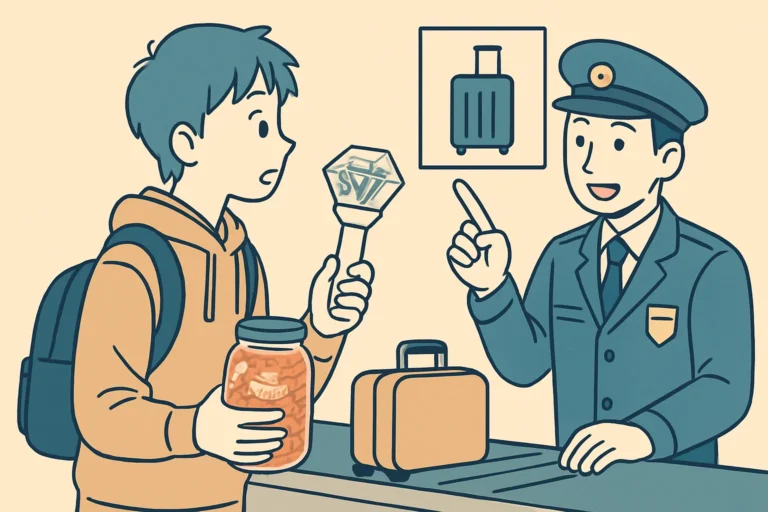
Let’s see how these phrases work in a real conversation! Imagine you’re at Incheon Airport after buying a souvenir.
- A (Traveler): 저기요. 이 김치, 이거 기내 반입 돼요?
- (Jeogiyo. I gimchi, igeo ginae banip dwaeyo?)
- (Excuse me. This kimchi, can I carry this on?)
- B (Security Staff): 잠시만요… 아, 이건 액체류로 분류돼서 안 됩니다. 100ml가 넘네요.
- (Jamsimanyo… a, igeon aekcheryu-ro bullyudwaeseo an doemnida. 100ml-ga neomneyo.)
- (One moment… Ah, this is classified as liquids, so it’s not allowed. It’s over 100ml.)
- A (Traveler): 아, 정말요? 그럼 버려주세요.
- (A, jeongmallyo? Geureom beoryeojuseyo.)
- (Oh, really? Then please throw it away.)
- B (Security Staff): 네, 알겠습니다. 좋은 여행 되세요!
- (Ne, algesseumnida. Joeun yeohaeng doeseyo!)
- (Yes, I understand. Have a good trip!)
Culture Tip & Trend Deep Dive
Your K-Pop Lightstick is Safe!
Good news for K-pop fans! Your precious lightstick (응원봉, eungwonbong) is generally allowed in your carry-on. However, airport staff might ask you to remove the batteries. It’s always a good idea to take the batteries out beforehand and keep them separate to speed up the process. If a security officer looks confused, you can point to it and say, “이거 기내 반입 돼요?” They’ll understand and help you out! This little phrase can save you a lot of worry.
Time to Practice!
Great job today! You’re now ready to face the airport security line with confidence. Let’s check what you’ve learned.
- Fill in the blank: You have a bottle of water. What do you ask the staff?
이거 ______ ______ ______?
- Challenge: How would you politely ask the staff to throw away your perfume (향수, hyangsu) because it’s too big?
You’ve learned some incredibly useful phrases for your trip to Korea. Don’t be shy to use them!
Now it’s your turn! Try answering the practice questions in the comments below. 화이팅 (Hwaiting)!
Frequently Asked Questions (FAQ)
Q: What does "기내" mean in Korean and how do you pronounce it?
A: In Korean, "기내" is pronounced [ginae] and means: means "in the cabin" or "in-flight," and
Q: What does "반입" mean in Korean and how do you pronounce it?
A: In Korean, "반입" is pronounced [banip] and means: means "bringing in" or "entry." It refers to anything you are taking with you onto the plane.
Q: What does "기" mean in Korean and how do you pronounce it?
A: In Korean, "기" is pronounced [gi] and means: is a "g" sound, but it's softer than the English "g" in "go." The second part,
Q: What does "반입" mean in Korean and how do you pronounce it?
A: In Korean, "반입" is pronounced [banip] and means: , is pronounced smoothly together. The final ‘ㅂ’ (b) sound in ‘반입’ is a soft, unreleased 'p' sound. Imagine you're about to say "pop" but stop right before you open your mouth.







