

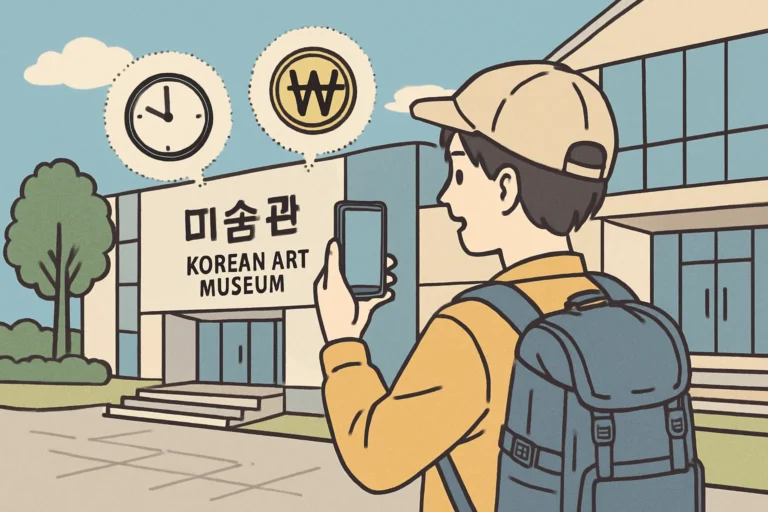
Unlock K-Museums & Galleries: 4 Phrases to Sound Like a Local!
Hello! This is Maeil Hangeul (매일한글), here to upgrade your Korean skills!
Are you planning a trip to Korea? Or maybe you’re already here and looking for something fun to do this weekend? Well, you’re in luck! Lately in Korea, visiting trendy art museums and unique exhibitions is super popular. It’s all about soaking in the art and, of course, taking that perfect “인증샷” (proof shot) for Instagram!
To help you enjoy these amazing places to the fullest, today we’re going to learn four essential phrases for getting information at any Korean museum or art gallery. With these, you’ll be navigating the K-art scene like a pro!
Let’s get started!
Core Expressions You Need to Know
Here are the key phrases that will make your museum visit smooth and enjoyable.
1. What are the opening hours?
- Korean: 관람 시간이 어떻게 되나요?
- Pronunciation [Romanization]: Gwallam sigani eotteoke doenayo?
- English Meaning: What are the viewing hours? / What are the opening hours?
- Detailed Explanation: This is the most polite and natural way to ask about opening and closing times. 관람 (gwallam) means ‘viewing’ (like for an exhibition), and 시간 (sigan) means ‘time’. It’s a must-know phrase before you go!
- 💡 Pronunciation Tip:
Notice the pronunciation of 시간이 [si-ga-ni]. The final consonant of a word block often “links” to the next syllable if it starts with a vowel. So, the ‘ㄴ (n)’ sound from ‘간 (gan)’ smoothly moves over to ‘이 (i)’, making it sound like [시가니 / sigani] instead of a choppy ‘sigan-i’. This linking rule (called ‘연음’ or yeoneum) is key to sounding natural!
2. How much is the admission fee?
- Korean: 입장료는 얼마예요?
- Pronunciation [Romanization]: Ipjangnyoneun eolmayeyo?
- English Meaning: How much is the admission fee?
- Detailed Explanation: Your wallet will thank you for knowing this one! 입장료 (ipjangnyo) means ‘admission fee’. Combine it with the essential question 얼마예요? (eolmayeyo?), and you’re all set to ask for the price of anything.
- 💡 Pronunciation Tip:
This word has a tricky sound change! When the syllable ‘장 (jang)’ with a final consonant is followed by ‘료 (ryo)’, the ‘ㄹ (r/l)’ sound changes to ‘ㄴ (n)’. So, 입장료 is pronounced [입장뇨 / ipjangnyo], not ‘ipjang-ryo’. This is a type of ‘nasalization’ and it makes the word flow much better.
3. Is photography allowed?
- Korean: 사진 촬영이 가능한가요?
- Pronunciation [Romanization]: Sajin chwaryeongi ganeunghangayo?
- English Meaning: Is it possible to take photos? / Is photography allowed?
- Detailed Explanation: In the age of social media, this is a crucial question. 사진 촬영 (sajin chwaryeong) means ‘photo shooting’ or ‘photography’. 가능한가요? (ganeunghangayo?) is a polite way to ask, “Is it possible?”. Some exhibitions allow photos, but without flash, so be sure to ask!
- 💡 Pronunciation Tip:
Let’s focus on 촬영 [chwa-ryeong]. The first letter ‘ㅊ (ch)’ is an aspirated consonant. This means you need to release a strong puff of air when you say it, like the ‘ch’ in “chart”. It’s stronger than the ‘ㅈ (j)’ sound in ‘자다 (jada)’. Try holding your hand in front of your mouth—you should feel a burst of air when you say 촬 (chwal) correctly!
4. What time is the docent tour?
- Korean: 도슨트 투어는 몇 시에 있어요?
- Pronunciation [Romanization]: Doseunteu tueoneun myeot sie isseoyo?
- English Meaning: What time is the docent tour?
- Detailed Explanation: Want a deeper understanding of the art? Ask for a guided tour! 도슨트 (doseunteu) is a loanword from the English “docent,” so it’s easy to remember. 몇 시에 있어요? (myeot sie isseoyo?) is a useful pattern meaning “At what time is it?”.
- 💡 Pronunciation Tip:
Pay attention to 몇 시에 [며씨에 / myeot-ssie]. The final consonant ‘ㅊ (t)’ in ‘몇’ doesn’t get fully pronounced here. Instead, it tenses the ‘ㅅ (s)’ that follows, making it sound like the strong ‘ㅆ (ss)’. This is why it sounds like [며씨 / myeot-ssi] and not ‘myeot-si’. It’s a small change that makes a big difference!
Example Dialogue
Let’s see how these phrases work in a real conversation between two friends, A and B, planning a weekend outing.
A: 이번 주말에 국립현대미술관 가자! 인스타에서 봤는데 새로 온 전시가 엄청 멋있대.
(Let’s go to the MMCA this weekend! I saw on Instagram that the new exhibition is amazing.)
B: 좋아! 관람 시간이 어떻게 되나요?
(Sounds good! What are the opening hours?)
A: 오전 10시부터 오후 6시까지. 아, 그리고 입장료는 얼마예요?
(From 10 AM to 6 PM. Oh, and how much is the admission fee?)
B: 내가 확인해볼게… 서울관은 무료래! 대박! 거기 사진 촬영이 가능한가요? 인증샷 찍고 싶어!
(I’ll check… The Seoul branch is free! Awesome! Is photography allowed there? I want to take a proof shot!)
A: 보통 플래시 없으면 괜찮을 거야. 가서 도슨트 투어는 몇 시에 있어요? 라고도 물어보자!
(It should be fine without flash. Let’s also ask, “What time is the docent tour?” when we get there!)
Culture Tip: The “인증샷” (Proof Shot) Culture
You heard it in the dialogue! 인증샷 (ingeung-syat) is a huge part of modern Korean culture. It’s a “proof shot” you take to show people where you’ve been and what you’ve been doing, and it’s almost always posted on social media like Instagram.
This is why so many Korean museums and galleries now design special 포토존 (photo zones)—areas with perfect lighting and backdrops specifically for taking pictures. Asking “사진 촬영이 가능한가요?” is not just polite; it’s your ticket to participating in this fun social trend. If you post your photo, try using hashtags like #전시회 (exhibition) or #미술관 (art museum) to see what others are posting!
Let’s Practice!
Time to check your understanding. You can do it!
1. Fill in the blank:
You want to ask about the price of a ticket. What do you say?
“_________는 얼마예요?”
(Answer: 입장료)
2. Quick Quiz!
You’ve arrived at a cool pop-up exhibition and want to know when it closes. Which question should you ask?
A) 사진 촬영이 가능한가요?
B) 관람 시간이 어떻게 되나요?
C) 도슨트 투어는 몇 시에 있어요?
(Answer: B)
Great job, everyone! Now you’re ready to explore Korea’s vibrant art scene.
What’s your favorite type of museum? Try to answer in the comments using one of the phrases you learned today! See you next time
Frequently Asked Questions (FAQ)
Q: What does "관람" mean in Korean and how do you pronounce it?
A: In Korean, "관람" is pronounced [gwallam] and means: means 'viewing' (like for an exhibition), and
Q: What does "시간" mean in Korean and how do you pronounce it?
A: In Korean, "시간" is pronounced [sigan] and means: means 'time'. It's a must-know phrase before you go!
Q: What does "시간이" mean in Korean and how do you pronounce it?
A: In Korean, "시간이" is pronounced [si-ga-ni] and means: . The final consonant of a word block often "links" to the next syllable if it starts with a vowel. So, the 'ㄴ (n)' sound from '간 (gan)' smoothly moves over to '이 (i)', making it sound like
Q: What does "입장료" mean in Korean and how do you pronounce it?
A: In Korean, "입장료" is pronounced [ipjangnyo] and means: means 'admission fee'. Combine it with the essential question







