

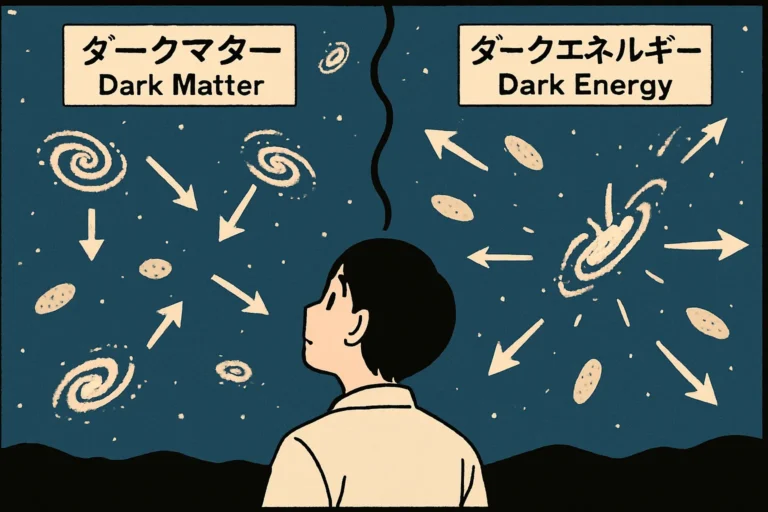
우주의 95%를 차지하는 미지의 존재 (The Unknown Being That Makes Up 95% of the Universe)
Hello! This is Maeil Hangeul (매일한글), here to upgrade your Korean skills!
Today, we’re venturing into the deepest, most mysterious corners of the universe. We’ll be tackling some advanced vocabulary related to cosmology, specifically Dark Matter and Dark Energy. You might wonder, “When will I ever use this?” Well, lately in Korea (요즘 한국에서는), with the massive success of sci-fi dramas and a growing public fascination with space exploration, these topics are no longer confined to academic circles. Being able to discuss these concepts will allow you to engage in high-level conversations, understand scientific news, and fully appreciate the depth of Korean sci-fi content. Let’s explore the unseen universe, in Korean!
Core Expressions: Unveiling the Universe’s Secrets
Here are the key terms you need to know to sound like a cosmology pro.
1. 암흑 물질 (Amheuk Muljil)
- Pronunciation [Romanized]: [Am-heung mul-jjil]
- English Meaning: Dark Matter
- Detailed Explanation: This is a compound noun combining 암흑 (amheuk), meaning “darkness” or “gloom,” and 물질 (muljil), meaning “matter” or “substance.” It refers to the mysterious, invisible substance that doesn’t emit light or energy but is believed to make up about 27% of the universe. Its existence is inferred through its gravitational effects on visible matter. This is a standard scientific term used in academic papers, news reports, and documentaries.
- 💡 Pronunciation Tip:
The pronunciation of 물질 is the key here. While written as ‘mul-jil,’ the ‘ㄹ’ 받침 (final consonant) causes the following ‘ㅈ’ to become tense. This phenomenon, called tensification (경음화), makes the ‘j’ sound like a strong ‘jj’. So, instead of a soft /muljil/, you should pronounce it with a punchy, sharp sound: [물찔 / muljjil].
2. 암흑 에너지 (Amheuk Eneoji)
- Pronunciation [Romanized]: [Am-heuk e-neo-ji]
- English Meaning: Dark Energy
- Detailed Explanation: Similar to the first term, this combines 암흑 (amheuk) with 에너지 (eneoji), the Korean word for “energy” (a loanword). Dark energy is the hypothetical form of energy believed to be responsible for the accelerating expansion of the universe. It’s often discussed in contrast to dark matter, which has a gravitational (pulling) effect.
- 💡 Pronunciation Tip:
The pronunciation is quite straightforward. However, notice the first syllable in 암흑. The ‘ㄱ’ sound at the end is an “unreleased stop.” This means you form the ‘k’ sound at the back of your throat but don’t release the puff of air before moving to the next word, ‘에너지’. This creates a smooth, connected sound: [암흑 에너지 / amheuk eneoji].
3. 중력 상호작용 (Jungnyeok Sanghojakyong)
- Pronunciation [Romanized]: [Jung-nyeok sang-ho-ja-gyong]
- English Meaning: Gravitational Interaction
- Detailed Explanation: This is a highly academic but essential term. It breaks down into 중력 (jungnyeok) for “gravity” and 상호작용 (sanghojakyong) for “interaction” or “interplay.” Scientists say we can only detect dark matter through its gravitational interaction with stars and galaxies. Using this phrase demonstrates a sophisticated understanding of the topic.
- 💡 Pronunciation Tip:
In 중력, the final consonant ‘ㄱ’ meets the initial ‘ㄹ’ of the next syllable ‘력’. This triggers a phonetic change where ‘ㄹ’ is assimilated into ‘ㄴ’, making the pronunciation [중녁 / jungnyeok]. This is a common rule in Korean phonology called assimilation (동화).
4. 우주의 팽창을 가속화시키다 (Ujuui Paengchangeul Gasokwasikida)
- Pronunciation [Romanized]: [U-ju-ui paeng-chang-eul ga-so-kwa-si-ki-da]
- English Meaning: To accelerate the expansion of the universe
- Detailed Explanation: This is a full descriptive phrase.
- 우주의 (ujuui): of the universe
- 팽창 (paengchang): expansion
- 가속화시키다 (gasokwasikida): to cause acceleration / to accelerate
This phrase is the primary function attributed to dark energy. It’s a complex verb structure perfect for advanced learners, combining a noun (가속) with the suffix -화 (화, -hwa, meaning “-ization”) and the causative verb 시키다 (sikida).
- 💡 Pronunciation Tip:
Let’s look at the particle 을 after 팽창. The final consonant ‘ㅇ’ in 팽창 [paengchang] smoothly links to the vowel ‘으’ in 을 [eul]. This is called liaison (연음). It’s not “paengchang / eul” with a pause, but a fluid [팽창을 / paengchangeul].
Example Dialogue
Let’s see how these terms are used in a real conversation. Two friends, Junho and Sora, are discussing a science documentary they just watched.
A (준호): 와, 오늘 본 우주 다큐멘터리 정말 흥미로웠어. 우주의 95%가 아직 우리가 모르는 물질과 에너지라니.
A (Junho): Wow, the space documentary we watched today was fascinating. To think that 95% of the universe is matter and energy we don’t know about yet.
B (소라): 맞아. 특히 암흑 물질에 대한 부분이 인상 깊었어. 직접 볼 수는 없지만, 별의 움직임에 미치는 중력 상호작용으로 그 존재를 증명하잖아.
B (Sora): I know, right? The part about dark matter was especially impressive. We can’t see it directly, but they prove its existence through its gravitational interaction with the movement of stars.
A (준호): 그리고 암흑 에너지는 더 미스터리한 것 같아. 우주를 서로 밀어내서 우주의 팽창을 가속화시킨다는 개념은 정말 상상하기 힘들어.
A (Junho): And dark energy seems even more mysterious. The concept that it pushes the universe apart and accelerates the expansion of the universe is really hard to imagine.
B (소라): 응, 아직은 가설 단계라고 하더라. 인류가 풀어야 할 가장 큰 숙제 중 하나겠지.
B (Sora): Yeah, they said it’s still in the hypothesis stage. It must be one of the biggest challenges humanity has to solve.
Culture Tip & Trend Deep Dive
In Korea, discussions about these complex scientific topics are often found on popular science YouTube channels like “과학쿠키 (Gwahak Cookie)” or “안될과학 (Unreal Science).” These channels break down difficult concepts for the general public in an entertaining way.
When you discuss these topics, you’ll sound more like a native speaker if you add phrases that acknowledge the uncertainty and mystery. For example, after explaining dark energy, you could add:
- “아직은 베일에 싸여 있는 영역이죠.” (Ajigeun be-il-e ssayeo inneun yeong-yeogijyo.)
- Literal meaning: “It’s an area that is still wrapped in a veil.”
- Nuance: This poetic expression means “It’s still shrouded in mystery.” Using it shows a high level of linguistic and cultural fluency.
Mentioning the 한국천문연구원 (Korea Astronomy and Space Science Institute) when discussing recent findings can also add credibility and context to your conversation, showing you’re in tune with scientific developments in Korea.
Let’s Wrap Up & Practice!
Today, we’ve equipped ourselves with some truly advanced vocabulary to discuss the fundamental mysteries of our universe: 암흑 물질 (dark matter), 암흑 에너지 (dark energy), 중력 상호작용 (gravitational interaction), and the phrase 우주의 팽창을 가속화시키다 (to accelerate the expansion of the universe).
Now, it’s your turn to practice!
- Fill in the blank:
과학자들은 (____________)이(가) 우주의 팽창 속도를 점점 더 빠르게 만들고 있다고 믿는다.
(Scientists believe that (____________) is making the expansion speed of the universe faster and faster.) -
Sentence Building:
Using the verb 가속화시키다, write a short sentence about something (other than the universe) that is accelerating. (e.g., technological development, climate change, etc.)
We’d love to see your answers! What are your thoughts on these cosmic mysteries? Leave a comment below using the expressions you learned today
Frequently Asked Questions (FAQ)
Q: What does "암흑" mean in Korean and how do you pronounce it?
A: In Korean, "암흑" is pronounced [amheuk] and means: , meaning "darkness" or "gloom," and
Q: What does "물질" mean in Korean and how do you pronounce it?
A: In Korean, "물질" is pronounced [muljil] and means: , meaning "matter" or "substance." It refers to the mysterious, invisible substance that doesn't emit light or energy but is believed to make up about 27% of the universe. Its existence is inferred through its gravitational effects on visible matter. This is a standard scientific term used in academic papers, news reports, and documentaries.
Q: What does "암흑" mean in Korean and how do you pronounce it?
A: In Korean, "암흑" is pronounced [amheuk] and means: with
Q: What does "에너지" mean in Korean and how do you pronounce it?
A: In Korean, "에너지" is pronounced [eneoji] and means: , the Korean word for "energy" (a loanword). Dark energy is the hypothetical form of energy believed to be responsible for the accelerating expansion of the universe. It's often discussed in contrast to dark matter, which has a gravitational (pulling) effect.







