

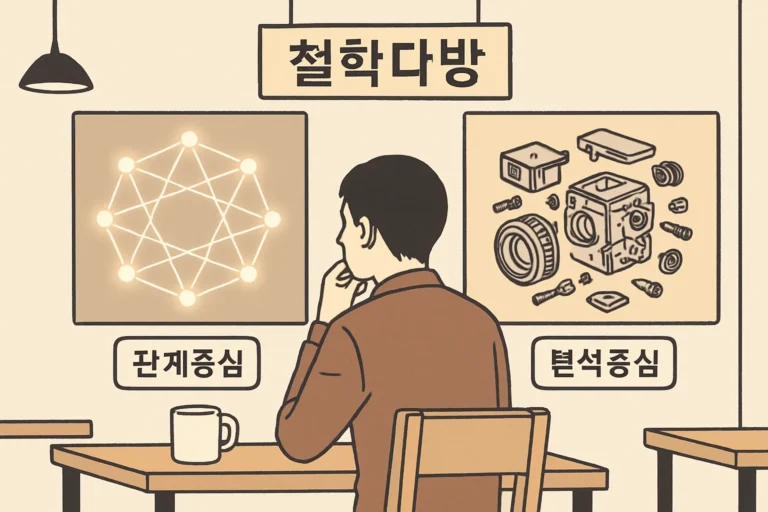
East Meets West: A Philosophical Deep Dive in Korean
Hello! This is Maeil Hangeul (매일한글), here to upgrade your Korean skills!
Today, we’re moving beyond everyday conversation and diving into a much deeper topic: philosophy! Have you ever wondered how to express the fundamental differences between Eastern and Western thought in Korean? It might sound academic, but you’d be surprised. Lately in Korea, there’s a huge trend of “philosophical self-care.” Bestselling books and even trendy “philosophy cafes” (철학 카페) are popping up, encouraging people to reflect on their lives. Understanding these concepts will not only enrich your vocabulary but also give you a profound insight into the modern Korean mindset.
Let’s explore the core ideas that separate these two great traditions!
Core Expressions for Your Philosophical Toolkit
Here are three essential terms that will help you discuss philosophy like a pro.
1. 세계관 (Segyegwan)
- Romanization: [Se-gye-gwan]
- English Meaning: Worldview
- Detailed Explanation: This is a crucial, high-level term. It’s a compound word made of 세계 (segye), meaning “world,” and 관 (gwan), which comes from a Hanja character (觀) meaning “view” or “perspective.” A person’s 세계관 is the fundamental cognitive orientation encompassing their knowledge, beliefs, and the way they interpret the world. It’s a more formal and profound term than simply “opinion” (의견) or “thought” (생각).
- 💡 Pronunciation Tip:
The pronunciation is quite straightforward. The key is the vowel ‘ㅖ’ (ye) in 세계 (segye). It’s a diphthong, a combination of ‘ㅣ’ (i) and ‘ㅔ’ (e). Start by saying ‘ee’ and glide quickly into an ‘eh’ sound. Practice saying it smoothly:se-gye.
2. 관계 중심적 (Gwangye jungsimjeok)
- Romanization: [Gwan-gye jung-sim-jeok]
- English Meaning: Relationship-oriented / Relational
- Detailed Explanation: This is the heart of understanding the Eastern worldview. Let’s break it down: 관계 (gwangye) means “relationship,” 중심 (jungsim) means “center,” and the suffix -적 (-jeok) turns a noun into an adjective, like “-ic” or “-al” in English. So, 관계 중심적 describes a perspective where identity and meaning are derived primarily from one’s relationships with others (family, community, nation), rather than from an isolated individual self. It emphasizes harmony, interdependence, and context.
- 💡 Pronunciation Tip:
The first syllable 관 (gwan) can be tricky. It’s not “gwan” as in “swan.” The ‘w’ sound is made by rounding your lips for ‘ㅗ’ (o) and then quickly opening them to ‘ㅏ’ (a). It’s a quicko-aglide. Practice:gwan-gye.
3. 분석적 (Bunseokjeok)
- Romanization: [Bun-seok-jjeok]
- English Meaning: Analytical
- Detailed Explanation: This term is often used to characterize the Western philosophical tradition. 분석 (bunseok) means “analysis.” A 분석적 approach involves breaking down a complex topic or substance into smaller parts to gain a better understanding of it. This contrasts sharply with a more holistic, 관계 중심적 view. Think of Aristotle categorizing the world or Descartes’ “I think, therefore I am,” which focuses on the individual mind as the starting point of knowledge.
- 💡 Pronunciation Tip:
This word has a fantastic example of a common Korean sound change rule called tensification (경음화). When a syllable ending in a consonant like ‘ㄱ’, ‘ㄷ’, or ‘ㅂ’ is followed by another ‘ㄱ’, ‘ㄷ’, ‘ㅂ’, ‘ㅅ’, or ‘ㅈ’, the second consonant becomes “tense” or “doubled.” So, 분석 (bunseok) + 적 (jeok) is not pronounced [bun-seok-jeok] but rather [분석쩍 – bunseokjjeok]. The ‘ㅈ’ sound becomes ‘ㅉ’ (jj). This makes your pronunciation sound much more natural!
Example Dialogue (At a “Philosophy Cafe”)
Let’s see how these words are used in a real conversation.
A: 이 철학 카페 정말 흥미롭네요. 이 책을 읽으니 제 세계관에 대해 다시 생각하게 돼요.
A: [I cheolhak kape jeongmal heungmiromneyo. I chaegeul ilgeuni je segyegwane daehae dasi saenggakage dwaeyo.]
A: This philosophy cafe is so interesting. Reading this book is making me rethink my own worldview.
B: 맞아요. 동양 사상은 관계 중심적인 반면, 서양 사상은 더 분석적이라고 설명하는 부분이 인상 깊었어요.
B: [Majayo. Dongyang sasangeun gwangye jungsimjeokin banmyeon, seoyang sasangeun deo bunseokjeokirago seolmyeonghaneun bubuni insang gipeosseoyo.]
B: I agree. The part explaining how Eastern thought is relationship-oriented, whereas Western thought is more analytical, was really memorable.
A: 저도요. 어느 한쪽이 더 낫다는 게 아니라, 세상을 이해하는 접근 방식이 다르다는 걸 알게 됐어요.
A: [Jeodoyo. Eoneu hanjjogi deo natdaneun ge anira, sesangeul ihaehanen jeopgeun bangsigi dareudaneun geol alge dwaesseoyo.]
A: Me too. It’s not that one is better than the other, but I’ve come to understand that their approaches to understanding the world are simply different.
Culture Tip & Trend Deep Dive
So why is this philosophical language suddenly relevant in modern Korea?
The Korean MZ generation (Millennials + Gen Z) grew up in an intensely competitive and increasingly individualistic society. This has led to high levels of stress and burnout. In response, many are turning to both Eastern and Western philosophies not as academic subjects, but as practical tools for self-help and finding balance (a key concept of 조화 – johwa, or harmony).
When you use a term like 관계 중심적 in a conversation, it shows you have a nuanced understanding of Korean culture. For instance, you could observe: “한국의 조직 문화는 여전히 개인의 성과보다 팀워크를 중시하는 관계 중심적인 면이 강한 것 같아요.” (It seems Korean organizational culture still has a strong relationship-oriented aspect that values teamwork over individual performance.)
Using these terms demonstrates that you’ve moved beyond simple vocabulary and can engage with the complex ideas shaping Korean society today.
Let’s Recap & Practice!
Today, we learned three powerful words to discuss complex ideas:
* 세계관 (segyegwan): Your fundamental worldview.
* 관계 중심적 (gwangye jungsimjeok): The relational perspective, key to Eastern thought.
* 분석적 (bunseokjeok): The analytical approach, often associated with Western thought.
Now, it’s your turn to practice!
- Fill in the blank:
If someone tends to break down problems into smaller pieces to solve them, you could describe their thinking style as _______________. -
Your Turn:
Briefly describe your own 세계관. Is it more 관계 중심적 or 분석적? Try to write a short sentence in Korean!
Leave your answers and thoughts in the comments below. We’d love to hear your perspective
Frequently Asked Questions (FAQ)
Q: What does "세계" mean in Korean and how do you pronounce it?
A: In Korean, "세계" is pronounced [segye] and means: , meaning "world," and
Q: What does "관" mean in Korean and how do you pronounce it?
A: In Korean, "관" is pronounced [gwan] and means: , which comes from a Hanja character (觀) meaning "view" or "perspective." A person's
Q: What does "세계" mean in Korean and how do you pronounce it?
A: In Korean, "세계" is pronounced [segye] and means: . It's a diphthong, a combination of 'ㅣ' (i) and 'ㅔ' (e). Start by saying 'ee' and glide quickly into an 'eh' sound. Practice saying it smoothly:
Q: What does "관계" mean in Korean and how do you pronounce it?
A: In Korean, "관계" is pronounced [gwangye] and means: means "relationship,"






