

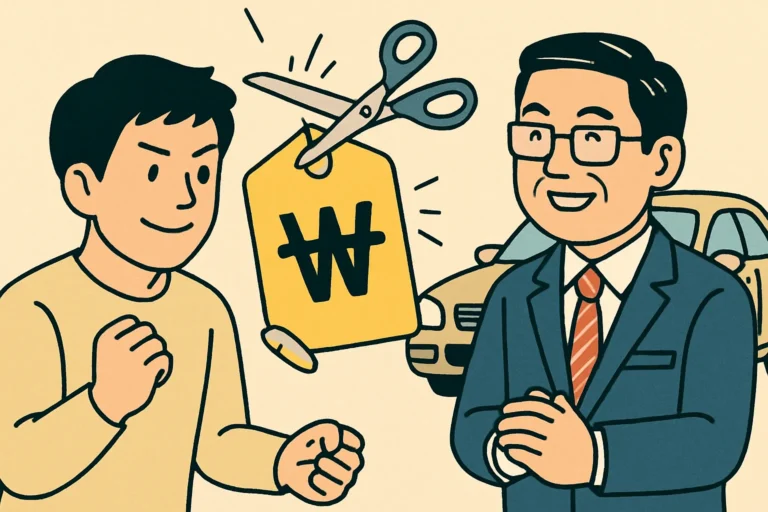
Haggle Like a Pro: Your Guide to Buying a Used Car in Korea
Hello! Welcome to [Daily Hangul], here to upgrade your Korean skills!
Ever dreamed of cruising down the roads of Korea in your own car? You’re not alone! Lately in Korea, with rising prices and a focus on smart spending, the used car market (중고차 시장) is hotter than ever. But getting a great deal requires more than just knowing car models—it requires strategic negotiation skills.
Today, we’re moving beyond textbook Korean and diving into the art of haggling. You’ll learn the essential phrases to negotiate the price of a used car with confidence, helping you save money and sound like a native speaker. Let’s get started!
Core Negotiation Expressions
Here are four key phrases that will be your secret weapons in any negotiation.
1. 혹시 가격 조정이 좀 가능할까요? (Hoksi gagyeok jojeong-i jom ganeunghalkkayo?)
- English Meaning: “By any chance, is it possible to adjust the price a bit?”
- Detailed Explanation: This is the perfect opening line. It’s polite, indirect, and signals your intention to negotiate without being aggressive.
- 혹시 (hoksi) means “by any chance” and is a magic word that instantly makes any request softer and more polite.
- 가격 조정 (gagyeok jojeong) literally means “price adjustment,” which is a more formal and sophisticated term than simply asking for a discount.
- -ㄹ/을까요? (-lkkayo?) is a gentle way to ask a question or make a suggestion, showing respect to the seller.
- 💡 Pronunciation Tip:
Notice the phrase 가격 조정이 (gagyeok jojeong-i). In Korean, when a syllable ending in a consonant is followed by a syllable starting with ‘ㅇ’ (which is a silent placeholder), the consonant sound “moves over” to the next syllable. This is called 연음 (yeon-eum) or liaison. So, instead of sayinggagyeok jojeong - ias two separate parts, it flows smoothly as [가굑조정이 / gagyeok-jojengi].
2. 시세보다 조금 비싼 것 같은데요. (Siseboda jogeum bissan geot gateundeyo.)
- English Meaning: “It seems a little more expensive than the market price.”
- Detailed Explanation: This is how you justify your request for a discount. It shows you’ve done your research.
- 시세 (sise) is a crucial C1-level word meaning “market price” or “going rate.” Using this word proves you’re a serious buyer.
- -보다 (-boda) is the particle for “than.”
- -ㄴ/은 것 같다 (-n/eun geot gatda) means “it seems like…” or “I think that…” It’s a softer way to state your opinion rather than declaring, “This is expensive!”
- The ending -는데요 (-neundeyo) is used to present background information gently and often implies you have more to say or are expecting a response.
- 💡 Pronunciation Tip:
In 같은데요 (gateundeyo), the final consonant ‘ㅌ’ (t) in ‘같’ is not fully aspirated like at the beginning of a word. When a ‘ㅌ’ is in the final position (받침), it is pronounced as an unreleased [t], similar to the ‘t’ sound in the English word “bat.” So, it sounds like [가튼데요 / gateundeyo].
3. 딱 천오백만 원에 맞춰 주시면 바로 계약할게요. (Ttak cheon-obaek-man won-e matchwo jusimyeon baro gyeyakalkkeyo.)
- English Meaning: “If you can match it to exactly 15 million won, I’ll sign the contract immediately.”
- Detailed Explanation: This is a powerful closing phrase. You’re making a firm, specific offer and showing you’re ready to commit.
- 딱 (ttak) means “exactly” or “precisely.”
- -에 맞춰 주다 (-e matchwo juda) means “to adjust to” or “to set it at for me.” It’s a common way to ask someone to meet your desired number.
- 바로 계약할게요 (baro gyeyakalkkeyo) means “I’ll sign the contract right away.” This signals the end of the negotiation and pressures the seller to accept.
- 💡 Pronunciation Tip:
Let’s look at 계약할게요 (gyeyakalkkeyo). This phrase demonstrates two pronunciation rules. First, liaison in계약할 (gyeyak-hal), where the finalㄱ(k) sound of계약moves over, making the pronunciation [계야칼 / geyakal]. Second, the grammar pattern-ㄹ게(요)is often tensed after a vowel, so게요 (geyo)is pronounced as [께요 / kkeyo]. This tensing (경음화) is very common in everyday speech.
4. 조금만 더 깎아 주시면 안 될까요? (Jogeumman deo kkakka jusimyeon an doelkkayo?)
- English Meaning: “Would it not be possible for you to cut the price a little more?”
- Detailed Explanation: This is a softer, final appeal when you’re close to a deal but want one last little discount.
- 깎다 (kkakda) is the quintessential verb for haggling. It literally means “to shave” or “to cut,” but in this context, it always means “to give a discount.”
- The pattern -아/어 주시면 안 될까요? (-a/eo jusimyeon an doelkkayo?) is a very polite and slightly pleading way to ask a favor. It translates to “If you do X for me, would it not be possible?” and is less direct than “Please do X.”
- 💡 Pronunciation Tip:
In 깎아 (kkakk-a), we see liaison again. The finalㄲ(kk) sound from the first syllable moves to the empty vowel slot of the second, resulting in a smooth [까까 / kkakka] pronunciation.
Example Dialogue
Let’s see these phrases in action! Here, Buyer (A) is looking at a popular used car, a Hyundai Avante (현대 아반떼).
- A (Buyer): 이 아반떼 상태가 아주 좋네요. 그런데 사장님, 혹시 가격 조정이 좀 가능할까요?
(This Avante is in great condition. But sir, by any chance, is it possible to adjust the price a bit?) -
B (Seller): 이미 저렴하게 내놓은 가격이라서요… 혹시 생각하시는 금액이 있으세요?
(I’ve already listed it at a cheap price… Do you have a price in mind?) -
A (Buyer): 제가 알아본 바로는, 시세보다 조금 비싼 것 같은데요.
(From what I’ve researched, it seems a little more expensive than the market price.) -
B (Seller): 음… 그럼 얼마를 원하시는데요?
(Hmm… Then how much are you hoping for?) -
A (Buyer): 딱 1,500만 원에 맞춰 주시면 바로 계약할게요.
(If you can match it to exactly 15 million won, I’ll sign the contract immediately.) -
B (Seller): 아, 1,500은 너무 힘든데… 1,550은 어떠세요?
(Ah, 15 million is too difficult… How about 15.5 million?) -
A (Buyer): 그럼 마지막으로… 조금만 더 깎아 주시면 안 될까요? 1,530만 원으로 하죠.
(Then as a final offer… couldn’t you cut it just a little more? Let’s do 15.3 million won.) -
B (Seller): …알겠습니다. 그렇게 하시죠.
(…Alright. Let’s do that.)
Culture Tip & Trend Deep Dive
-
Know the Lingo: “네고” (Nego)
In Korea, you’ll constantly see the word 네고 (nego), which is Konglish for “negotiation.” On online used goods platforms like Karrot (당근마켓) or in used car listings, you’ll often see “네고 가능” (negotiation possible) or “네고 불가” (negotiation not possible). Using the word “네고” will make you sound instantly fluent in this context. -
Do Your Homework:
Before you even start a negotiation, Koreans believe in being prepared. Use websites like Encar (엔카) or K Car (케이카) to research the 시세 (sise) for the car model, year, and mileage you’re interested in. Coming armed with this data gives you immense bargaining power. -
The Power of “정” (Jeong):
While business is business, a little human connection, or 정 (jeong), can go a long way. Before jumping straight to the price, compliment the car or the seller’s management of it. A simple phrase like “와, 사장님, 차 관리 정말 잘하셨네요!” (Wow, sir, you’ve taken excellent care of the car!) can create a friendly atmosphere, making the seller more willing to work with you.
Wrap-up & Practice!
Great job! You’ve just learned four powerful expressions to handle one of the most challenging and rewarding real-life situations in Korea. You now know how to politely open a negotiation, justify your offer with market data, make a firm final offer, and ask for one last discount.
Now, let’s test your skills!
- Fill in the Blank: You want to say, “It seems a little expensive compared to the market price.”
______ 조금 비싼 것 같은데요.
- Sentence Building: You’ve decided on a final price of 2,300만 원 (23 million won). How would you make a firm, final offer to the seller? (Hint: Use the “딱… 바로 계약할게요” pattern).
Let us know your answers in the comments! Try making your own negotiation sentences. We’d love to see what you come up with. Happy negotiating
Frequently Asked Questions (FAQ)
Q: What does "혹시" mean in Korean and how do you pronounce it?
A: In Korean, "혹시" is pronounced [hoksi] and means: means "by any chance" and is a magic word that instantly makes any request softer and more polite.
Q: What does "가격 조정" mean in Korean and how do you pronounce it?
A: In Korean, "가격 조정" is pronounced [gagyeok jojeong] and means: literally means "price adjustment," which is a more formal and sophisticated term than simply asking for a discount.
Q: What does "-ㄹ/을까요?" mean in Korean and how do you pronounce it?
A: In Korean, "-ㄹ/을까요?" is pronounced [-lkkayo?] and means: is a gentle way to ask a question or make a suggestion, showing respect to the seller.
Q: What does "가격 조정이" mean in Korean and how do you pronounce it?
A: In Korean, "가격 조정이" is pronounced [gagyeok jojeong-i] and means: . In Korean, when a syllable ending in a consonant is followed by a syllable starting with 'ㅇ' (which is a silent placeholder), the consonant sound "moves over" to the next syllable. This is called







